City attorney warns of state preemptions and urges council to weigh in on Colorado River draft EIS
Loading...
Summary
Rodney Short briefed council on fast-moving state legislation that could reduce local revenues (rental and food-tax proposals, property tax measures) and urged the city to prepare a joint position for the Department of Interior's Colorado River draft EIS and public-comment process.
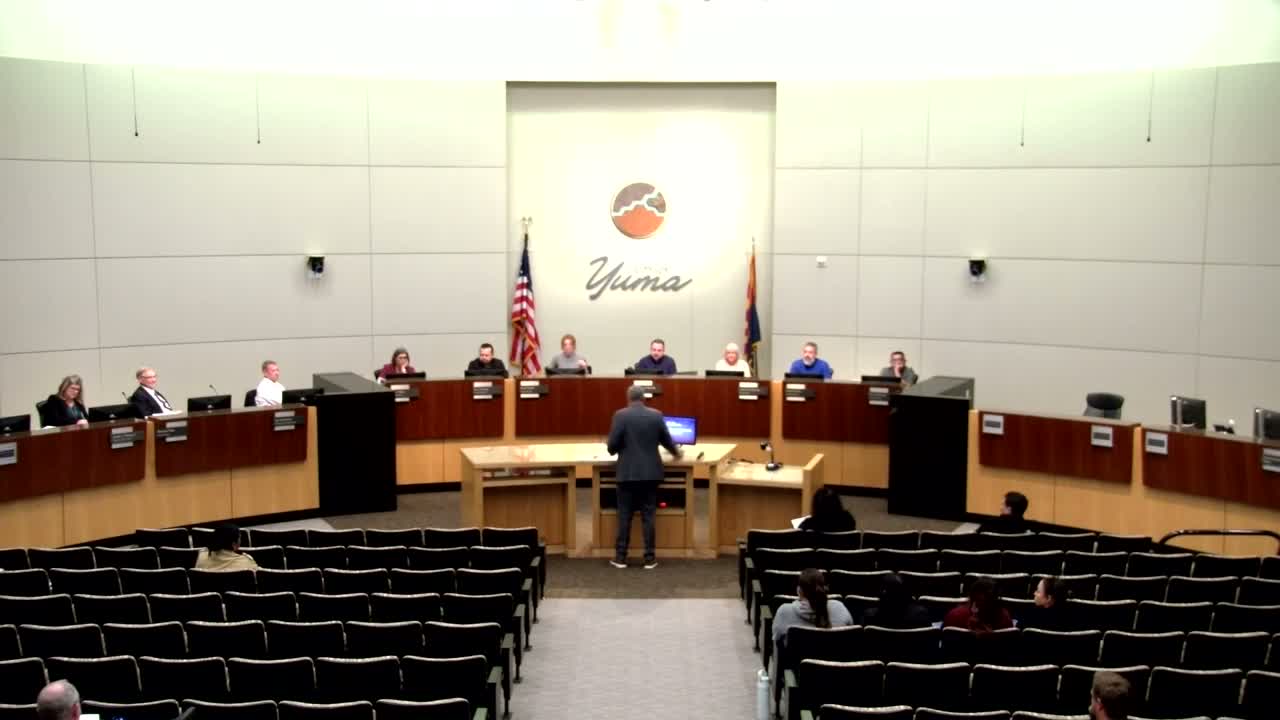
Rodney Short, deputy city attorney, told the Yuma City Council on Jan. 20 that the state legislature opened with an unusually high bill volume and several proposals could meaningfully reduce local revenues, particularly in non-metropolitan communities.
Short cited prior state preemptions that removed Yuma’s residential rental tax and recent bills that would eliminate sales tax on many food items. "HCR 2018 and House Bill 2839 would de facto eliminate the food tax," Short said, adding staff project roughly an $8 million hit to local revenues if those measures pass. He also identified HCR 2017 and other property-tax proposals as bills the city will monitor for revenue-replacement language.
Short highlighted a lean state discretionary budget (about $38 million in executive discretionary appropriations under current projections) and explained how potential federal border funding could change the fiscal picture if appropriations occur. He reminded council of the city's legislative guiding principles: support tools for local policy implementation, preserve local decision-making and protect local revenues from unfunded state mandates.
On federal issues, Short discussed the Department of Interior's draft environmental impact statement for post-2026 Colorado River operations, which lists five alternatives and did not include a preferred alternative in the draft. He told council staff will evaluate alternatives and recommended the city prepare a formal position for the public-comment process. The city will aim to draft recommended language and return to a future work session in February for council consideration.
Short also clarified local water-rights mechanics relevant to the EIS: Yuma holds a section 5 contract with the Bureau of Reclamation and maintains some priority 1 water alongside larger allocations that are priority 3; while Arizona cannot unilaterally alter Yuma’s federal contract, statewide actions and inter-basin agreements could affect the city’s ability to collect expected water.
Council members asked for frequent updates during the legislative session; Short agreed to present at least once a month and more often if the session accelerates. No formal council action on state bills occurred during the work session, but staff were directed to prepare a draft position and resolution for council review and possible adoption.