
Redondo Beach council moves ahead with broad general-plan FAR changes, sets path for ballot vote on major items
Get AI-powered insights, summaries, and transcripts
Subscribe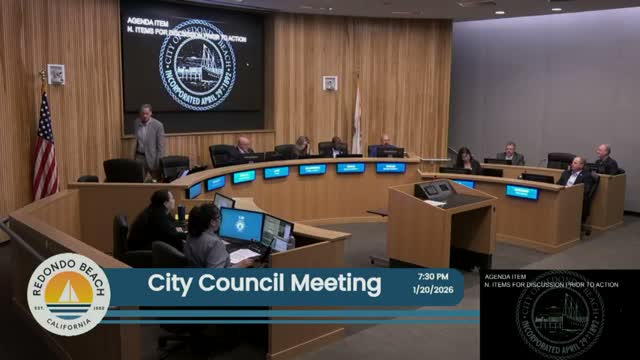
Summary
After extended debate, council directed staff to pursue a single Article 27 vote on major land-use changes (late summer 2026), set City Hall/annex caps at 1.25, recommended a 0.75 cap for most public-institutional sites while allowing Beach Cities Health District to seek up to 1.25 tied to development standards, and advanced changes to industrial and commercial FARs for targeted corridors.
The Redondo Beach City Council voted to advance a package of land-use updates to the city’s general plan and to place major changes on a single Article 27 ballot question in late summer 2026.
Staff presented proposed changes to floor area ratio (FAR) and land-use designations that would identify building intensity for public institutional (PI) and several nonresidential areas. The staff recommendation studied and supports a 1.25 FAR for City Hall/annex and up to 1.25 at the Beach Cities Health District (BCHD) site (supported by an EIR addendum), while proposing 0.75 for most other PI properties. The proposal also calls for increasing the industrial FAR (I1, I3) north of Manhattan Beach Boulevard from 0.7 to 1, and for certain Pacific Coast Highway shopping-center areas to be redesignated to support higher intensity redevelopment.
Council and planning-commission members debated the tradeoffs between enabling reinvestment and protecting scarce open-space and school fields. Planning Commission members had recommended lower FAR caps (some PI locations at 0.5) to preserve open space and to retain public hearing rights for significant changes. Supporters of higher FARs, including staff and some council members, argued a higher cap could enable revitalization and needed flexibility for institutions (for example, BCHD’s preferred developer’s concept was described as slightly under 1 FAR).
After hours of public comment — which included residents urging protection of school open space and others urging flexibility for BCHD to finance services — the council directed staff to pursue a consolidated Article 27 process, set City Hall/annex to 1.25, maintain 0.75 for most PI designations while developing targeted standards and an approach for BCHD to seek up to 1.25 subject to zoning and development standards, and to return with detailed maps and refined analyses for school/open-space parcels. Council emphasized those development standards and any zoning changes should be written and tracked alongside the ballot work so neighborhoods can review specific mitigation for size, scale and design prior to construction. The motion carried unanimously.