Get Full Government Meeting Transcripts, Videos, & Alerts Forever!
Get email alerts on the Communications Audit topic
No spam. Unsubscribe anytime.
Oxford Area School District reviews communications audit; plans three‑year branding, translation and crisis communications work
Summary
Don Patton and district leaders presented a communications audit recommending a three‑year plan to unify district branding, expand translation and accessibility, formalize crisis communications and promote staff ambassadors; the education committee will review recommendations at the board work session next month.
Don Patton, the district’s communications lead, presented results of a communications audit conducted with the Intermediate Unit and laid out a three‑year plan the district will begin in the 2025–26 school year. Year‑one priorities include defining and aligning a single Oxford Area School District brand through workshops, a messaging platform and a visual style guide; building trust by publishing district goals and providing two‑way opportunities for questions; and formalizing crisis‑communications roles and templates to speed emergency messaging.
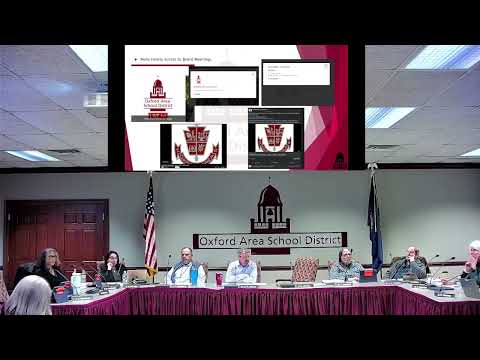
"Throughout my time at Oxford, I've seen tons of different types of hornets or different types of logos that people use," Patton said as he described the need to limit logo variations and provide a central template toolkit for presentations, newsletters and flyers. Dr. Woods read the audit's recommended ideal for the district: "Oxford Area School District seeks to create a trusted, connected community that honors its traditions while embracing innovation." The district attributes that phrasing to the district's mission and the core‑group discussions used in the audit.
The presentation included detailed, year‑one steps: an in‑progress visual style guide with official logos and color palettes; standardized PowerPoint and flyer templates (examples shown in the committee packet); monthly board meeting recaps distributed by the superintendent and communications director; improved calendar visibility on the district website; and enhanced accessibility practices including ADA compliance, captions on videos and translated materials. Patton said the communications director will get access to emergency‑notification systems to accelerate district messaging during incidents.
Board members pressed on language access for families. One member asked how Spanish‑speaking parents would connect with district communications; staff replied the website has built‑in translation functionality for many languages (with Spanish predominant for local audiences) and that the district maintains translators for in‑person and phone support. The committee agreed to highlight translation options in next‑day stakeholder recaps and to restart brief meeting synopses within 48 hours to ensure families know how to access livestreams and translations.
Dr. Woods emphasized the work will span multiple school years and that while some items were quick wins after receipt of the report in December, others will require the planned multi‑year effort. The education committee will discuss the report and recommendations at the full board work session next month and determine rollout timing to staff and school leaders.
The presentation included a summary of audit methods and sample counts: 20 artifacts and six accounts audited, 239 survey respondents and four focus groups, including a student focus‑group Dr. Woods said the IU consultant found "very impressive." No formal board action was taken on the audit at the meeting; the committee agreed further board discussion will occur at the next work session.