Get Full Government Meeting Transcripts, Videos, & Alerts Forever!
Get email alerts on the City Budget topic
No spam. Unsubscribe anytime.
Colorado Springs officials present 2026 budget with $11 million revenue gap, reserves as buffer
Summary
Finance director Sherry McDaniel told City Council that the proposed 2026 General Fund is $427.3 million, driven by sales-tax reliance and a $11 million revenue decrease from 2025; city leaders discussed using reserves, conservative forecasting, and a two‑week markup schedule before ordinance votes.
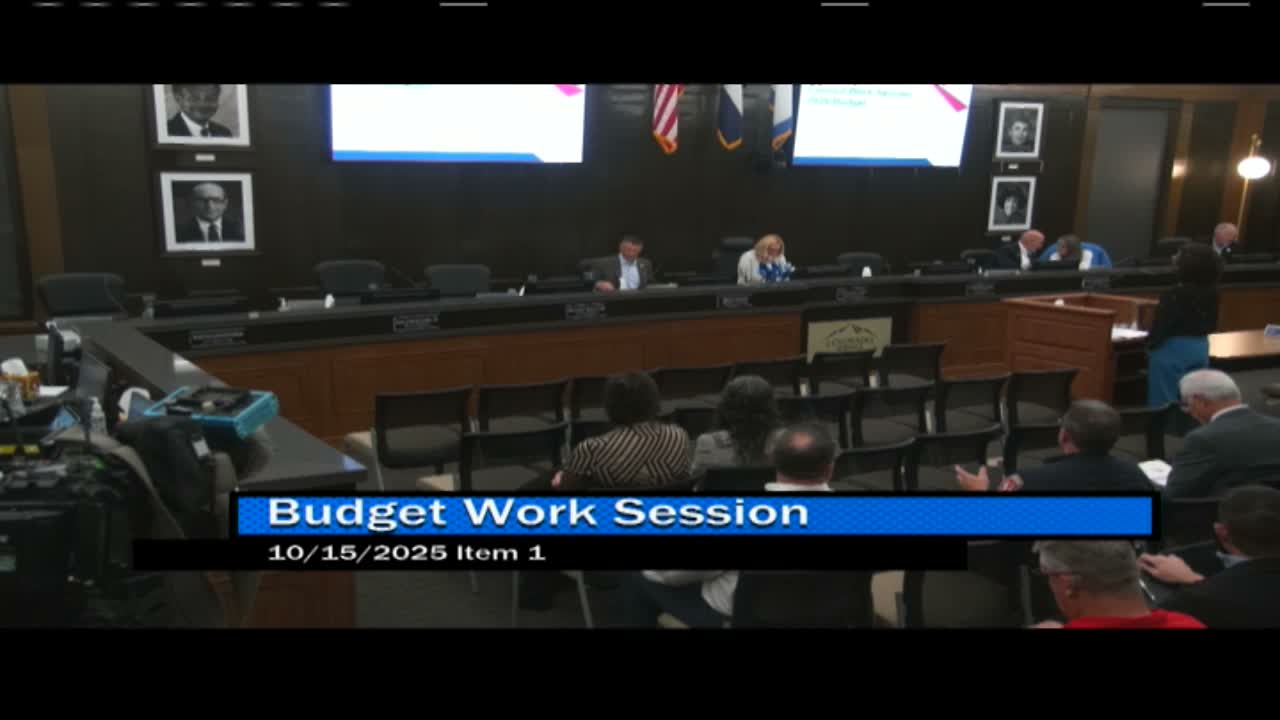
Sherry McDaniel, the City of Colorado Springs Chief Financial Officer, told the council on Oct. 15 that the proposed 2026 General Fund budget before council adjustments is $427.3 million and that the city faces a projected $11 million decrease in General Fund revenue compared with the 2025 budget.
McDaniel said sales and use tax remains the largest single revenue source, representing about 59% of General Fund revenue for 2026, while property tax is roughly 6% and utility surplus about 14%. "Sales tax is, for 2026, 59% of the general fund revenue budget," she said. The administration’s forecast shows the sales-tax budget moving from the original 2025 budget of $261,500,000 to a 2026 budgeted sales-tax figure of about $251.7 million, a budget-to-budget decline of roughly $9.7–$9.8 million. Overall General Fund revenue is shown down about $11 million from the 2025 budget to the 2026 proposed budget.
McDaniel said the administration used forecasting software plus "professional judgment," and consulted national indicators (Bloomberg, the Congressional Budget Office and academic forecasts) to support a 1.4% ongoing revenue assumption for 2026. Several council members urged a more conservative approach. Councilmember Rizzoli told the record he had spoken with downtown business owners reporting double-digit revenue declines and said he preferred holding the sales-tax budget flat rather than assuming an increase.
On reserves, McDaniel said the city’s unrestricted General Fund balance is healthy relative to best-practice guidance: the fund balance is projected at about 19.8% of the 2026 expenditure budget, above the Government Finance Officers Association recommendation of roughly 16.7%. McDaniel said the fund balance is an available mechanism to address revenue shortfalls but that the administration prefers to limit draws and instead manage expenditures when possible.
The budget document presented to council includes across-the-board changes: no market movement or pay-for-performance increases for civilian employees, a reduced pay-progression program (up to 2% for eligible civilians), and step progressions for sworn staff. McDaniel summarized net compensation, benefit and pension changes that contribute to the expenditure side of the ledger, and said departmental reductions and one-time expenditure changes helped bring the overall General Fund spending plan into balance.
Procedure and next steps: McDaniel reminded council that a public input hearing is scheduled for Oct. 27 (5:30–7 p.m.), the formal markup session is Oct. 29, and the budget ordinance will be presented for two votes in November (Nov. 10 and Nov. 25). She said council members who propose additions at markup should identify offsets so the city leaves the process with a balanced budget.
McDaniel emphasized that these figures are the administration’s proposal and that council’s markup will be the opportunity to alter revenue assumptions or reallocate funding before ordinance introduction.