
Senate Transportation Committee reviews Gov. Ferguson’s 2026 supplemental transportation budget
Get AI-powered insights, summaries, and transcripts
Subscribe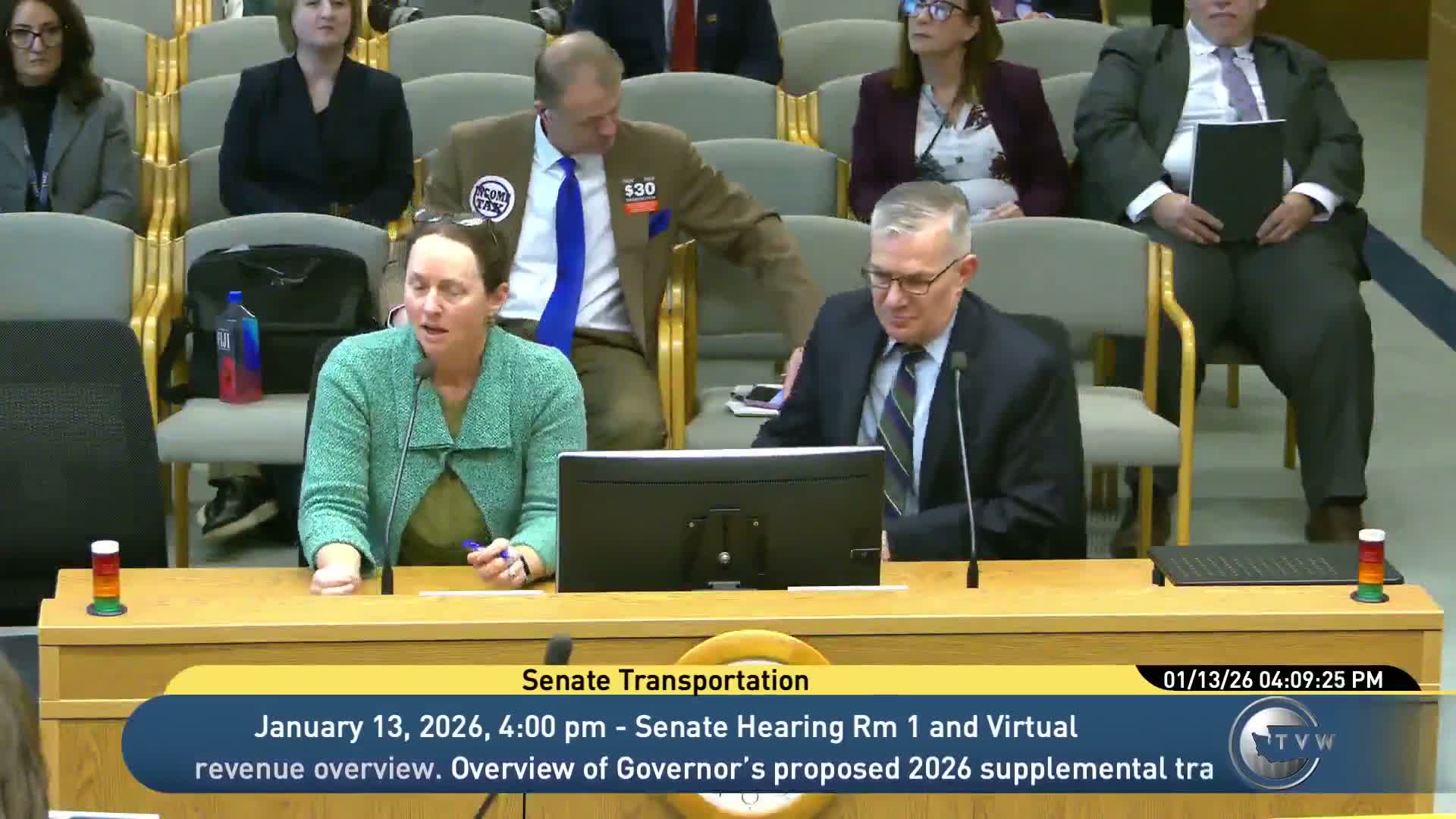
Summary
Senate Transportation Committee heard a work session on Gov. Ferguson’s proposed 2026 supplemental transportation budget, focusing on preservation, bonding authority, ferries procurement, and pressures on Climate Commitment Act revenues and fuel‑tax forecasts.
The Senate Transportation Committee on Jan. 13 heard a work session on Gov. Ferguson’s proposed 2026 supplemental transportation budget, which officials say emphasizes preservation and maintenance and uses a mix of bonds and cash to avoid exceeding bonding capacity.
Haley Gamble, the committee’s fiscal coordinator, reviewed last year’s adopted transportation plan (stated in the presentation as about $15.5 billion) and said the Department of Transportation accounts for the majority of that total. She and budget staff highlighted that the 2025 session produced roughly $8.9 billion in new revenues over 10 years — including a 6¢ gasoline increase (inflating 2% annually), an extra 3¢ diesel tax that phases up, higher weight and license fees, and a 0.1% sales‑tax transfer to transportation beginning next biennium.
Budget staff said updated revenue forecasts reduced near‑term fuel‑tax receipts (the presentation cited roughly a $108 million downward revision in 2025–27 and about a $1.1 billion reduction over 10 years), but that the state’s net fiscal position remains positive after prior session changes. The presentation also flagged uncertainty in Climate Commitment Act (CCA) receipts: staff showed a short‑term upward revision in CCA totals (an example projection in FY2026 showed about $800 million more in total CCA receipts compared with an earlier projection) but projected declines by FY2030 that could put pressure on transportation allocations.
Megan Cotton, the governor’s senior policy advisor for transportation, and Eric Hansen, the governor’s senior budget advisor, described key elements of the supplemental proposal. Hansen said the administration proposes roughly $3.1 billion in bonding for eligible capital projects and uses nonbond cash for preservation and maintenance activities that are not bondable. Cotton said preservation items include additional paving, bridge work and vessel procurement: the presentation referenced a multi‑year preservation package and noted plans to execute a contract for two new ferries with an option for a third and that, absent continued investment, service disruptions will persist while the state replaces aging vessels.
The proposal discussed program‑level details: a biennial preservation allocation tied to programmed paving (the staff presentation referenced a programmed $164 million for paving this biennium and plans for additional paving capacity if funding is approved), $2.2 million front‑loaded for the County Road Administration Board to stand up a local roads grant program, $2.1 million to modernize Department of Licensing (including mobile licensing units and call‑center improvements), and a $15 million request for Lower Columbia River dredging in support of the federally authorized 43‑foot channel.
Committee members pressed staff on several items. On electric‑vehicle effects on fuel tax forecasts, staff said EV adoption is a factor the forecast considers qualitatively but acknowledged high uncertainty; they will continue to monitor assumptions. On tort liability and the state self‑insurance account, staff said the governor’s omnibus budget includes roughly $143 million from transportation to begin restoring a negative balance and offered to provide methodology follow‑up. Members also asked whether 160‑car ferries will fit existing docks and whether DOT could spend additional paving funds in 2026; agency staff said the next vessels are consistent with legislative direction and that DOT has programmed paving to match near‑term delivery capacity.
The session ended by moving to a public hearing on Senate Bill 6,005 (the governor’s supplemental transportation appropriations bill). No committee votes were taken at this meeting. The hearing then opened for public testimony. The committee adjourned after closing that hearing.