Get Full Government Meeting Transcripts, Videos, & Alerts Forever!
Get email alerts on the Public Safety topic
No spam. Unsubscribe anytime.
House committee hears bill to penalize driving around emergency road closures
Summary
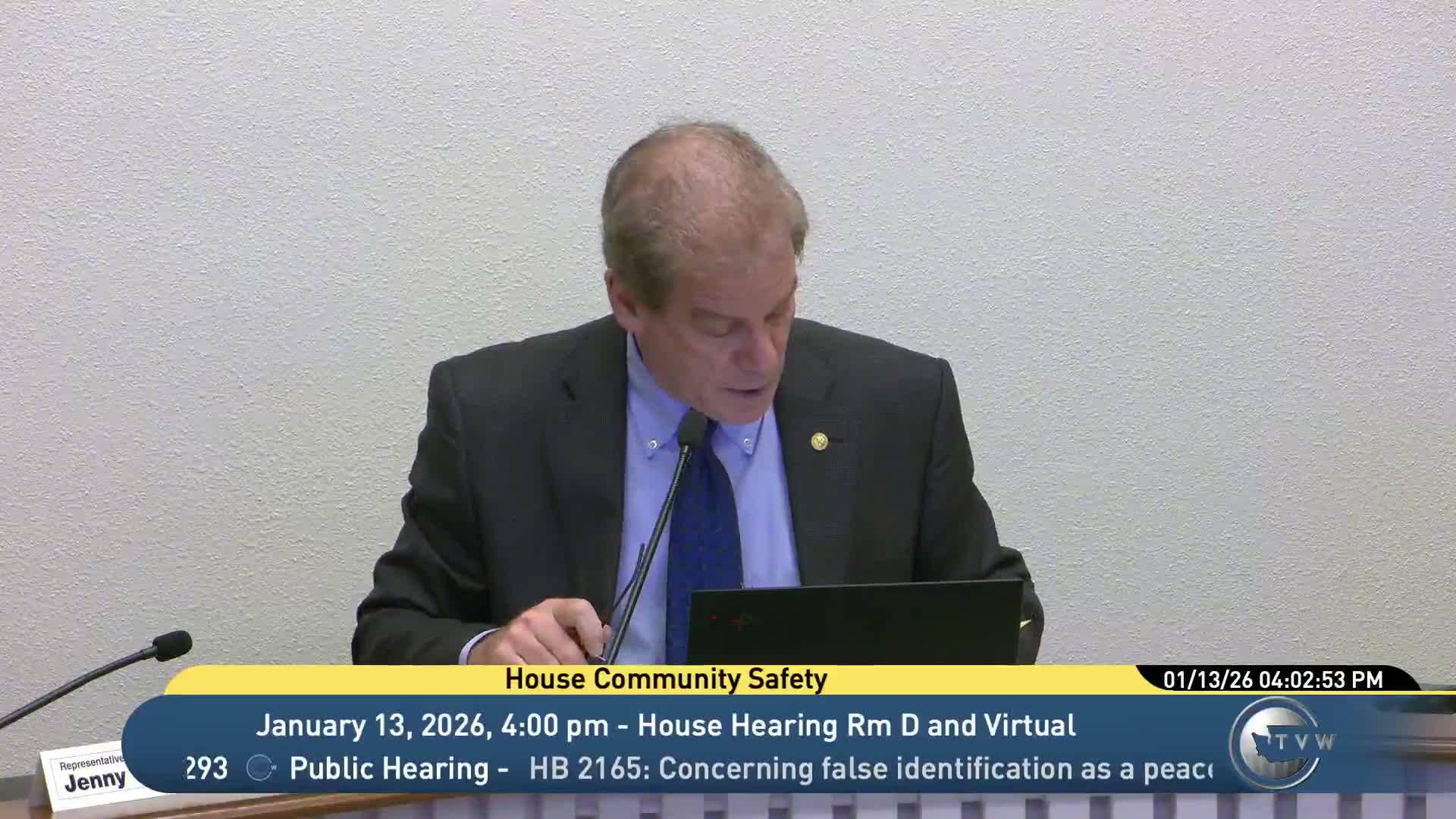
The House Community Safety Committee heard testimony on HB 2203 on Jan. 13, 2026. The bill would create the offense of reckless interference with emergency operations, authorize suspension of driving privileges and allow courts to order reimbursement of emergency response costs; the Sentencing Guidelines Commission opposed elevating the offense to a felony.
A House Community Safety Committee hearing on Jan. 13, 2026, focused on House Bill 2203, a proposal to create a criminal offense for knowingly operating a vehicle on a roadway closed by official barricade, signage or emergency vehicle and to make the offense liable for emergency-response costs.
Lina Langer, counsel to the committee, described the bill’s elements: at the gross-misdemeanor level the offense covers knowingly driving on a road closed for hazardous conditions; the offense would be elevated to a class C felony if a resulting emergency response causes bodily injury to a first responder or if a minor is present and the incident requires rescue, evacuation or similar assistance. Langer said the bill also allows courts to order reimbursement of emergency-response costs up to $25,000 when the court finds the expenses reasonable.
Supporters said the measure responds to recent storms and dangerous behavior. "We routinely encounter drivers who ignore barricades, signage, or emergency vehicles," said Devin Gabrelick, police chief of Orting, recounting a recent flooding incident that required multi-agency rescues and diverted limited emergency resources. Gabrelick told the committee the bill would give small agencies clearer authority and a stronger deterrent when drivers deliberately bypass closures.
The Washington State Sentencing Guidelines Commission, represented by coordinator Carrie Ann Yentzer, opposed elevating the conduct to felony-level punishment. Yentzer said members "did not believe that behavior was commensurate with felony conduct" and recommended a first-level traffic infraction and a second-level gross misdemeanor instead.
Committee members asked staff to clarify license-suspension periods, the precise definition of a roadway "closed" by official action and how civil cost recovery would interact with existing statutes. No vote was taken; the chair said members would "chew on it for a while" and that staff and sponsors may propose amendments before executive action.
The committee concluded the public hearing on HB 2203 without taking final action; sponsors and staff will work with stakeholders on definitions and penalties ahead of any further committee consideration.