
Oregon presents Family First prevention plan and strategy to draw down Title IV‑E funds
Get AI-powered insights, summaries, and transcripts
Subscribe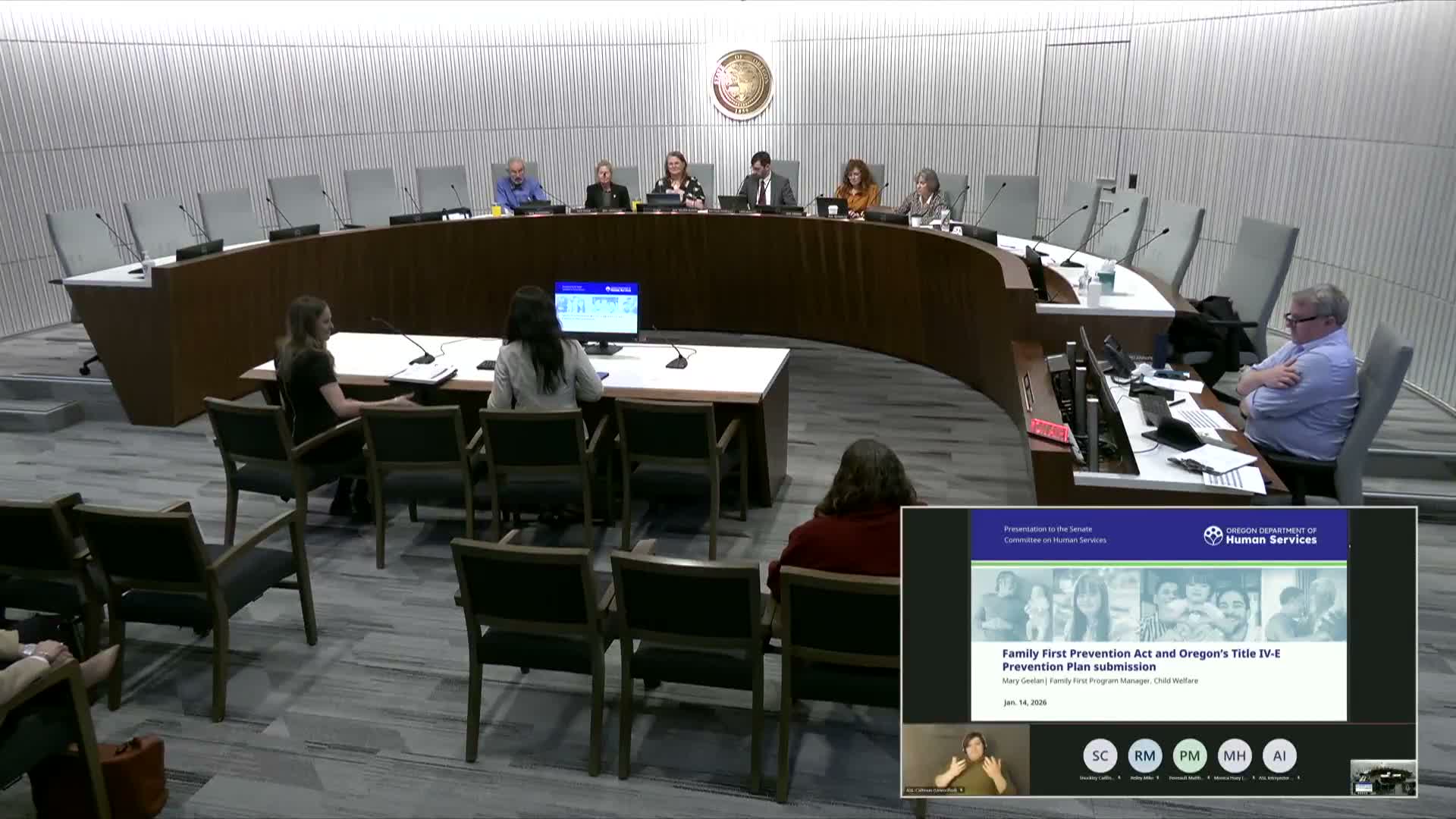
Summary
ODHS told the Senate Human Services Committee it submitted a new five‑year Title IV‑E prevention plan and expects federal review; the plan expands eligibility, emphasizes tribal and lived‑experience leadership, and aims to scale evidence‑based services while expanding claiming capacity.
Oregon Department of Human Services officials presented an update on the Family First Prevention Services Act and the state's strategy to expand prevention services, draw down federal Title IV‑E funds and reduce foster‑care entries.
Molly Miller introduced Mary Geelen, the state's Family First manager, who said prevention is grounded in the idea that "every child deserves to be safe." Geelen outlined Oregon's current plan, noting the state secured a 2021 federal approval and a December 2025 extension that preserves federal reimbursement while a new five‑year plan is under federal review.
Geelen said Title IV‑E prevention is an uncapped entitlement that, if utilized effectively, allows Oregon to leverage federal matching funds for evidence‑based mental‑health, substance‑use and parenting supports. She described a collaborative planning process that elevated tribal representatives and individuals with lived experience and highlighted that Oregon plans to expand eligibility beyond families already involved with child welfare, potentially including juvenile justice and early‑childhood home‑visiting populations.
The presentation noted that, to date, more than 2,200 children and families have received Family First services in Oregon and that kinship navigator services have handled over 8,000 support calls statewide. Geelen said Oregon hopes to have an approved new plan by June and will continue implementing the current plan while negotiating with the Children's Bureau.
Andrew Grover of Youth Villages added a national perspective, pointing to analyses that show a decline in foster‑care claims and urging Oregon to pursue an "ambitious goal" to safely reduce the number of youth in foster care over five years while calling attention to the technical and claiming challenges states face when scaling services.
What happens next: ODHS will continue negotiations with the federal Children's Bureau, proceed with evaluation and CQI planning for outcome measurement starting in 2026, and return to the committee with updates as requested.