Get Full Government Meeting Transcripts, Videos, & Alerts Forever!
Get email alerts on the Extraordinary Medical Placement topic
No spam. Unsubscribe anytime.
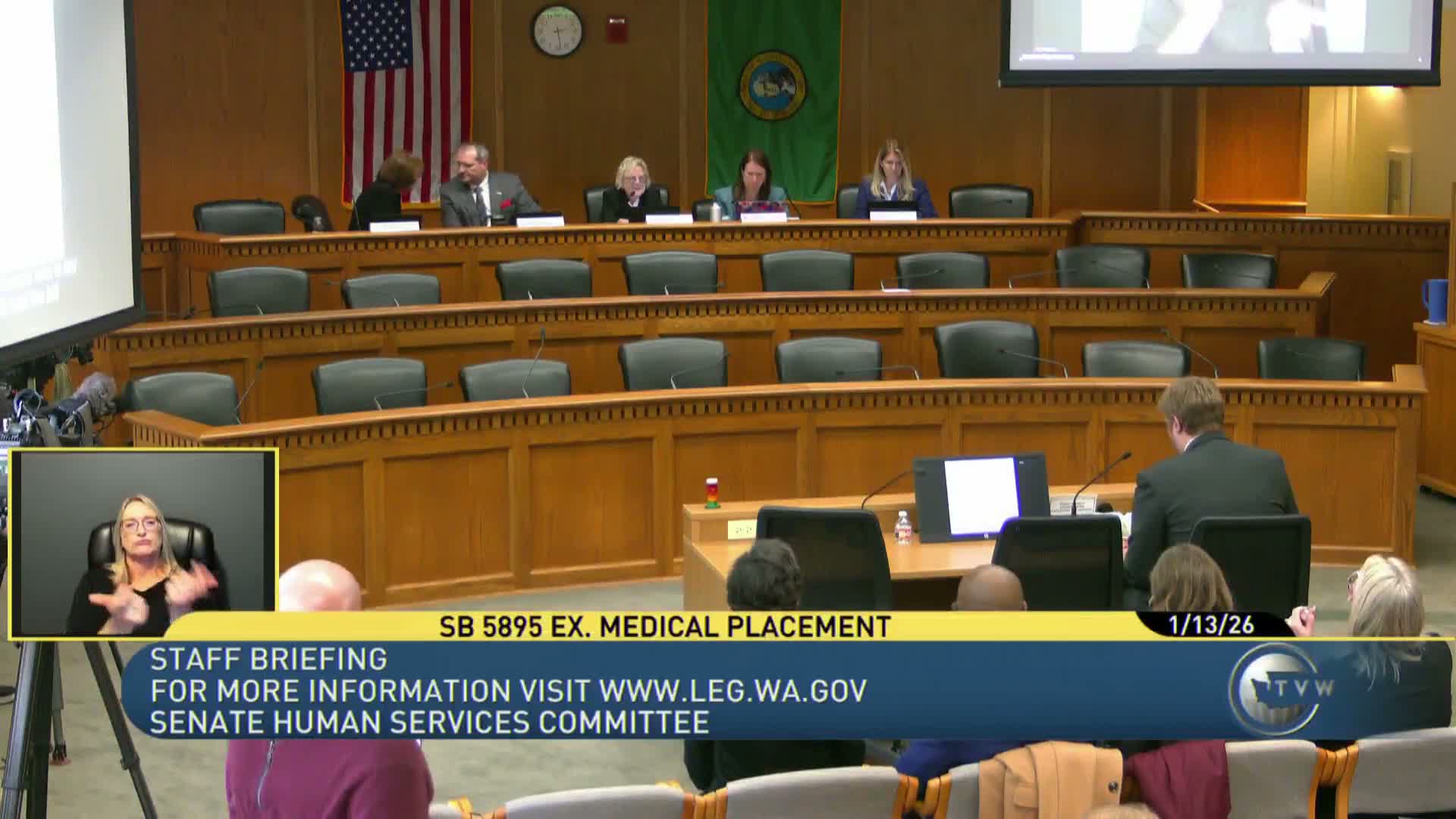
Lawmakers hear bill to broaden extraordinary medical placements for incarcerated people
Summary
Senate Bill 5,895 would add a condition allowing extraordinary medical placement when DOC cannot meet an individual's basic medical needs; advocates urged passage after 2023 reforms increased referrals but not approvals, while DOC staff raised concerns about definitions and implementation detail.
Senate Bill 5,895, introduced to the Human Services Committee on Jan. 13, would permit the Secretary of the Department of Corrections to authorize an extraordinary medical placement (EMP) — transfer to an alternative care setting outside DOC custody — when two physicians find a qualifying condition and the person poses low community risk. Committee staff said the bill would add an additional condition authorizing EMP when DOC cannot meet an individual's basic medical care needs as required by the constitution or state law and would define "medical care needs." A fiscal note was described as indeterminate but non-zero.
Will Tronson, staff for the committee, summarized procedural safeguards in current EMP practice: two-physician assessments, electronic monitoring except where detrimental to health, and exclusions for people sentenced to death, life without parole, or designated as persistent offenders.
Supporters urged the committee to make the EMP pathway workable. Melody Simley, a coalition advocate, said 2023 statutory changes did not produce the expected increases in EMP use and that the proposed language creates a clearer pathway for people whose in-facility care is inadequate. Sarah Leon, who said she is married to an incarcerated person with multiple sclerosis, described delayed and inconsistent medical treatment and asked the committee whether that constituted "adequate medical care." Rachel Sievers, an attorney with Disability Rights Washington, said the organization's review after 2023 found more than 550 DOC referrals for EMP but that more than 70% of those referrals failed to meet medical criteria and only "two or three" people were approved for release in one year.
"After that statutory language went into effect, we did an investigation and found that more than 550 people had been referred... but more than 70% of those people were found not to meet medical criteria and only 2 or 3 people were actually approved for release in that year," Sievers said.
DOC health officials expressed concerns about the bill's definitions. David Flynn, Assistant Secretary for Health Services, said the department values the EMP framework and its dignity-centered purpose but wants clearer language on what "basic medical care needs" means and how DOC would independently determine constitutional or statutory inadequacy.
Physician Mark Stern, who has overseen EMP candidate evaluations, suggested technical amendments: lengthening the period for program eligibility (he recommended 12'18 months rather than six) and adding flexible language such as "approximately" to help clinicians make recommendations.
The committee closed the SB 5,895 hearing after public testimony and indicated staff follow-up on technical language and fiscal details would continue.