DOC outlines —Washington Way— reforms; new correctional ombuds director details priorities
Loading...
Summary
Department of Corrections Secretary Tim Lang and agency officials briefed the Senate Human Services Committee on the "Washington Way," reentry expansions, treatment and health-system modernization. Jeremiah Bourgeois, director of the Office of Correctional Ombuds, described OCO's statutory role and recent investigations and resource constraints.
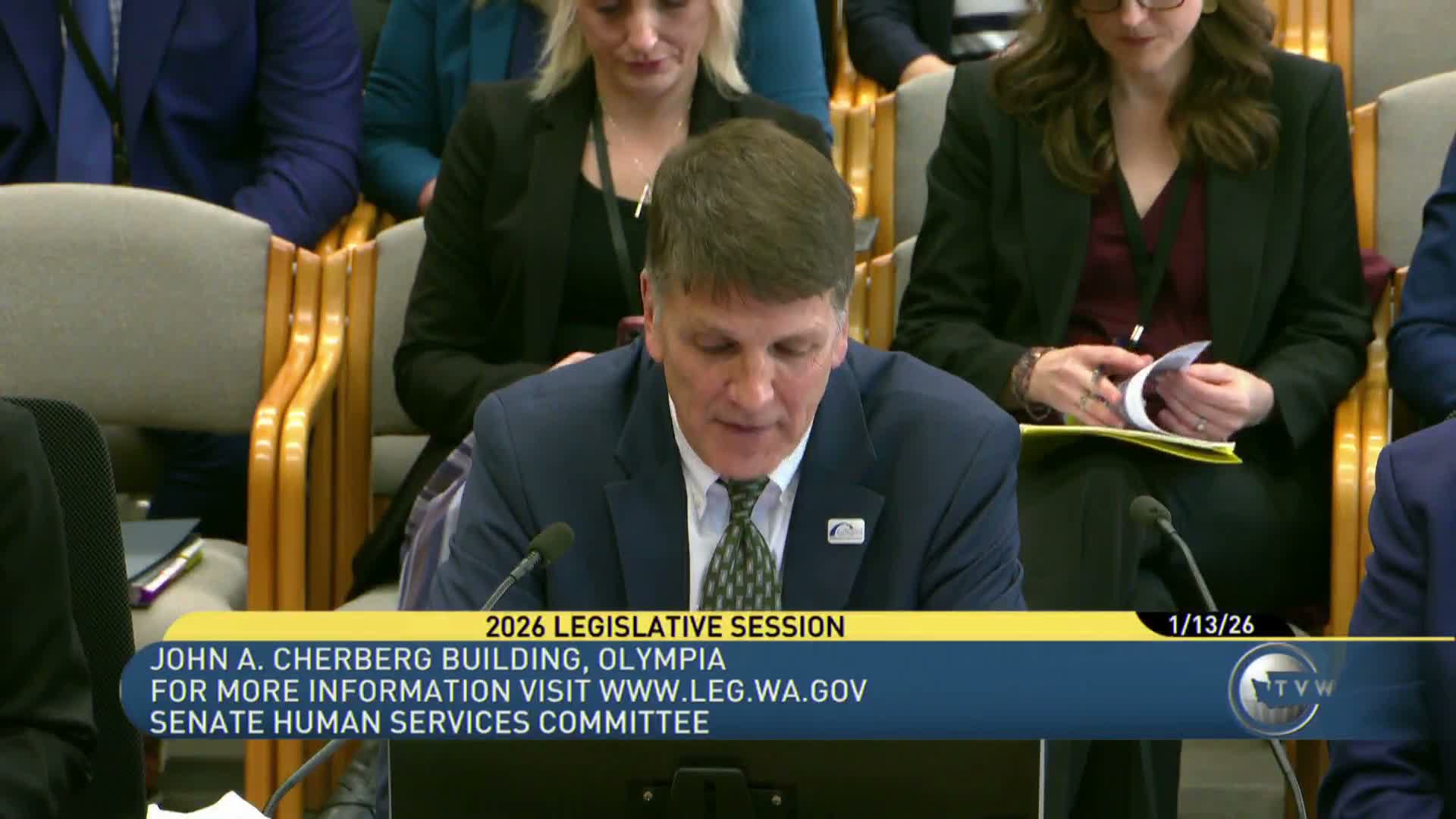
Secretary Tim Lang, head of the Washington State Department of Corrections, told the Senate Human Services Committee on Jan. 13 that the agency is pursuing a cultural shift toward a "public health focused approach" it calls the Washington Way, with an emphasis on rehabilitation, staff safety and family-centered reentry supports.
The presentation highlighted several ongoing reforms. Lang said the department employs "over 9,000 Washingtonians" and described the Reimagine Visiting project, which produced 67 recommendations to improve family visits. He also told lawmakers the department has restored authority to impose community-custody sanctions "up to 30 days," the statutory maximum, after a pandemic-era temporary reduction to 15 days.
"The Washington Way is about bringing a public-health focused approach to corrections," Lang said, describing visits to Norwegian facilities and a focus on normalizing staff interactions with incarcerated people to support rehabilitation.
Danielle Armbruster, Assistant Secretary for Reentry, described work to expand postsecondary education in custody after the 2024 substitute bill that opened access to federal and state financial aid. Armbruster said 137 students participated in Pell-approved programming statewide last year and the department is working with colleges and the state board to expand eligible pathways.
Armbruster also outlined reentry-focused changes to transportation and partial confinement. She said a 2024 bill removed a $100 cap on transportation provided at release; in the six months after implementation, the department logged more than 70 releases where costs exceeded $100. She described substitute SB 5219's 18-month partial-confinement pathways, which the department is implementing and using to transition people into community-based reentry programs earlier.
David Flynn, Assistant Secretary for Health Services, told the committee the department is preparing for Medicaid reimbursement under a 1115 waiver and implementing electronic health records and HIPAA compliance work. He said the agency expects Medicaid-covered services to start 90 days before release and continue for 90 days after release, and that the DOC plans a go-live date of July 1, 2026, for the first cohort of facilities.
Jeremiah Bourgeois, the newly appointed director of the Office of Correctional Ombuds (OCO), also addressed the committee. Bourgeois said the OCO is charged (by statute) to promote public awareness of incarcerated people's rights, identify system issues for the governor and legislature, and ensure compliance with relevant statutes and policies. He described OCO's recent investigation into excessive use of force at a women's facility and said DOC agreed to implement the office's four recommendations in that case.
"I was appointed director of the Office of Correctional Ombuds on 12/01/2025," Bourgeois said, and described his lived experience and the limits of his office's resources: he reported an OCO budget of about $2,500,000, fewer than 15 staff, and approximately 15,000 people confined in the DOC system.
Committee members asked DOC about telehealth for medication for opioid use disorder; Lang and Flynn said medications are currently prescribed by DOC clinicians and administered on-site rather than by telehealth because of diversion and administration controls. Lawmakers also pressed DOC about close-custody capacity, female-bed distribution in the eastern part of the state, and volunteer program consistency across facilities.
The presentation closed with Lang urging continued investment in treatment capacity, custody staffing relief, and resources to address contraband drugs and close-custody demand.
The committee moved next to bill hearings after the DOC and OCO presentations.