Get Full Government Meeting Transcripts, Videos, & Alerts Forever!
Get email alerts on the Clean Energy Transformation Act topic
No spam. Unsubscribe anytime.
Senate committee hears competing views on bill to bring ports and single‑customer generators under CETA
Summary
Senators heard proponents say SB 5982 closes a loophole letting large users avoid the Clean Energy Transformation Act, while ports and industry groups warned the bill risks burdening small ports and preexisting customers with new compliance and reporting obligations.
Senator Victoria Hunt, sponsor of Senate Bill 5982, told the Environment, Energy and Technology Committee the bill would close a gap in Washington’s Clean Energy Transformation Act (CETA) so that port districts and other large electricity generators are covered by the state’s decarbonization timelines.
"This is a bill that ensures that all of our state's electricity is subject to CETA," Hunt said, arguing the change is needed as data centers and other large users put growing pressure on the grid.
The bill, staff explained, would amend CETA definitions to include port districts as consumer‑owned utilities, expand the market‑customer definition to capture entities that generate any of their electricity, and direct the Utilities and Transportation Commission (UTC) to adopt rules and reporting requirements for affected market customers. Staff also noted a fiscal estimate of $78,000 for UTC rulemaking.
Supporters framed the measure as closing an inequitable loophole. Julian Santos of Washington Conservation Action said the bill would prevent large users from escaping the law’s emissions limits by operating as boutique utilities or procuring independent power. Zach Baker of the Northwest Energy Coalition said the change implements recommendations from the governor’s data‑center work group and would ensure high‑intensity users follow Washington’s clean‑energy goals.
But port representatives and industry groups warned of unintended consequences. Patrick Boss, representing ports in Grant County, said many ports face 7–14 year waits for transmission and are building microgrids or localized generation to attract businesses; he cautioned a one‑size‑fits‑all approach would "tie ports' hands" and saddle small ports with compliance burdens meant for larger utilities. Brandon Huskaper of the Alliance of Western Energy Consumers said removing the prior 100% self‑generation threshold could sweep in modest on‑site generators and penalize entities that invested before CETA.
Joel Creswell of the Department of Ecology said Ecology supports extending CETA coverage but flagged a policy consequence: expanding consumer‑owned utilities would increase allocations of no‑cost allowances under the Climate Commitment Act, reducing auction revenue unless paired with complementary policy changes. He recommended pairing the bill with measures to constrain growth in no‑cost allowances.
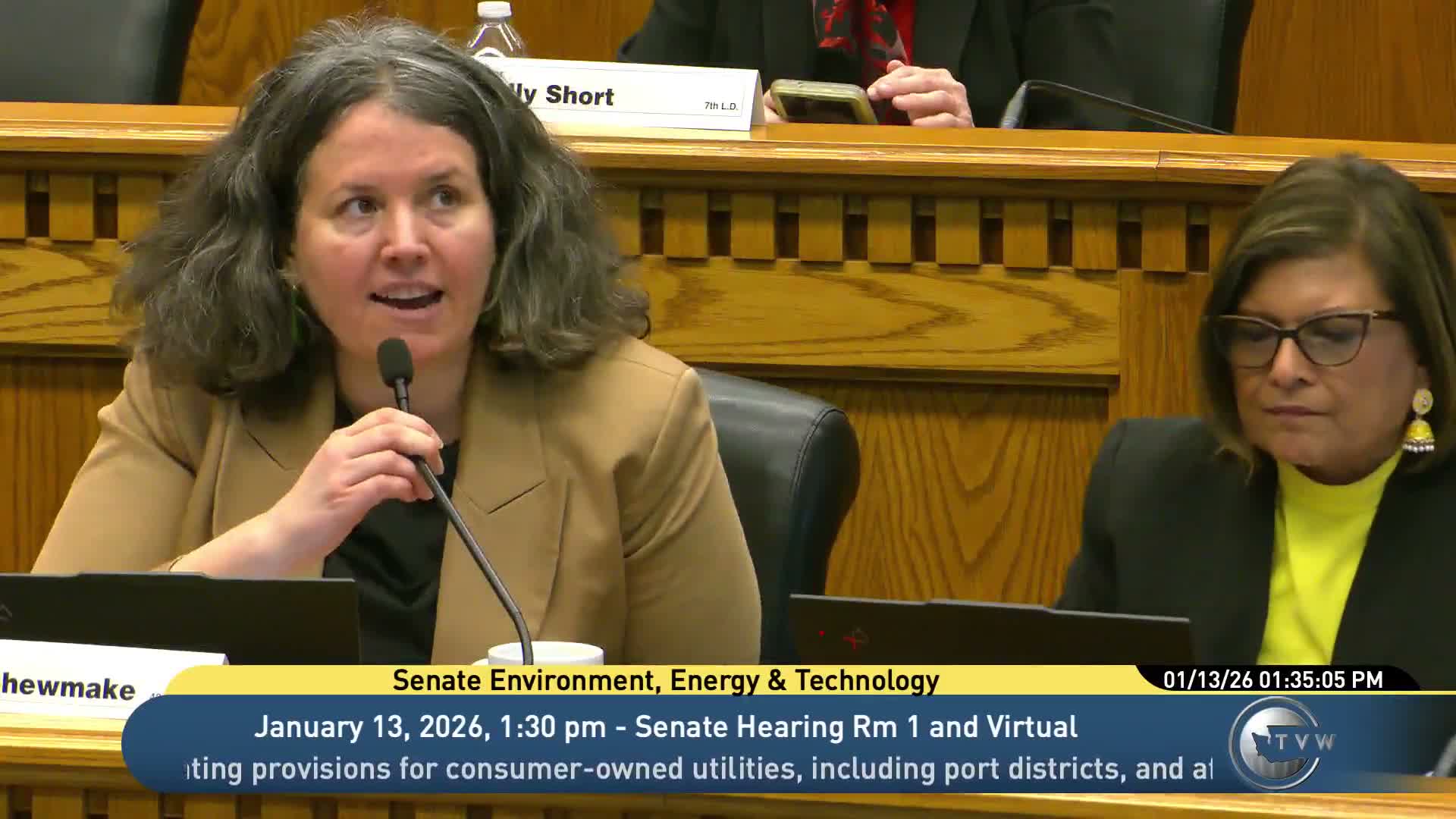
Committee members asked about carve‑outs and waivers for systems that use only renewables; witnesses noted the bill gives UTC waiver authority in limited cases but that language and implementation details would need further clarification.
The committee closed the hearing on SB 5982 after staff reported sign‑in tallies: 40 pro (signed but not testifying), 61 con, and 1 other. No committee vote was recorded during the hearing.
What happens next: The bill remains at the public‑hearing stage; sponsors, ports, utilities and environmental groups identified technical and fiscal details that would need to be resolved in follow‑up negotiations.