Committee hears bill to allow remote notarization of paper documents
Loading...
Summary
Lawmakers heard House Bill 2158, which would let electronic notaries remotely notarize tangible (paper) records by recording the signing, requiring a declaration and preserving the audiovisual recording for at least 10 years; sponsors said the change would help rural residents, while members probed fraud safeguards.
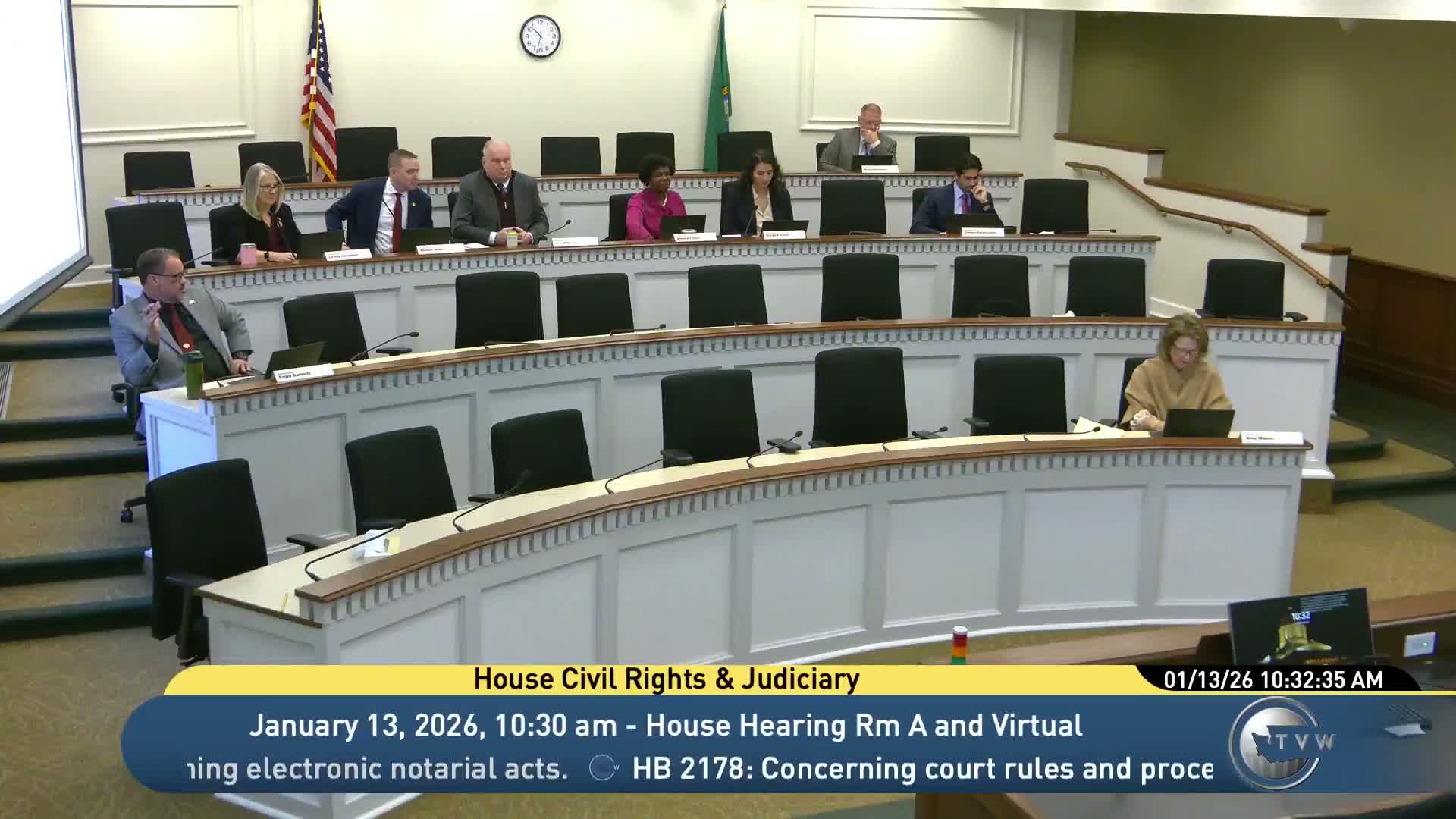
House members of the Washington House Civil Rights & Judiciary Committee heard testimony on House Bill 2158 on Jan. 13, 2026, which would implement 2021 updates to the Revised Uniform Law on Notarial Acts to allow remote notarization of tangible records.
Supporters and staff said the bill adopts three specific changes to electronic notarial practice, including a process for "remote ink" notarization where a remotely located individual signs a tangible record, signs a declaration that it is the same document, and then sends the physical record to the notary before the notary executes a certificate noting the remote witnessing. The bill also authorizes an electronic-records notary to administer an oath or affirmation remotely, provided the notary records the oath and retains the recording for at least 10 years, and it permits a notary to acknowledge a signature on a tangible record displayed during the audiovisual session if the remote signer identifies the document.
"Remote electronic notarization is a boon to rural areas, and I commend this bill to you," Representative Vabell said, describing the change as useful for constituents who must travel long distances to reach a notary.
Caitlin Wolf of the Uniform Law Commission, who testified in support, said the bill "allows us to keep pace with technological innovation while still maintaining strong consumer protections" and called the updates modest technical fixes that increase options for residents.
Ranking Member Jim Walsh asked a pointed security question: "What if a clever criminal takes your Zoom, video right now, manipulates it, shows you waving a document around, and uses it to notarize a second mortgage on your house?" Wolf and other supporters responded that the bill builds in timing and procedural safeguards — including the requirement the remotely located signer provide a signed declaration and the requirement that the notary retain the audiovisual recording for investigations — and emphasized secure storage of recordings so any manipulation could be investigated.
The committee received testimony but did not record a final vote on the bill during the Jan. 13 hearing. The committee then proceeded to hear other bills on its agenda.