
JLARC recommends continuing or refining most tax preferences; finds emissions, reporting and measurement gaps
Get AI-powered insights, summaries, and transcripts
Subscribe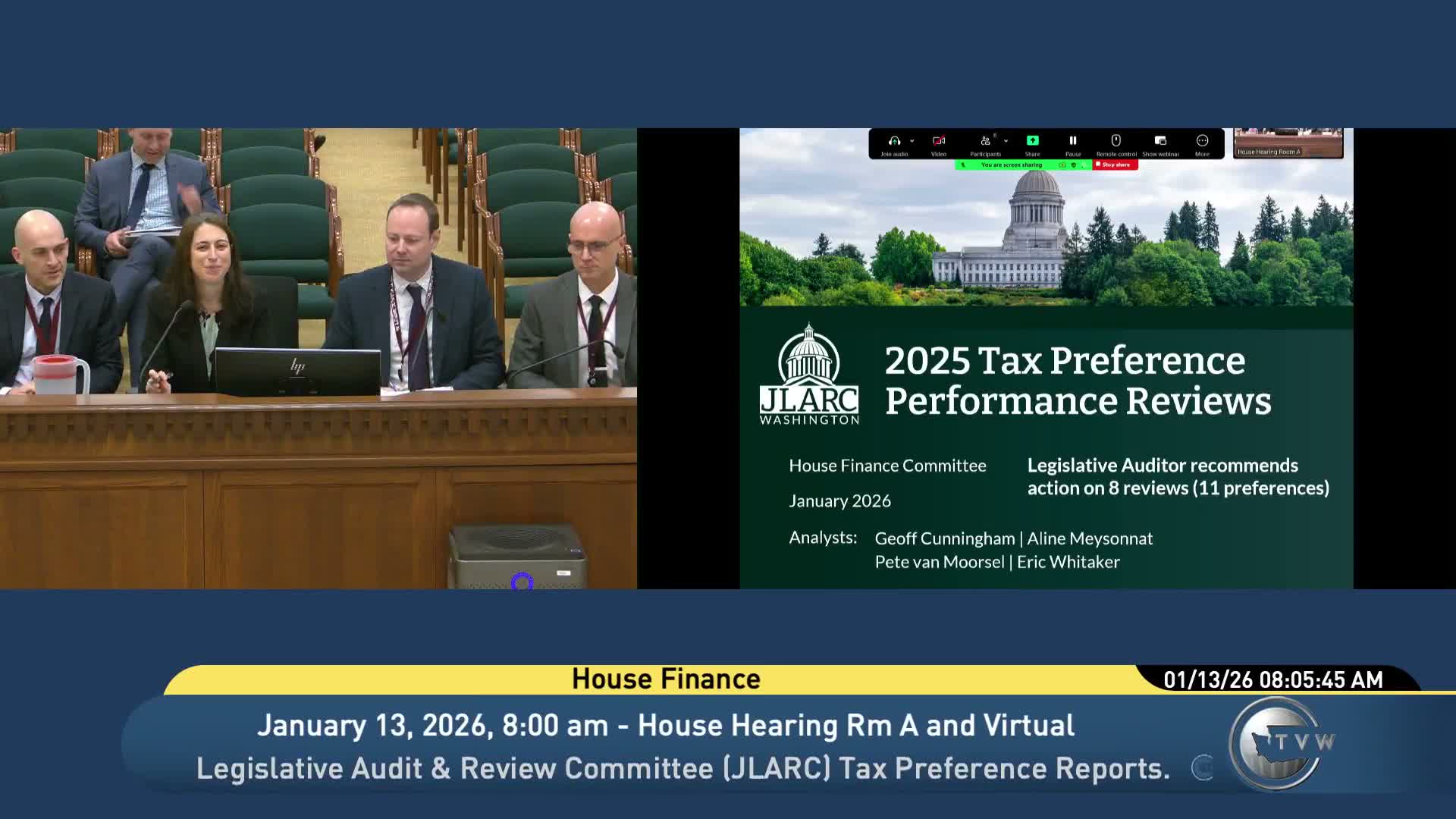
Summary
Joint Legislative Audit and Review Committee told the House Finance Committee that most tax preferences it reviewed should continue but some require reporting changes or new performance metrics after finding unmet environmental targets and limited use for several preferences.
The Joint Legislative Audit and Review Committee told the House Finance Committee on Jan. 13 that most tax preferences in its 2025 review should be continued, but several need changes to reporting or performance metrics to make future evaluations useful.
JLARC staff member Aileen Mezzona opened the presentation, saying, "Today, we will present to you, the 20 25 tax preference performance reviews," and noted the project covered nine reviews with the legislative auditor recommending action on eight. The reviews ranged from natural gas used as a transportation fuel to exemptions for nonprofit housing and travel-industry B&O rates.
JLARC concluded three natural-gas preferences reduce the cost of using compressed or liquefied natural gas but do not meet the legislature’s emissions-reduction objective because fewer ships and vehicles converted to natural gas than anticipated. Mezzona said JLARC recommends continuing the public utility tax and natural-gas use tax exemptions "to ensure uniform taxation of natural gas as a transportation fuel" and to modify the public-utility exemption to require beneficiaries to report production and sales amounts to facilitate future reviews.
On preferential B&O rates for travel agents and tour operators, JLARC found that large beneficiaries’ savings have increased while the number and savings of small beneficiaries have declined. Staff recommended continuing the 0.275% preferential rate for small beneficiaries, adding a stated objective and measurable performance metrics, and reviewing the 0.9% rate for higher earners.
The review of a property-tax exemption for nonprofit low-income housing found the preference is enabling developers to build homes as intended — 814 exemptions were granted between 2017 and early 2025 and nonprofit developers sold 333 qualifying homes over the period — but that metrics tied to the share of revenue devoted to housing can be skewed by project timing and grant spikes. JLARC recommended the legislature decide whether to continue the exemption and, if it does, to consider changing the metric or requiring annual renewal to improve reporting.
JLARC reported the multipurpose senior-center exemption meets its inferred objective of treating eligible nonprofit centers similar to government-owned centers and recommended continuation, including consideration of making the exemption permanent. By contrast, the sales-and-use tax remittance for disabled veteran adapted housing is used rarely: the Department of Revenue has reported about $3,000 refunded since the preference was enacted in 2017, and JLARC recommended continuing the preference but modifying outreach and design and consulting the Washington Department of Veterans Affairs to improve uptake.
On a preference that exempts attendees of one trade convention per year from creating a physical-presence nexus, JLARC said beneficiary use is unknown because companies need not register with the Department of Revenue; the office nonetheless recommended continuation to align Washington with other states but advised improvements in performance statements and data collection.
During questioning, Representative Rammel asked whether tax savings at the Tacoma LNG facility were passed to consumers; JLARC staff said that was outside the review’s scope. Representative Santos pressed the office on causal inferences for the convention preference, saying, "I think this is probably the preference report that troubles me the most," and questioned recommending continuation when use is unknown; JLARC staff answered that continuation was based on the stated objective and comparison with other states.
JLARC also announced a pilot to add a standardized rubric to fiscal notes evaluating four components of tax-preference performance statements — alignment of objective and metric, clarity and quantifiable targets, data availability, and timing to allow sufficient data collection and review.
Chair members noted bills related to several preferences appeared on the committee’s intro sheet and said the JLARC rubric should help bill sponsors draft clearer performance statements. The committee had no formal votes during the session; JLARC’s recommendations were placed on the record for the legislature to consider.
The committee is expected to review related bills and fiscal notes in coming weeks as the short session proceeds.