Get email alerts on the Garnishment Forms topic
No spam. Unsubscribe anytime.
Judges and courts back technical fix to garnishment forms in SB 5,865
Summary
Judge and court-affiliated witnesses told the Senate Law and Justice Committee that statutorily mandated garnishment answer forms produce inaccurate calculations; SB 5,865 would replace statutory forms with a pattern-committee form to improve accuracy and transparency, with stakeholders urging a transition to avoid gaps.
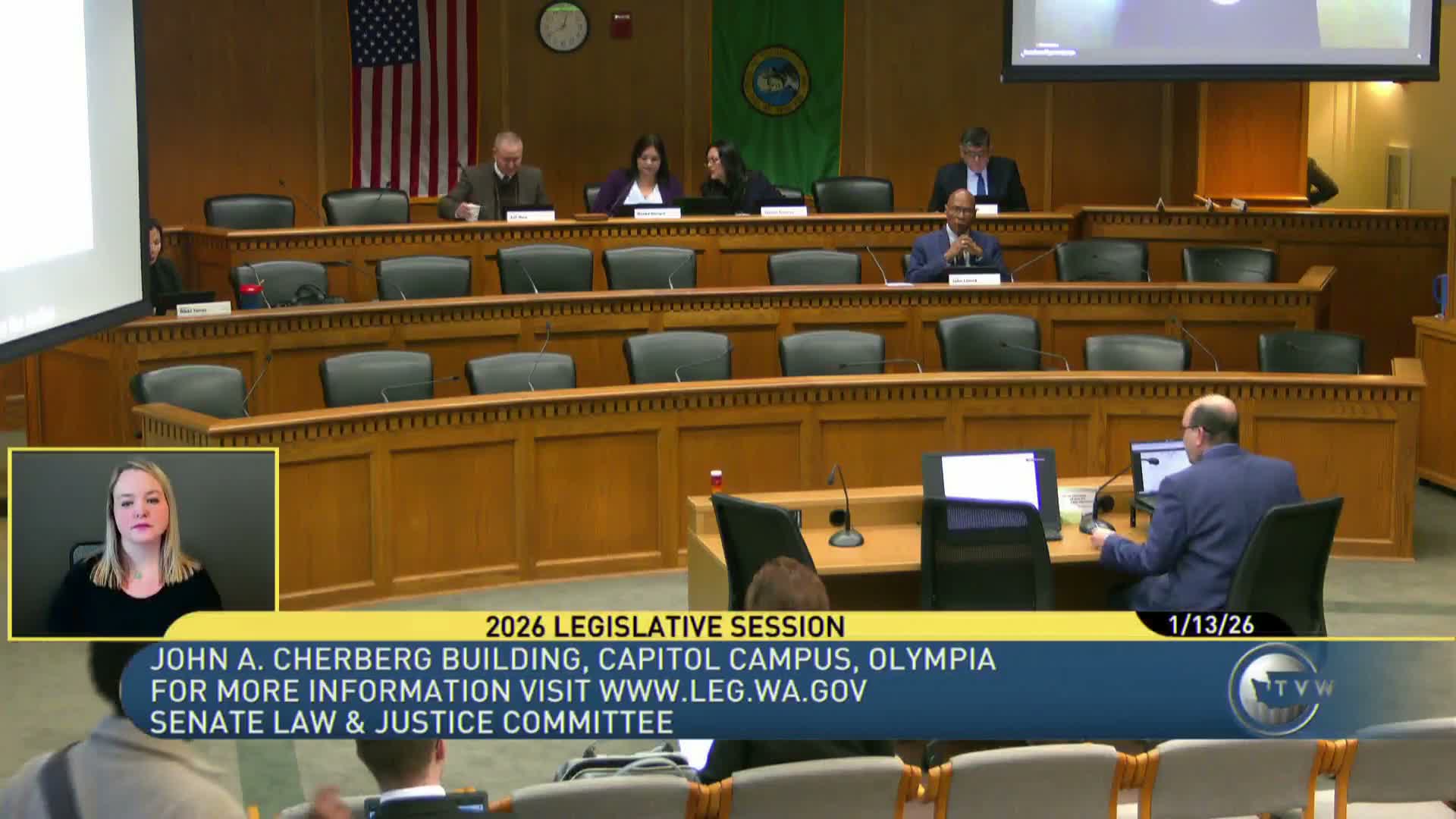
Chair Manka Deangram convened the Senate Law and Justice Committee on Jan. 13, 2026, where members heard testimony on Senate Bill 5,865, which would repeal statutory garnishment answer forms in the Revised Code of Washington and require use of a form developed by the Washington Pattern Forms Committee or a substantially equivalent form.
Judge Andrew Viviano, a Spokane County district court judge, testified that he repeatedly rejected garnishments because employer calculations using the statutorily required answer form produced incorrect results. ‘‘The form provides only 1 column for employers to combine all wages during the 60 day garnishment window even though employers are supposed to calculate exemptions on a weekly basis,’’ Viviano said, arguing the statutory form can yield inaccurate results when wages fluctuate.
Melissa Johnson, who also spoke for the District and Municipal Court Judges Association, described the bill as a ‘‘straightforward technical fix’’ with no fiscal impact and urged the committee’s support.
Kevin Underwood of the Northwest Collectors Association said his members are not opposed in principle but raised a practical concern: the Washington Pattern Forms Committee has sometimes been slow to publish updated forms, leaving a gap after statutory changes become effective. Underwood suggested retaining statutory forms as valid until the pattern-committee forms are publicly available to avoid a period without an authorized form.
Tim Ford, committee staff, confirmed the bill’s effect is to remove the statutory form and require the pattern-committee’s form, and acknowledged a fiscal note had been requested. Prime sponsor Senator John Lovic said the bill ‘‘does not change garnishment law’’ but modernizes the forms and encouraged a yes vote.
The committee concluded the public hearing and proceeded to other calendar items.
AI generated
The text on this page is AI generated. Summaries, highlights, analysis, and video transcripts are all produced from the original source material.
AI can make mistakes, so if you spot one, and we will fix it for everyone.
Note: the source content is unaltered by us. Any content source we link to, be it a video, an audio recording, or a document, is presented exactly as its publisher released it. That publisher is usually a government body, sometimes an individual official or another organisation.