Commerce outlines climate-resiliency requirements, online policy tool and grant timeline
Loading...
Summary
Department of Commerce staff told a Senate local government committee about the 2023 climate planning law’s resilience and greenhouse-gas subelements, recommended UW Climate Impacts Group mapping, introduced a Climate Policy Explorer of empirically supported measures, and described a $24M grant pot with about $5M remaining and a 2029 Puget Sound deadline.
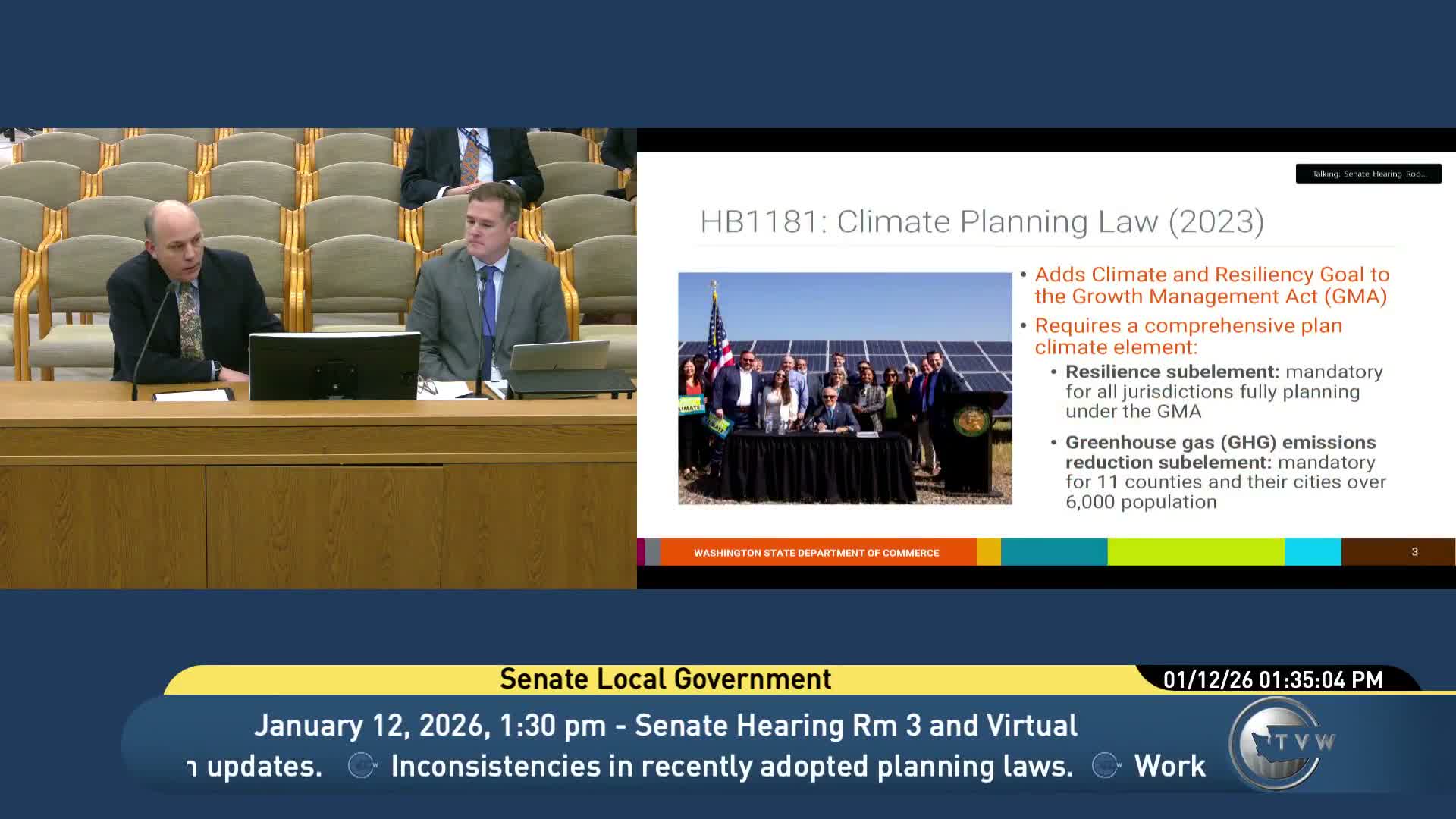
Department of Commerce officials told the Washington State Senate Local Government Committee that the climate planning law passed in 2023 requires two subelements in local plans: a resilience subelement that applies to all jurisdictions and a greenhouse gas–reduction subelement that applies mainly to larger metropolitan counties. Dave Anderson, senior managing director for growth management at Commerce, said the resilience element must address natural hazards, identify and protect natural areas, and use scientifically credible climate projections to guide policy and project choices.
Michael Burnham, the climate policy program manager and principal author of Commerce’s resiliency guidance, said jurisdictions should use the University of Washington Climate Impacts Group’s Resilient Washington tool as the primary source for projecting sea‑level rise, inundation, and many local climate risks, and noted that the tool includes riverine and storm‑event flooding projections in addition to sea‑level projections. Burnham also pointed committee members to complementary FEMA tools for hazard planning.
The department described a five‑step implementation path: explore locally relevant climate impacts; identify vulnerabilities and local assets to protect; review existing plans and policies; pursue implementation pathways and measurable policy actions; and integrate those actions with hazard mitigation planning (including FEMA hazard mitigation processes where appropriate). Anderson emphasized that jurisdictions may adopt measures from Commerce’s Climate Policy Explorer — an online catalog of policies Commerce found to have empirical support for emissions reductions and resilience — or compile their own evidence for alternative measures.
On funding, Anderson said $24,000,000 was appropriated for climate planning grants from the Climate Commitment Act, with roughly $19,000,000 already drawn and about $5,000,000 remaining. Commerce foresees using reappropriations across fiscal years to accommodate jurisdictions that are late or need additional time; the department flagged 2029 as the major compliance milestone for the remaining Puget Sound jurisdictions.
Committee members asked whether Commerce relies on FEMA flood maps; Burnham replied that Commerce is not using FEMA maps as the primary source for the Climate Policy Explorer and resiliency mapping, and that the UW tool (Resilient Washington) is the first recommended dataset for projected sea‑level and related inundation impacts. Anderson and Burnham said the guidance also encourages jurisdictions to work with local stakeholders to identify assets that matter most to the community and to prioritize actions for overburdened and vulnerable populations, citing the State Department of Health’s environmental health disparities map as one screening resource.
The Commerce presenters said jurisdictions may rely on the department’s catalog of empirically supported measures to meet statutory requirements for measures with demonstrated ability to reduce greenhouse‑gas emissions, and that the statute also allows jurisdictions to produce their own empirical evidence for noncatalog measures. The presenters closed by encouraging early coordination and offering technical assistance as jurisdictions move into phased implementation.