OSPI presents pilot results showing declines in restraint and isolation; urges clearer definition and limited prohibitions
Loading...
Summary
OSPI told the House Education Committee that pilot and demonstration sites reporting grants and professional development saw substantial reductions in restraint and isolation; OSPI recommended banning certain dangerous practices and clarifying the statutory standard for "imminent likelihood of serious harm."
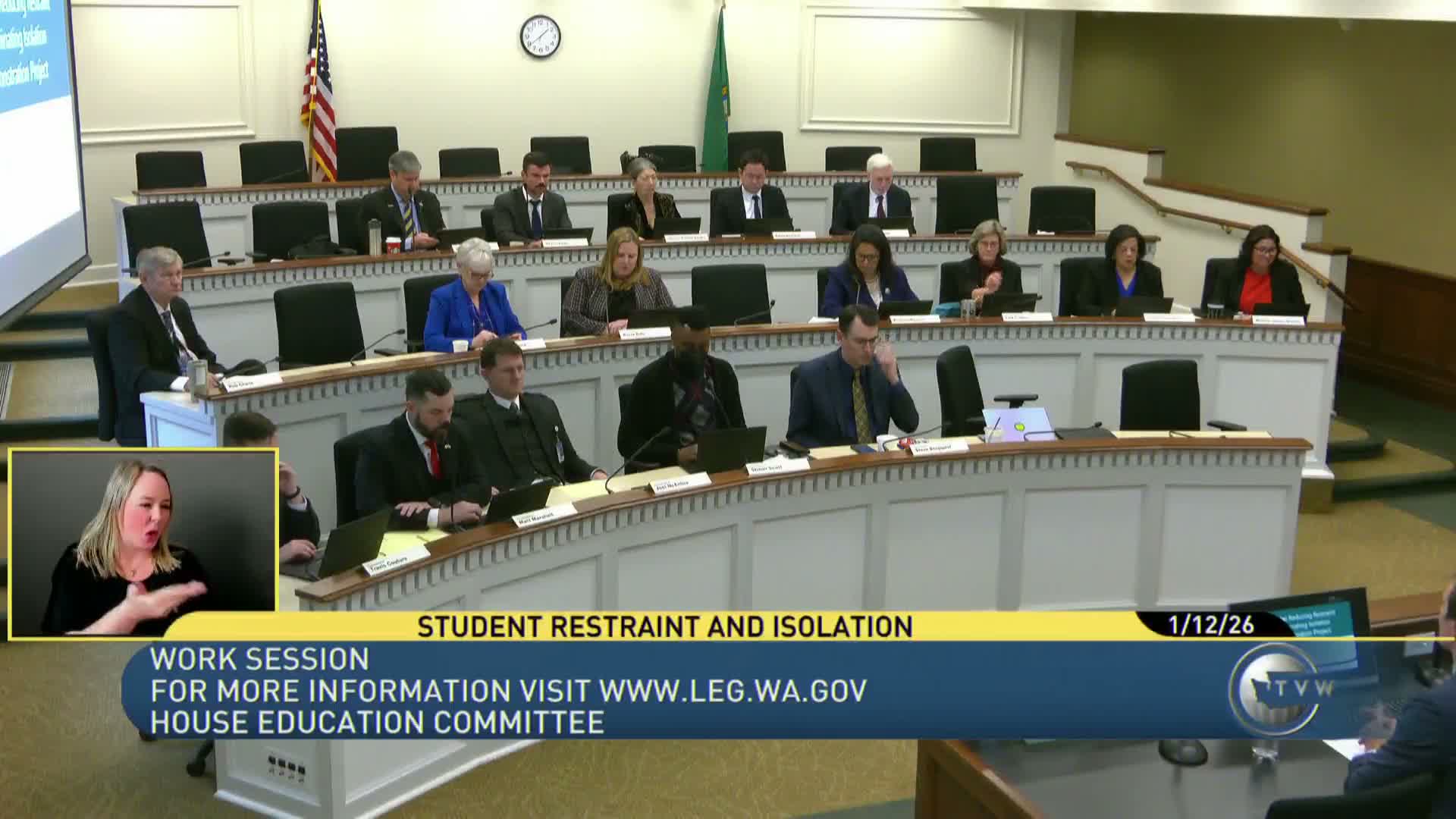
The House Education Committee heard an update from the Office of Superintendent of Public Instruction on its "reducing restraint and eliminating isolation" demonstration project, which OSPI officials say has coincided with declines in reported restraint and isolation at participating districts.
Misha Chernisky, acting director of policy and legislative affairs at OSPI, told the committee the initiative is in its third year and that the state provided $3,100,000 in fiscal 2025 and budgeted $2,000,000 each for fiscal 2026 and 2027 to continue demonstration and pilot work. "The demonstration projects must build school‑level and district‑level systems that eliminate student isolation and reduce restraint use," he said.
OSPI identified three tiers of supports — intensive (demonstration/pilot sites), targeted (pilot and other interested districts), and universal (statewide supports) — and said each pilot/demonstration site receives roughly $40,000 for substitutes, staff time, materials to convert isolation rooms and data‑systems improvements. "Sixty‑eight percent of the project sites reported a reduction in restraint and isolation compared to the prior year," Chernisky said; he also cited a Kelso School District example that saw a 61% reduction after data review and targeted PD.
Committee members pressed OSPI on measurement and scope. Representative Root asked whether incidents in authorized entities and nonpublic agencies were included in the pilot graphs; Chernisky said the slides presented were limited to project sites and that some statewide slides with different denominators exist. When asked whether the data count separate incidents or unique students, he said incidents are counted separately. He agreed to follow up with more disaggregated numbers by grade level, restraint type and demographic subgroups.
OSPI described related work: a technical assistance "Positive Behavioral Supports" manual (version 2 planned to be more user‑friendly), a behavioral tracking tool and a preselected menu of 10 professional development vendors that districts can use at no direct vendor cost. Chernisky said immediate policy recommendations include extending prohibitions on prone and supine restraints, wall restraints and noxious sprays and clarifying what statutory "imminent likelihood of serious harm" means in practice.
Representatives from three pilot and demonstration districts — Auburn, Bainbridge Island and Concrete — described local implementation. Patrick Mullick of Auburn said better reporting and removal of an isolation room were among changes that accompanied a roughly 40% decline in restraint/isolation from last year to this year, and stressed a mix of BCBA supports, tiered PD (including a 2‑day certification and a 4‑hour asynchronous option) and inclusion practices. "When you don't put students with very high behavioral needs in concentrated spaces, your likelihood for needing such interventions goes down significantly," he said. Annalisa Sanchez of Bainbridge said her district eliminated isolation rooms and reported zero isolations while expanding training to transportation and food‑service staff; Concrete superintendent Carrie Crickmore said a part‑time BCBA and in‑district training have reduced incidents but cautioned that small absolute counts make percentages volatile.
Next steps: OSPI committed to provide the committee with more disaggregated pilot‑site data and the committee moved into a public hearing on the substitute bill later in the session.