Get Full Government Meeting Transcripts, Videos, & Alerts Forever!
Get email alerts on the Interrogation topic
No spam. Unsubscribe anytime.
Experts urge Washington to adopt 'science-based' interview training to reduce false confessions
Summary
Two remote experts told the Community Safety Committee that report-based, research-validated interview techniques can reduce false confessions, increase courtroom reliability and lower civil liability; they urged careful curriculum review and safeguards for vulnerable interviewees.
Chair Goodman opened the committee’s public work session by asking two remote experts to describe law‑enforcement experience behind emerging, research‑backed interviewing methods.
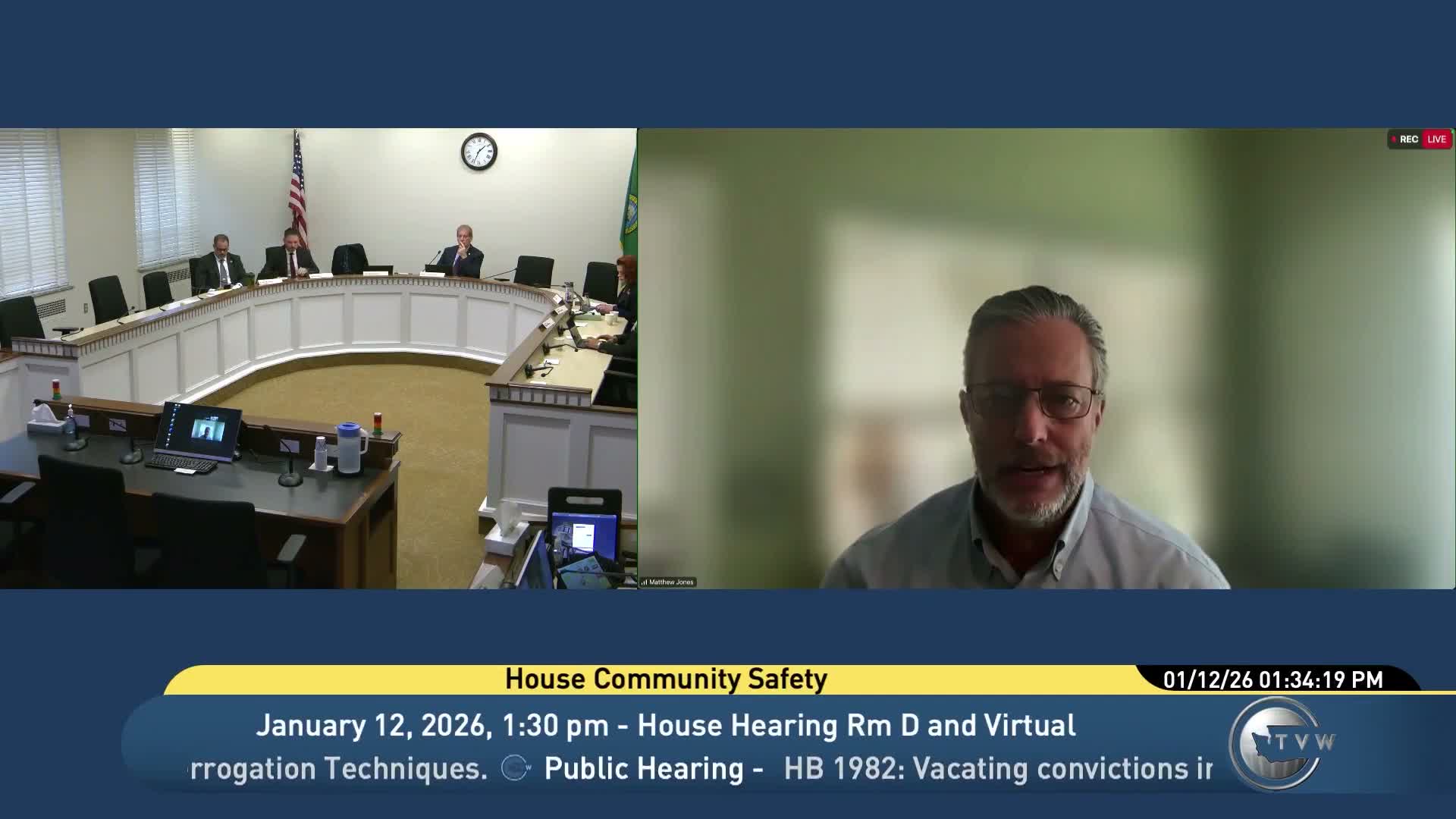
Matthew Jones, a retired homicide detective and president of EVOCAVI, told the Community Safety Committee that jurisdictions are seeing more conviction‑review units and wrongful‑conviction litigation and that states should consider replacing confrontational, confession‑driven tactics with empirically validated techniques. "We are seeing a tremendous increase in the number of wrongful convictions cropping up every single week," Jones said, and offered to provide the committee with key research resources and a 27‑minute explanatory video.
Jones outlined four criteria to evaluate curricula: whether a method preserves information reliability (does it contaminate interviewee responses), whether it accounts for vulnerable interviewees (juveniles, people with mental‑health or intellectual disabilities, and even truthful people), whether it is free of coercion, and whether it enhances investigator credibility in court.
Mark Fallon, former assistant director at the Federal Law Enforcement Training Center and founder of Club Fed LLC, framed science‑based interviewing as an operational imperative. Drawing on interagency research efforts dating to 2009, Fallon said peer‑reviewed studies are being operationalized nationally and internationally and argued that "confessions are not a reliable proxy for truth" when psychological coercion, deceptive ploys or overly lengthy interviews are used. Fallon told lawmakers that report‑based methods such as the PEACE framework emphasize open‑ended questioning, corroboration and reduced cognitive contamination.
During questioning, members raised victim‑sensitivity concerns. A committee member asked whether a victim could be retraumatized by viewing a recorded interview in which the interviewer appeared overly sympathetic. Jones acknowledged the risk and said the minimization themes sometimes used in difficult sexual‑assault investigations are problematic and not taught in his science‑based training.
The presenters offered to share research and to bring in the authors of key studies. Committee members requested curated materials and examples the staff can circulate to help the committee evaluate curricula before any statewide adoption decisions.
The work session concluded with the chair thanking both experts and transitioning to the public bill hearings.