Get Full Government Meeting Transcripts, Videos, & Alerts Forever!
Get email alerts on the Drug Takeback Fees topic
No spam. Unsubscribe anytime.
JLARC: drug takeback fee cap and operator‑linked formula limit DOH oversight cost recovery; recommends fee redesign
Summary
JLARC's expedited review found Department of Health fee revenue did not cover oversight costs in FY2022–2025 and recommended removing the fee cap and the fee's linkage to program operator expenditures so DOH can recover program oversight costs more reliably.
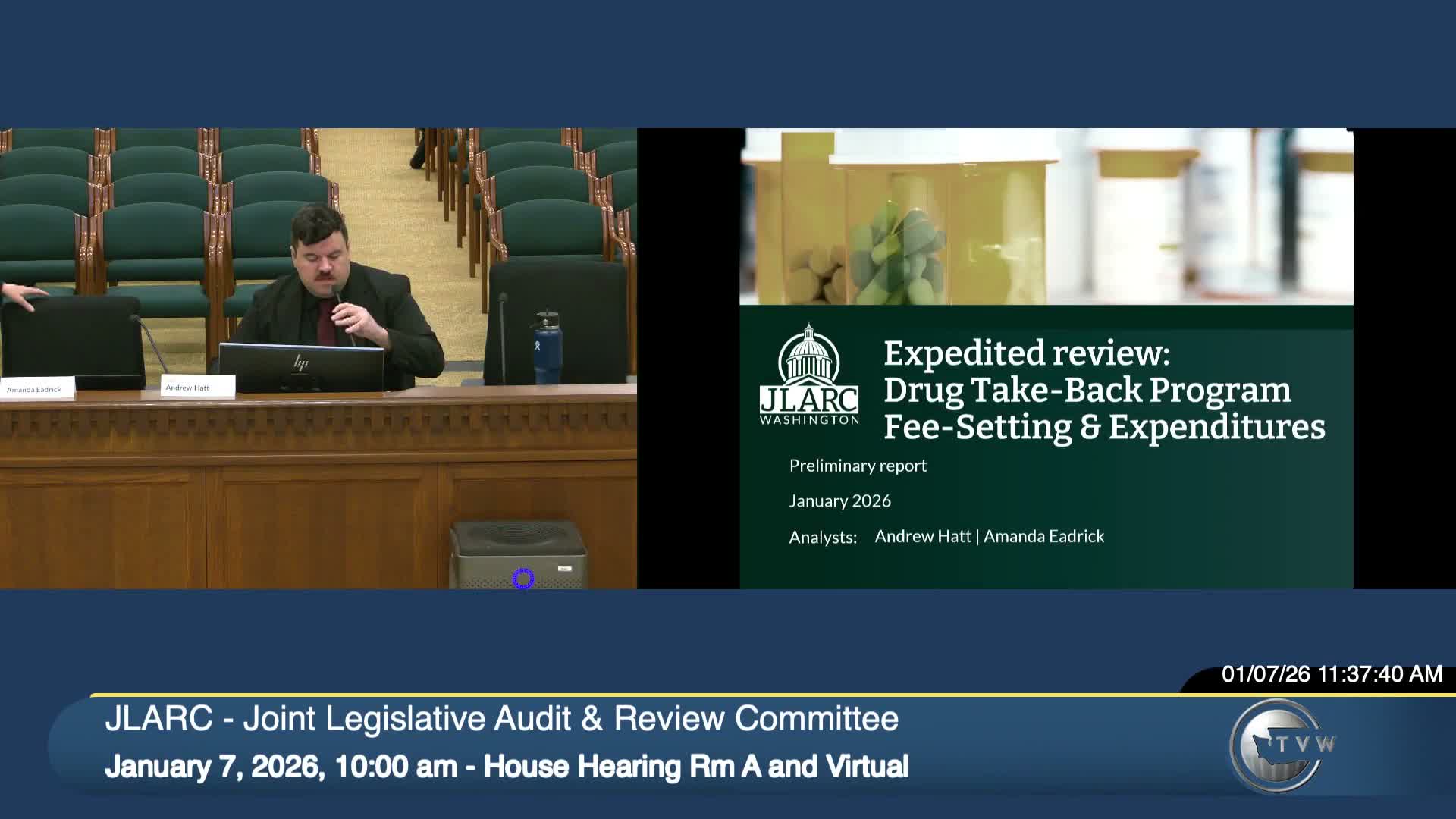
A JLARC expedited preliminary report presented Jan. 7 found that the current statutory fee design for Washington’s drug takeback program limits the Department of Health’s ability to recover oversight costs and reduces transparency for stakeholders.
"The legislative auditor recommends that the legislature should amend the fee design to meet best practices and enable full cost recovery by DOH," JLARC staff member Amanda Edrick told the committee. JLARC reported that DOH’s oversight of the program cost between about $321,000 and $527,000 annually from fiscal years 2022 through 2025, while fee revenue tracked to operator expenditures and, since 2022, did not cover those oversight expenses.
Under statute, annual fees for the program are equal for both program operators and historically were capped at 10% of operator expenditures calculated using the lower-spending operator; in 2025 the legislature amended the statute to allow fee caps to be set using the higher-spending operator instead. JLARC said tying fees to operator spending and retaining a cap creates unstable revenue for DOH because operator expenditures have declined (JLARC staff reported a 42% decline in largest operator expenditures since 2021) and may incentivize operators to lower spending to reduce fees.
JLARC staff recommended two steps: DOH should publicly report its oversight expenditures and activities to increase transparency, and the legislature should remove the fee cap and its association with program operator expenditures so DOH can recover oversight costs consistent with best practices for regulatory fee design.
DOH representatives (Carly Bartz Overman and Shawna Fox) told the committee they welcomed the expedited review and clarified how overhead costs were charged under DOH’s Office of Health Professions. DOH said moving the program out of that office will change how overhead shows up in accounting but not materially lower total program administration costs. DOH officials also indicated they would consider statutory changes to ensure sustainable cost recovery while noting DOH spending remains subject to appropriation.
The committee heard that the drug takeback program was created by statute in 2018, began operations statewide in 2020, reports roughly 600 collection kiosks and that program operators reported collecting about 220,000 pounds of medication in 2024. To cover a shortfall after one‑time start‑up fees ran out, the legislature appropriated $268,000 to DOH in 2025.
Next steps: JLARC will present a proposed final expedited report in April that includes DOH’s formal response and will begin a full sunset review of the program, with a preliminary sunset report expected in September 2026.