Get AI Briefings, Transcripts & Alerts on Local & National Government Meetings — Forever.
JLARC preliminary report finds about 41% of drivers install required ignition interlock devices; recommends stronger coordination and clearer financial aid
Loading...
Summary
A JLARC preliminary report estimates a 41% installation rate for ignition interlock devices among required drivers, finds half earn under $28,000 annually and that financial assistance reaches a small share of drivers. JLARC urged Department of Licensing and Washington State Patrol to develop a coordinated strategy and report back.
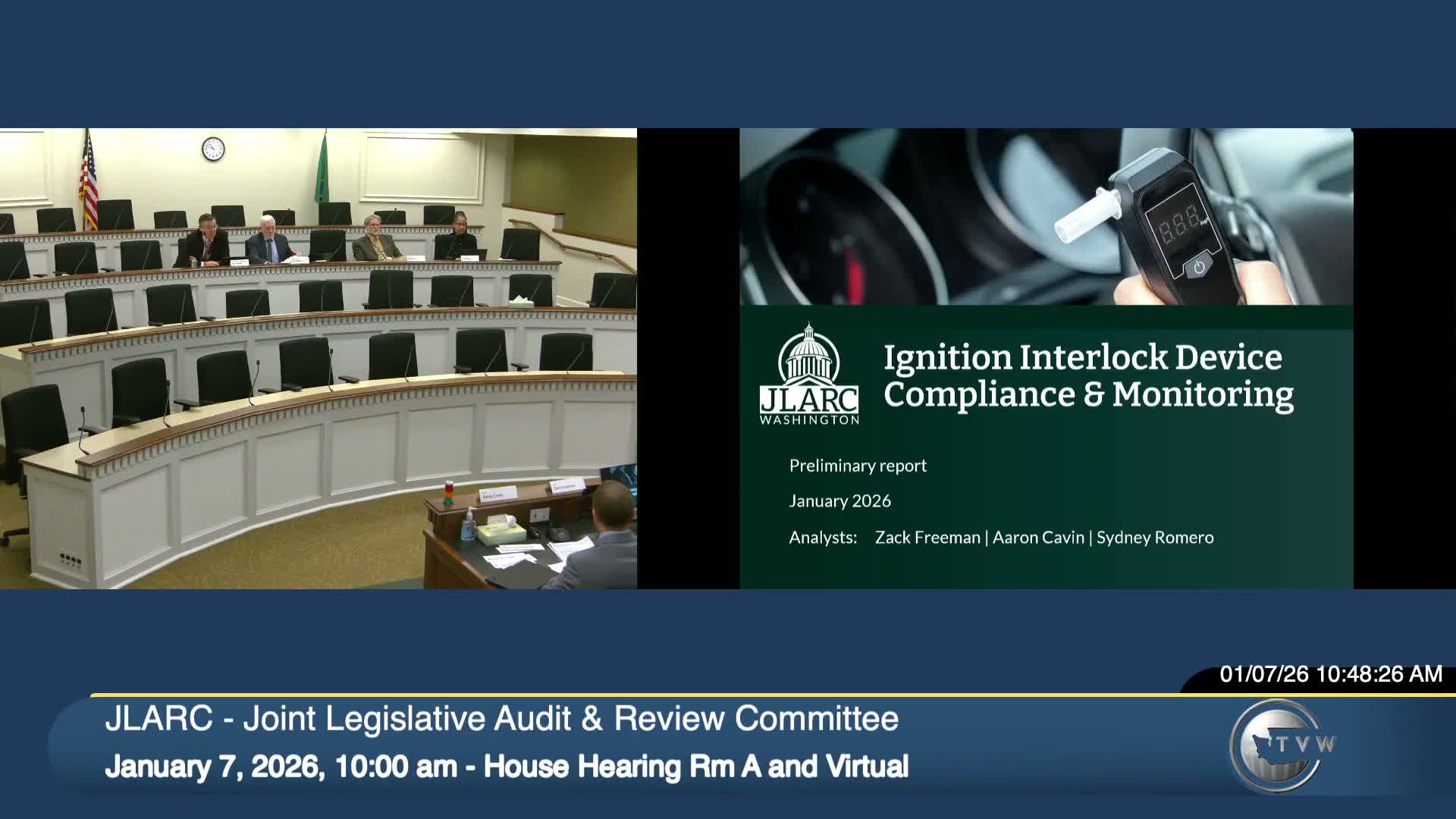
The Joint Legislative Audit and Review Committee released a preliminary report Jan. 7 estimating that 41% of drivers required to have ignition interlock devices (IIDs) have installed them, and that installation rates rise with income.
"We have calculated that 41 percent of drivers with an ignition interlock requirement have installed an ignition interlock device," JLARC staff member Aaron Cavan said during the committee presentation. JLARC staff told the committee their dataset covered about 66,000 device restrictions from January 2018 through June 2025 and used an ~8,000-person sample matched to employment-security income records for subgroup analysis.
The report found that half of drivers with IID requirements earn less than $28,000 per year and that installation rates ranged from about 30% for drivers earning $0–$10,000 to about 74% for those earning more than $100,000. "The installation rate increases with driver income," Cavan said.
JLARC staff also analyzed other factors. A regression that included income, requirement length and travel time to the nearest service center showed income had the largest effect; travel time had little measurable impact (average travel time about 10 minutes in urban areas and 38 minutes in rural areas). Staff noted other unmeasured influences — such as whether a person chooses not to drive, access to a vehicle or license status — could also affect installation decisions.
The committee heard staff estimates of typical costs to comply: about $2,700 per year to lease, install and calibrate a device, with total compliance costs (including high-risk insurance and fines) potentially reaching about $5,000 per year for some drivers. JLARC found the Department of Licensing’s financial assistance program reimburses about half of typical device costs by statute but that the average monthly reimbursement per eligible driver is roughly $1,000. JLARC staff said only about 11% of drivers with devices installed received financial assistance in a given month, and that outreach and program design limitations suppress take‑up.
JLARC’s conclusions emphasized program management rather than new statutory penalties: staff recommended the Department of Licensing and the Washington State Patrol develop a formal agreement to jointly administer IID responsibilities and craft a coordinated strategy to increase installation rates and report back to the legislature. The report described two pilots that informed the recommendations — a Snohomish County outreach pilot by the State Patrol and a Yakima County probation/relicensing pilot — and said agencies should incorporate lessons from those efforts when developing a plan.
Washington State Patrol Lieutenant Jeff Leonard, who spoke during the hearing, confirmed enforcement and outreach work has relied on grant-funded efforts and said the pilot in Snohomish would expand to Yakima. "We started our talks back up with Department of Licensing," Leonard said, noting recent joint meetings and a follow-up meeting scheduled after the hearing.
Department of Licensing Deputy Assistant Director Skyler Ryu and Legislative and Policy Director Molly Voorhis acknowledged the report’s findings and said Licensing has historically seen its role as record‑keeping and reimbursement processing but is open to pursuing outreach and other program changes. Licensing officials cautioned that other costs tied to DUI cases — treatment, high‑risk insurance and multiple suspensions — also pose barriers to compliance and that full reimbursement alone may not solve the installation gap.
Next steps: JLARC will finalize the report and staff asked the agencies to return with a management plan. The committee indicated it will include agency responses in the final report and likely request follow-up to track implementation of a coordinated strategy.