Get Full Government Meeting Transcripts, Videos, & Alerts Forever!
Get email alerts on the Wildfire Resilience topic
No spam. Unsubscribe anytime.
State forestry and fire officials map landscape resiliency strategy, voluntary defensible‑space code and post‑fire programs
Summary
Officials from the Oregon Department of Forestry and the State Fire Marshal described landscape‑scale restoration and fire‑adapted community programs tied to SB 762 and HB 3940, highlighted grant programs and homeowner retrofit and wildfire loss programs in development, and emphasized the need for joined‑up mitigation and community outreach.
Kyle Williams (Oregon Department of Forestry), State Fire Marshal Mariana Ruiz Temple and Josh Bernard (ODF) told the committee that suppression alone will not solve Oregon’s wildfire challenge and outlined a multi‑pronged mitigation and community strategy.
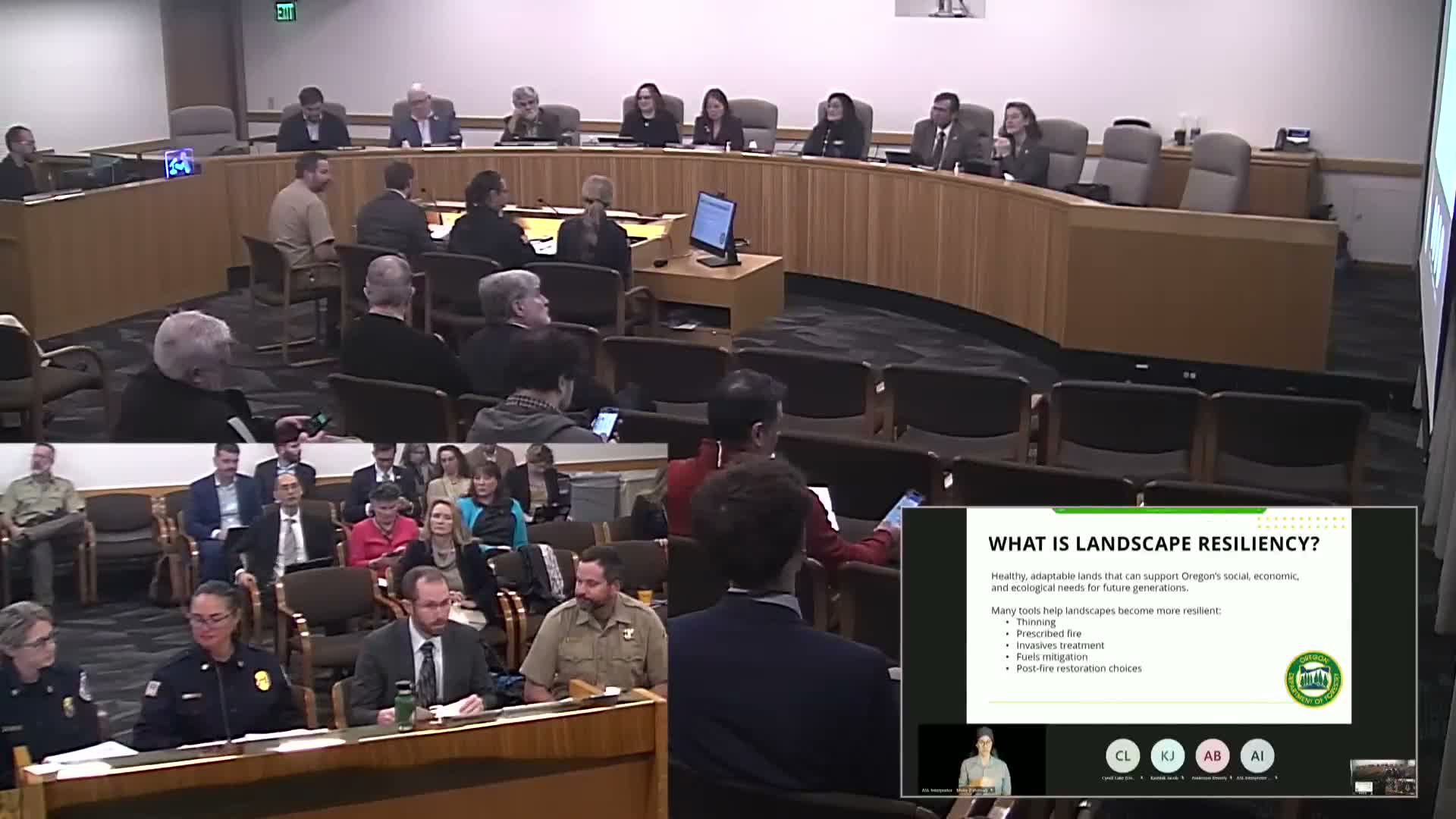
ODF leads a 20‑year landscape resiliency strategy under Senate Bill 762 to address about 13 million high‑risk acres through treatments such as thinning, prescribed burning and invasive species removal and by coordinating federal, state and local investments. Bernard described examples of federal/state partnerships (Good Neighbor Authority, Joint Chiefs funding) and local projects where grants and treatments reduced fire intensity and preserved structures.
Ruiz Temple highlighted investments from House Bill 3940 and the development of a wildfire loss program and an individual retrofit program to help homeowners harden structures; she said a voluntary statewide defensible‑space code is being finalized and expected to go to advisory boards for rulemaking with local adoption to follow. Claire McGrew described a live burn demonstration that contrasted a wildfire‑prepared home with a vulnerable structure and detailed partnerships with the Insurance Institute for Business and Home Safety to scale home hardening and community preparedness.
Officials emphasized cross‑agency coordination, community outreach, and continuing to invest in both landscape treatments and fire‑adapted communities. Committee members asked about voluntary versus mandatory approaches and incentives tied to insurance; officials said the code is voluntary and program design will consider vulnerable populations and funding constraints.