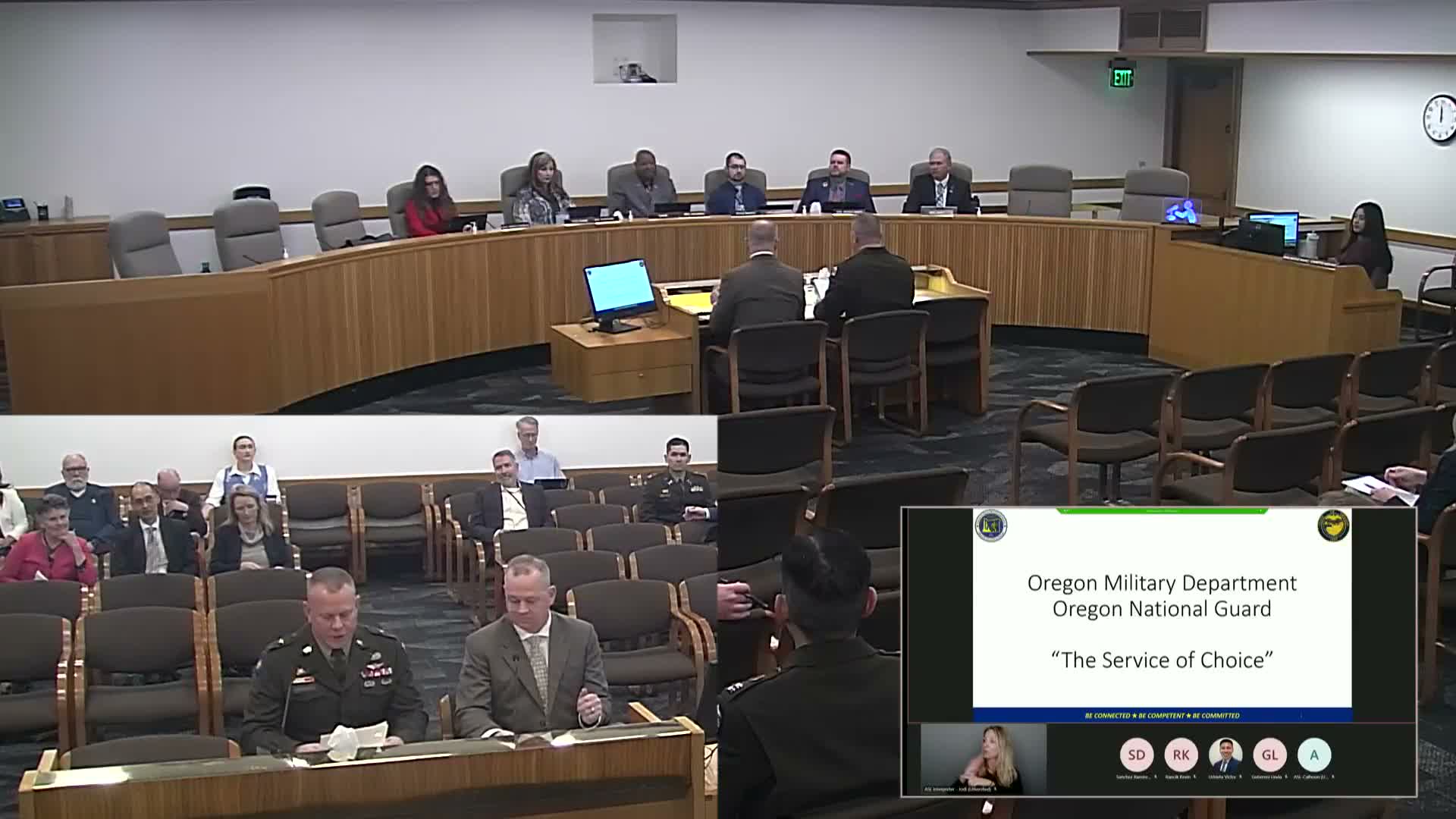
Oregon Adjutant General explains lawful and unlawful orders, outlines deployments and retention efforts
Loading...
Summary
Brig. Gen. Groenewald briefed the committee on Guard deployments and personnel programs and explained legal standards for unlawful orders under the Uniform Code of Military Justice, saying willful disobedience violates Article 92 and that a service member bears the burden to prove an order unlawful.
Brigadier General Groenewald, Oregon’s Adjutant General, told the committee Jan. 14 that Oregon Guard members are deployed globally and that the department is taking active steps on recruiting and retention while reminding members of legal responsibilities around orders.
Groenewald reported Guard deployments spanning multiple theaters and missions: Oregon Army National Guard rotations to the Horn of Africa, deployments on the southern U.S. border, personnel in Iraq and Germany, and Air National Guard airmen deployed to the Middle East, Pacific and Kosovo regions. He highlighted personnel initiatives — an enlistment enhancement program and a state retention bonus — citing improvements in recruits and reenlistments tied to those incentives.
On the subject of following orders, Groenewald explained the legal framework: orders are presumed lawful but an order is unlawful if it contravenes the Constitution, U.S. law or the law of war. He referenced Article 92 of the Uniform Code of Military Justice, saying, “Willfully disobeying an order is a violation of article 92 of the Uniform Code of Military Justice,” and added that if an order is patently illegal — i.e., would cause a person of ordinary understanding to see it results in a crime — it must be refused. He noted that when an order’s lawfulness is unclear, the judiciary resolves disputes and the burden of showing an order was unlawful rests with the service member who disobeyed it.
The committee thanked the adjutant general for the briefing; there were no formal actions attached to this informational presentation.