Get Full Government Meeting Transcripts, Videos, & Alerts Forever!
Get email alerts on the Criminal Justice topic
No spam. Unsubscribe anytime.
Statewide deflection pilots show early connections to services; funding decisions leave some pilots at risk
Summary
The Criminal Justice Commission and county programs described a rapid statewide rollout of behavioral health deflection programs, early engagement successes in Washington and Marion counties, and concerns about future funding—Marion County's Restore Court pilot will be shuttered because next-biennium allocations are insufficient.
The Oregon Criminal Justice Commission and county partners told the House Interim Committee on Behavioral Health that deflection programs—intended to connect people away from the criminal justice system into treatment—are now operating in many counties with varied designs and early measures of success.
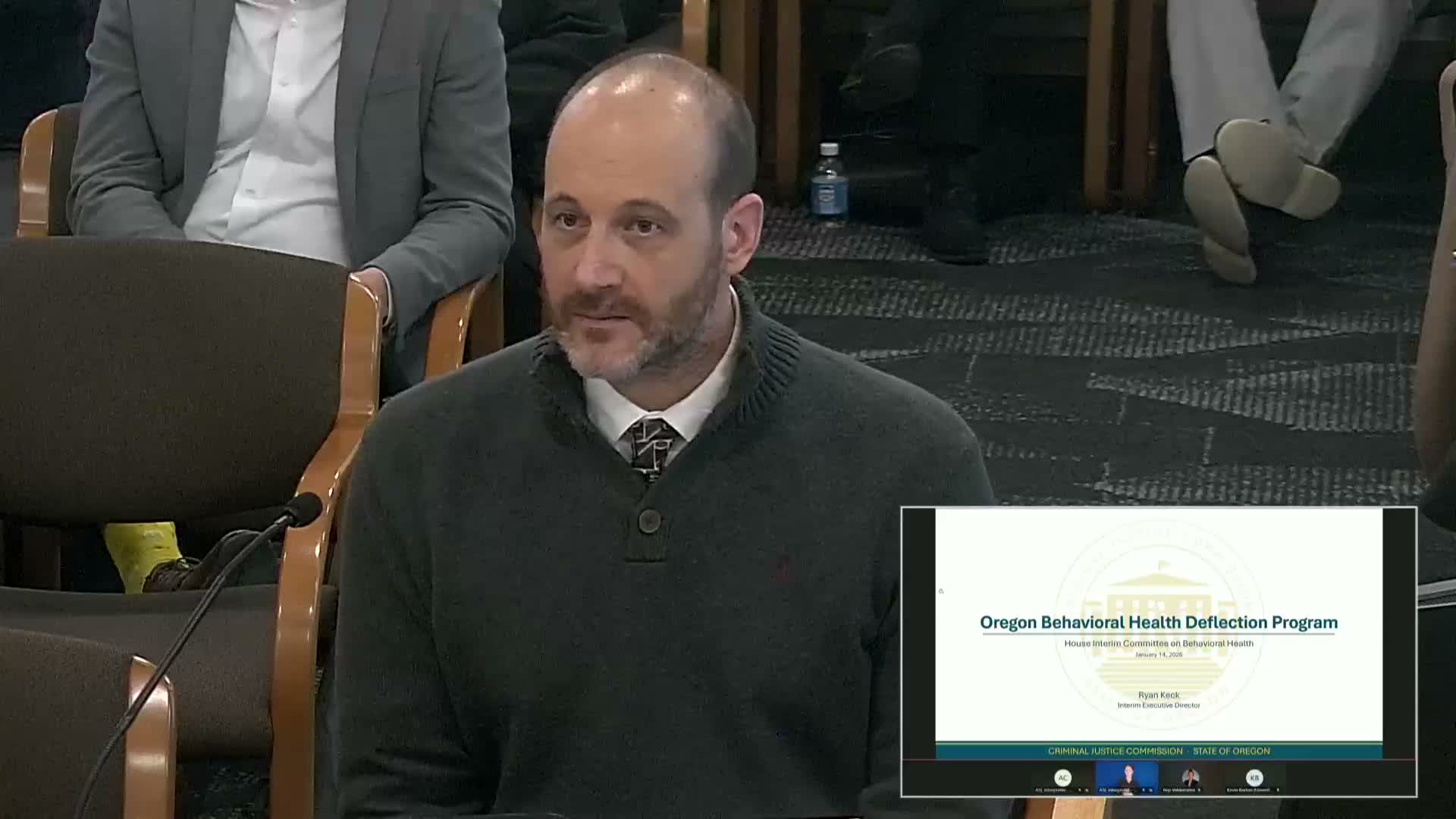
Ryan Keck, interim director of the Criminal Justice Commission, said the state stood up deflection programs after House Bill 4,002 and produced a best-practices report with OHSU and PSU. He described a rapid, staged rollout with a pilot phase focused on defining who deflection reaches and how success should be measured.
Washington County’s community-based, high-contact model reported over 400 referrals in the first year and an estimated connection rate of about 70%, with peer-delivered case management and a six-month engagement model. DA Kevin Barton described eligibility expansion over time to include many PCS charges and shorter citation windows (seven days) to reduce loss-to-follow-up; Eva Hawes (Washington County) said 37 successful completions had occurred as of Jan. 8 and highlighted housing and overdose statistics among participants.
Marion County—an established LEAD (Law Enforcement Assisted Diversion) operator—outlined a decade of programming and a Restore Court pilot that combines in-court conditional discharge, treatment, restitution via work crews and potential expungement. Marion County reported early Restore Court outcomes (46 referrals, 11 completed substance use treatment) but told the committee that their CJC allocation for the next biennium is insufficient and they have “effectively shuttered its doors” for future Restore Court enrollment while committing to complete services for current participants.
Committee members raised questions about measuring performance, rewarding existing successful programs versus funding new ones, and ensuring continued burn-program funding that supports rapid access. CJC said future grant distribution will include competitive elements and that standardized outcome definitions and reporting are a priority in the piloting stage.