ODE advisory proposes 30 hours of inclusive preschool, higher early-special-education service levels
Loading...
Summary
At a Jan. 14 Senate Education Committee informational session, Oregon Department of Education staff said an advisory group drafting recommendations under House Bill 2,682 proposes 30 hours per week of inclusive preschool and increased early childhood special education services; cost estimates and final recommendations are due by Sept. 15, 2026.
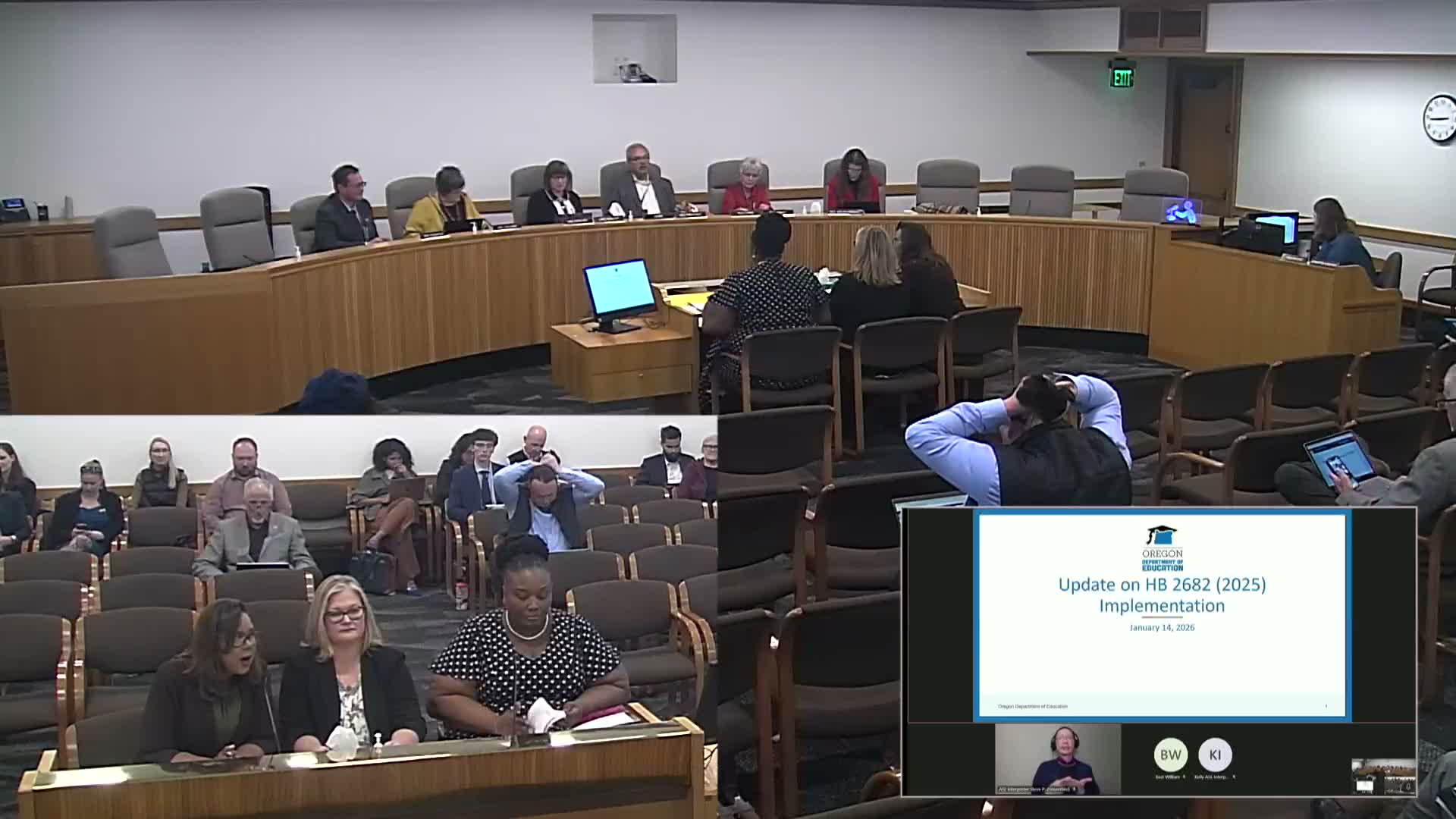
The Oregon Senate Education Committee received an informational update on House Bill 2,682 on Jan. 14, when Department of Education officials described draft recommendations from an advisory group to modernize the state's adequate service levels for early intervention and early childhood special education.
Kara Williams, director of inclusive services at the Oregon Department of Education, told the committee the bill directs the department to convene an advisory committee that includes families, providers and system experts to develop recommendations and submit final recommendations to the legislature by Sept. 15, 2026. "Adequate service levels define what children and families need," Williams said, calling the levels a "defensible, reliable floor" rather than a prescription for individualized services.
The advisory's draft recommendations include providing access to 30 hours per week of inclusive preschool in community settings for children with low, moderate and high needs. Williams said the 30-hour figure "comes from the dosage of preschool that children who do not experience disabilities have access to across Oregon in state funded programs." The advisory also proposed increasing early childhood special education (ECSE) services: for children with low needs, raising services from at least one per week to at least two per week; for moderate needs, increasing ECSE to at least three sessions per week while keeping monthly family teaching activities; and for high needs, increasing related services to at least four per week while maintaining one family teaching activity per month.
Williams explained how the adequate service levels feed into a separate cost model used to estimate system-level funding. She said the current service-level calculation for the 2027 biennium was shown as $408,600,000 and the advisory committee's adequate-service-level estimate was shown as $432,800,000, a difference of roughly $24,200,000; she cautioned that the advisory had not yet completed its internal voting and that the committee had not yet produced a costed model. "The adequate service level cost model does include other cost drivers," Williams said, "but we have not costed that out. That is positioning to be a next recommendation for this group."
Senators used the Q&A to press on evidence, implementation and measurement. One senator asked whether the 30-hour recommendation is "set in stone;" Williams said the recommendations are not fixed and the advisory will continue deliberations. Committee members also questioned the research base for dosage, and Williams acknowledged a "scarcity of data related to dosage," saying the advisory has relied on guest speakers, curated state and national reports and members' lived experience to form draft recommendations.
Members raised staffing and enrollment concerns. Williams described the state's current enrollment measure as a rolling average taken April 1 (looking back a year) and agreed that a rolling average can understate peak caseloads later in the school year; she said committee members could consider adjustments to better account for enrollment spikes. On staffing ratios, Williams said ratios and staffing implications are expected to follow once service levels are finalized and that the advisory anticipates addressing necessary staffing or ratio changes in its recommendations.
Committee members asked for concrete examples of ECSE services; Williams suggested speech-language pathologist home visits, special-education consultation embedded in preschool classrooms and occupational therapy visits. She said presenters would include such examples in future materials to make the service recommendations clearer to audiences.
Next steps: the advisory is completing internal votes on draft recommendations and the Department of Education expects to return to the committee in February for further discussion. The advisory's final recommendations are due to the legislature by Sept. 15, 2026; cost modeling of any adopted adequate service levels would follow as a separate step.