Get Full Government Meeting Transcripts, Videos, & Alerts Forever!
Get email alerts on the Disaster Finance topic
No spam. Unsubscribe anytime.
Pew briefs committee: rising disaster costs, data gaps and three budget principles for states
Summary
The Pew Charitable Trusts told lawmakers disaster frequency and costs have risen sharply and recommended states measure total disaster spending, manage risks with proactive budgeting (state disaster accounts) and mitigate through sustained investments in resilience.
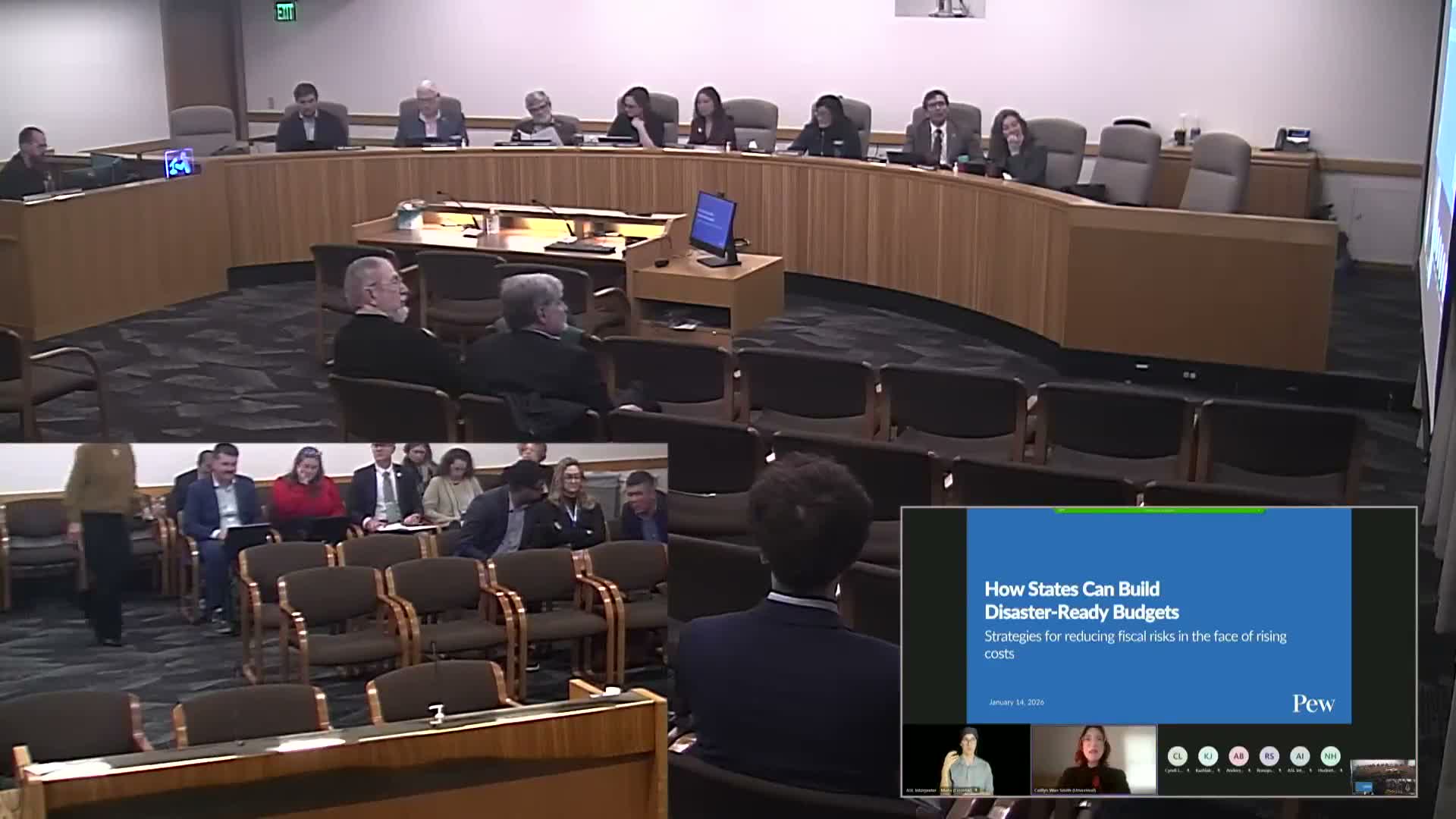
Caitlin Juan Smith of The Pew Charitable Trusts presented research to the committee showing that the frequency and cost of major weather and climate disasters have increased and that states face gaps in comprehensive disaster spending data and outdated budgeting approaches.
Pew’s analysis, the presenter said, shows major disasters costing society at least $1 billion each have become more frequent and that since 2010 such disasters have cost on average $116,000,000,000 per year compared with roughly $39,000,000,000 per year in previous decades. Pew identified three structural challenges for states: limited comprehensive disaster spending data across agencies and disaster phases; funding approaches that leave budgets vulnerable to shocks; and underinvestment in mitigation.
To address those problems Pew recommended states adopt three principles: measure (collect and publish comprehensive spending data), manage (use proactive budgeting tools such as state disaster accounts and clarify responsibilities) and mitigate (prioritize sustained funding for mitigation and resilience and maximize federal funding by building administrative capacity).
The briefing was informational; committee members discussed examples and implementation questions but took no formal action.