Get Full Government Meeting Transcripts, Videos, & Alerts Forever!
Get email alerts on the Behavioral Health Licensing topic
No spam. Unsubscribe anytime.
OHA outlines licensed behavioral health facilities and surge in outpatient applications
Summary
Oregon Health Authority officials told a Senate committee that OHA licenses a wide range of behavioral health programs and that outpatient provider applications surged late in 2024; OHA licenses capacity but does not currently report occupied bed counts and offered to follow up with utilization data.
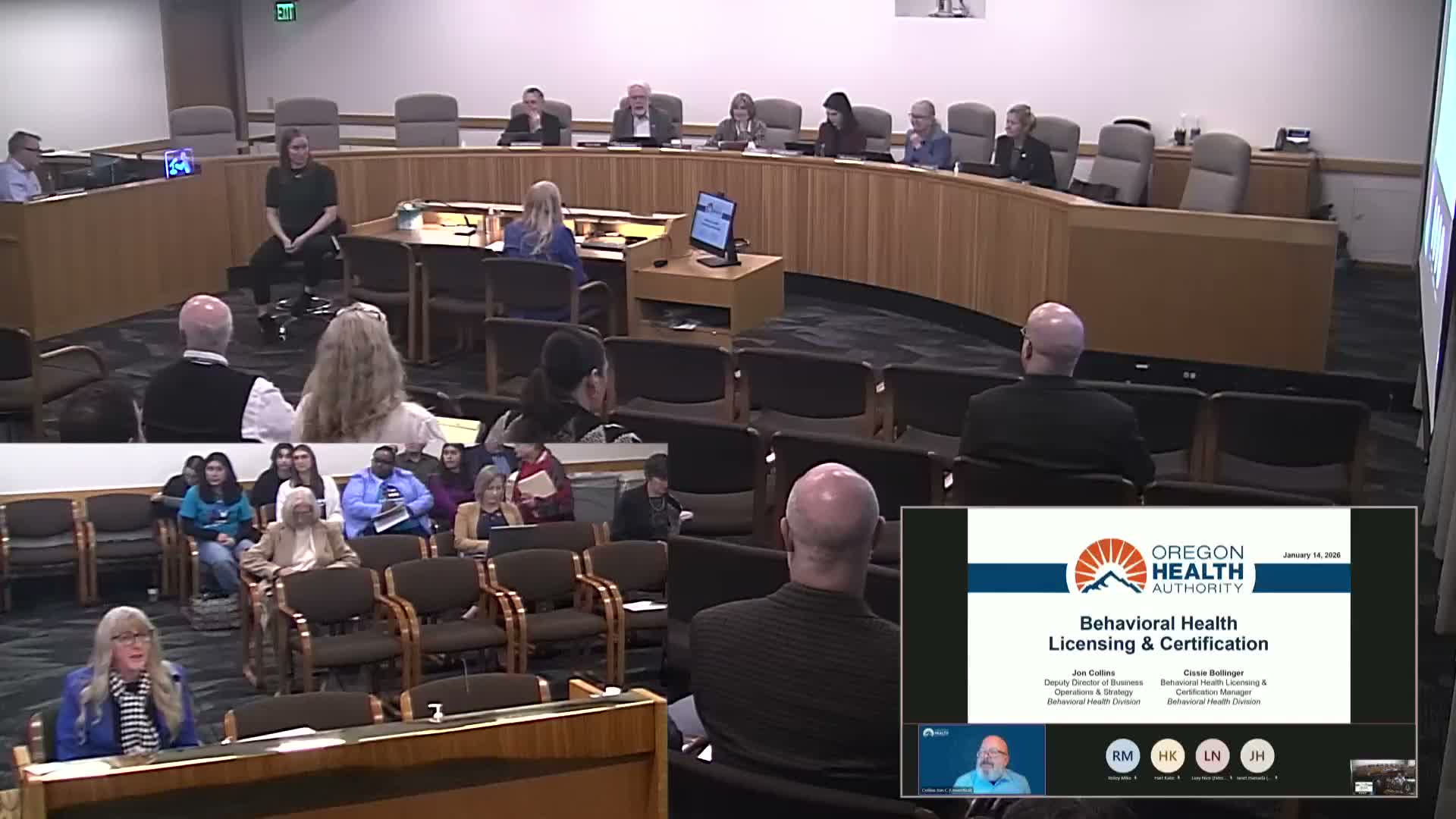
The Oregon Health Authority told the Senate Interim Committee on Early Childhood and Behavioral Health that the agency licenses dozens of behavioral health program types and is seeing an unprecedented increase in outpatient certification applications.
Cissy Bollinger, one of two managers of OHA’s Licensing and Certification Unit, said the division oversees roughly 37 program types under 20 parts of the Oregon Administrative Rules and licenses an estimated 270 residential homes and facilities with a combined licensed capacity of about 2,007 individuals as of year‑end 2024. Bollinger said secure residential treatment facilities are categorized at Level 1 or 2, with Level 1 allowing seclusion, restraint and compulsory medication under civil commitment orders and additional oversight layers.
Bollinger told the committee that the unit reports licensed capacity, not utilization: “What we do in licensing and certification is we identify the licensed capacity, not the utilized capacity,” she said, and offered to provide follow‑up information about utilization and staffed capacity. Committee members pressed for the distinction between physical beds and staffed capacity, saying that use and staffing are different questions for policy and funding decisions.
Bollinger also laid out that outpatient Certificates of Approval (COA) are required when programs employ non‑licensed staff (interns, QMHPs/QMHAs, peer specialists). She said outpatient COAs account for the bulk of recent activity and reported what she described as a dramatic recent increase in applications: “We’ve had a 933% growth in new provider outpatient applications last quarter in 2024,” and she gave counts of pending work — for example, roughly 110 new provider applications pending review and about 199 providers who have attended orientation and are pending application submission.
John Collins, deputy director at OHA’s Behavioral Health Division, confirmed the licensing unit will work with other parts of state government and can produce additional utilization data on request. The presentation also clarified that some licensed individuals (clinical social workers, professional counselors, marriage and family therapists and psychologists) enroll in Medicaid as licensed individuals without requiring a COA, and that OHA does not certify sober‑living homes or facilities already overseen by other state agencies.
The committee did not take formal action but asked OHA to return with more detailed utilization and staffing data to distinguish empty licensed beds from staffed, available capacity.