Get Full Government Meeting Transcripts, Videos, & Alerts Forever!
Get email alerts on the Ida Tax Credit topic
No spam. Unsubscribe anytime.
IDA tax credit: LRO and providers warn limited cap curbs program reach; donations increasingly stock-based
Summary
LRO staff and IDA program leaders told the committee the IDA tax credit (now 90% of donations, nonrefundable) has an annual cap raised to $7.7M in 2025 and $8.0M in 2026; program managers said the capped funding forces reduced match amounts and limits participants served statewide.
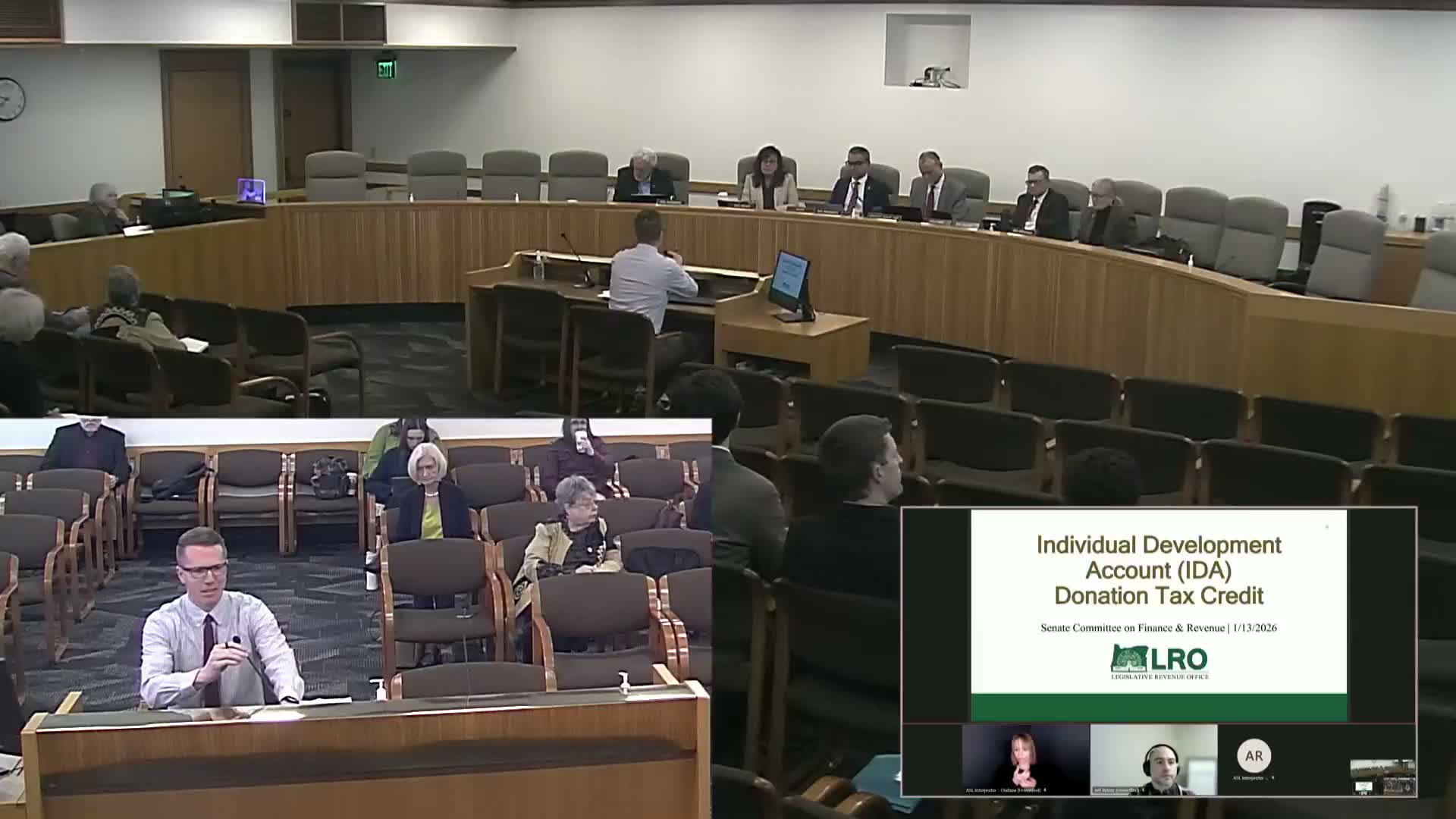
The committee heard a two-part briefing on the Individual Development Account (IDA) tax credit and the on-the-ground program that uses those funds.
Kyle Easton of the Legislative Revenue Office summarized the tax-credit mechanics: the credit equals 90% of the donated amount, is nonrefundable but may be carried forward up to three years, and had its annual cap increased to $7.7 million for 2025 and to $8.0 million in 2026. Easton said the credit is predominantly claimed by higher-income taxpayers and that donations increasingly come as gifted stock or other capital-gains property, which can be advantageous to donors and has trended up since the 2018 federal tax changes.
Luke Bonham, IDA program manager at Neighborhood Partnerships, said the IDA program operates statewide through a network of more than 60 community-based organizations and partners with the Department of Revenue and Oregon Housing and Community Services to distribute funds. He described IDAs as match-savings accounts for lower-income participants, combined with coaching and financial education; historically the program served more accounts when the cap and donation behavior produced greater match dollars.
Jeff Belzer, asset-building manager at Neighbor Impact in Central Oregon, described local consequences of the constrained funding environment: Neighbor Impact serves Deschutes, Jefferson and Crook counties and the Confederated Tribes of Warm Springs. He said reduced funds force the nonprofit to lower matching amounts for many applicants (about half of applicants will receive $3,000 in match this year rather than a typical $10,000), and that demand remains high (more than 900 people on a lottery list in his region).
Easton noted the credit is scheduled to sunset on Jan. 1, 2030, and last underwent a standard review in 2021; the LRO prepares reports for those review processes. He also gave an illustrative donor example: a $10,000 donation yields a $9,000 Oregon credit; if the donor itemizes at a 32% federal rate the $1,000 residual charitable deduction could be worth roughly $320 to the donor, making the net donor cost about $680 in that example.
Committee members expressed appreciation for the program’s community impact and heard specifics on how capped tax-credit capacity reduces matches and served participants.
What’s next: Program advocates asked the committee to consider higher caps or additional appropriations to restore broader match levels and expand participation.