LRO outlines retail-sales options and trade-offs as Oregon considers broader consumption taxes
Loading...
Summary
Legislative Revenue Office presented a primer on consumption taxes, noting Oregon’s lack of a general sales tax, tradeoffs among predictability and administrative complexity, and how other states (Washington, California) structure bases and thresholds.
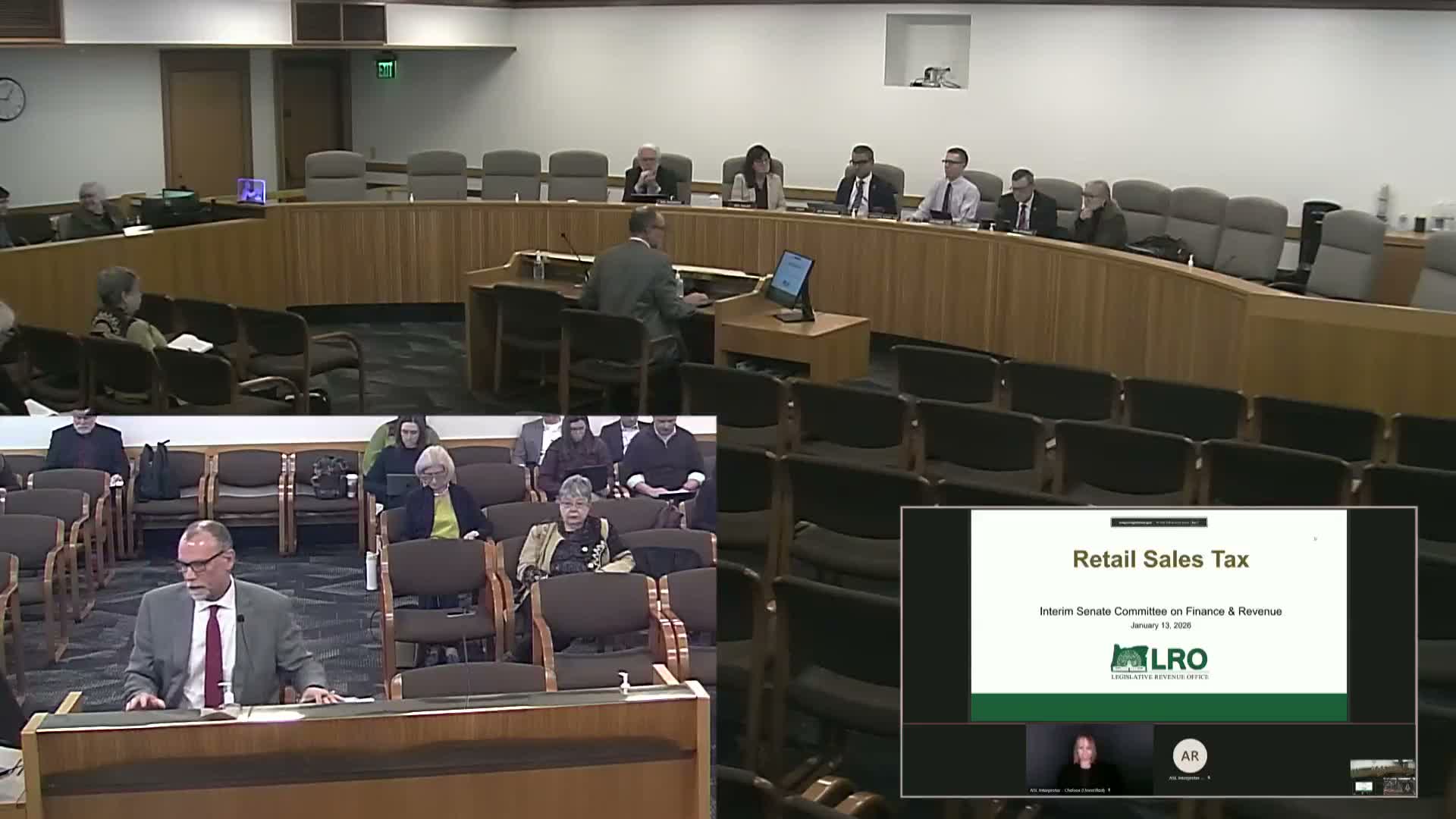
Chris Alenak of the Legislative Revenue Office gave a primer to the Senate Interim Committee on Finance and Revenue on types of taxes, the distinctions among general sales, selective sales, excise and gross-receipts taxes, and the policy choices states face when considering retail-sales taxation.
Alenak emphasized terminology and incidence: retail sales taxes are transactional and the legal incidence typically falls on the purchaser though sellers remit collections; excise taxes are per-unit; gross receipts (for example, Oregon’s corporate activity tax) have different legal incidence. He noted predictability differences across tax types: property tax is generally most stable, income tax most volatile, and consumption taxes intermediate.
Using national census comparisons, Alenak showed many states rely on general sales taxes for roughly 70% of consumption-tax revenue, while Oregon relies more on income and has consumption taxes that are selective (fuel, cigarette, CAT). He compared California and Washington approaches: California’s statutory threshold for remote sellers is $500,000 and focuses on tangible personal property and marketplace facilitators; Washington’s base includes some services and its threshold is $100,000.
Alenak flagged administrative and policy issues states confront: remote sales and marketplace facilitator collections, distinguishing goods from services, the role of business-activity taxes (B&O) versus retail sales taxes, and potential tax-on-tax issues if a retail sales tax overlapped existing excise taxes on fuel. He recommended separating Washington’s B&O tax from retail-sales tax in any analysis and noted the ongoing Streamlined Sales Tax Project addresses administrative uniformity across states.
Committee members asked follow-up questions on how Washington and California differ by design and what revenues a Washington-style sales tax might raise in Oregon; LRO staff said sample estimates exist in LRO’s "basic facts" materials and that a 1% rate on a Washington-style base could raise approximately $1.2 billion (1% example) and a 5% rate could raise several billion dollars, depending on base and local options.
The presentation was framed as background: no committee decisions were taken and staff said further detailed work would be needed to model specific design choices.
What’s next: if the committee pursues retail-sales options, staff said it would need to unbundle gross-receipts taxes from retail-sales tax and model definitions of taxable services and goods, thresholds, exemptions and administrative rules.