
Business Oregon outlines draft statewide economic development strategy with eight action areas
Get AI-powered insights, summaries, and transcripts
Subscribe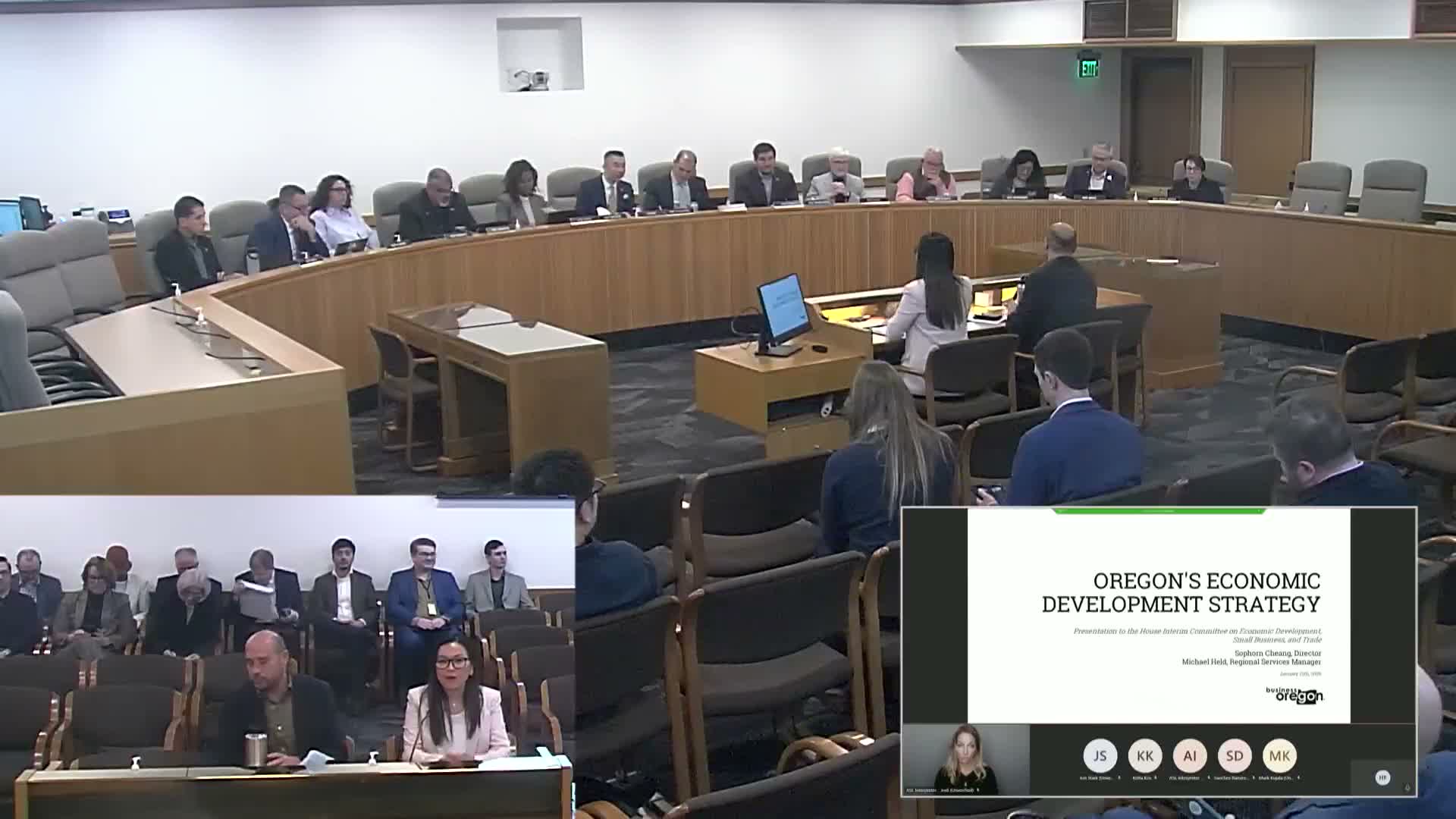
Summary
Business Oregon presented a draft statewide economic development framework to the House interim committee Jan. 13, describing eight action areas—business retention, business climate, regulation, innovation/capital access, workforce, infrastructure (including industrial lands), sector alignment and recruitment—and asked legislators for SMART, measurable goals and partner engagement.
Business Oregon leaders presented a draft statewide economic development strategy (the TRAP framework) to the House Interim Committee on Economic Development on Jan. 13 and asked legislators for input on measurable goals and timelines.
Soaporn Tien (S17), Director of the Oregon Business Development Department (Business Oregon), said the strategy follows stakeholder engagement with more than 200 partners and aligns with the governor’s Prosperity Roadmap. Michael Held (S18), regional services manager, walked the committee through the nine—or in his presentation eight—action areas that will form the backbone of the strategy, including business retention and expansion, business climate improvements, regulatory streamlining, innovation and capital access, workforce development, infrastructure and industrial lands, sector alignment, and business recruitment.
Held emphasized that the framework is a draft and that Business Oregon is working to translate goals into trackable metrics and implementation plans that can include policy recommendations. He said the agency plans to convene advisory groups and solicit additional input from legislators, local economic-development organizations, workforce partners, tribes and industry.
Committee members urged the agency to adopt SMART (specific, measurable, attainable, relevant, time-bound) goals and to move quickly rather than delay for perfection. Several members argued for near-term tactical steps—streamlining permitting, addressing energy prices and infrastructure constraints, and retaining existing employers—that can be deployed while the broader strategy is finalized.
Business Oregon said it will continue stakeholder engagement and expects to share more detailed measures and policy recommendations later in 2026.