
Governor’s Prosperity Roadmap focuses on fast-track permitting, $40M for site readiness and Enterprise Zone changes
Get AI-powered insights, summaries, and transcripts
Subscribe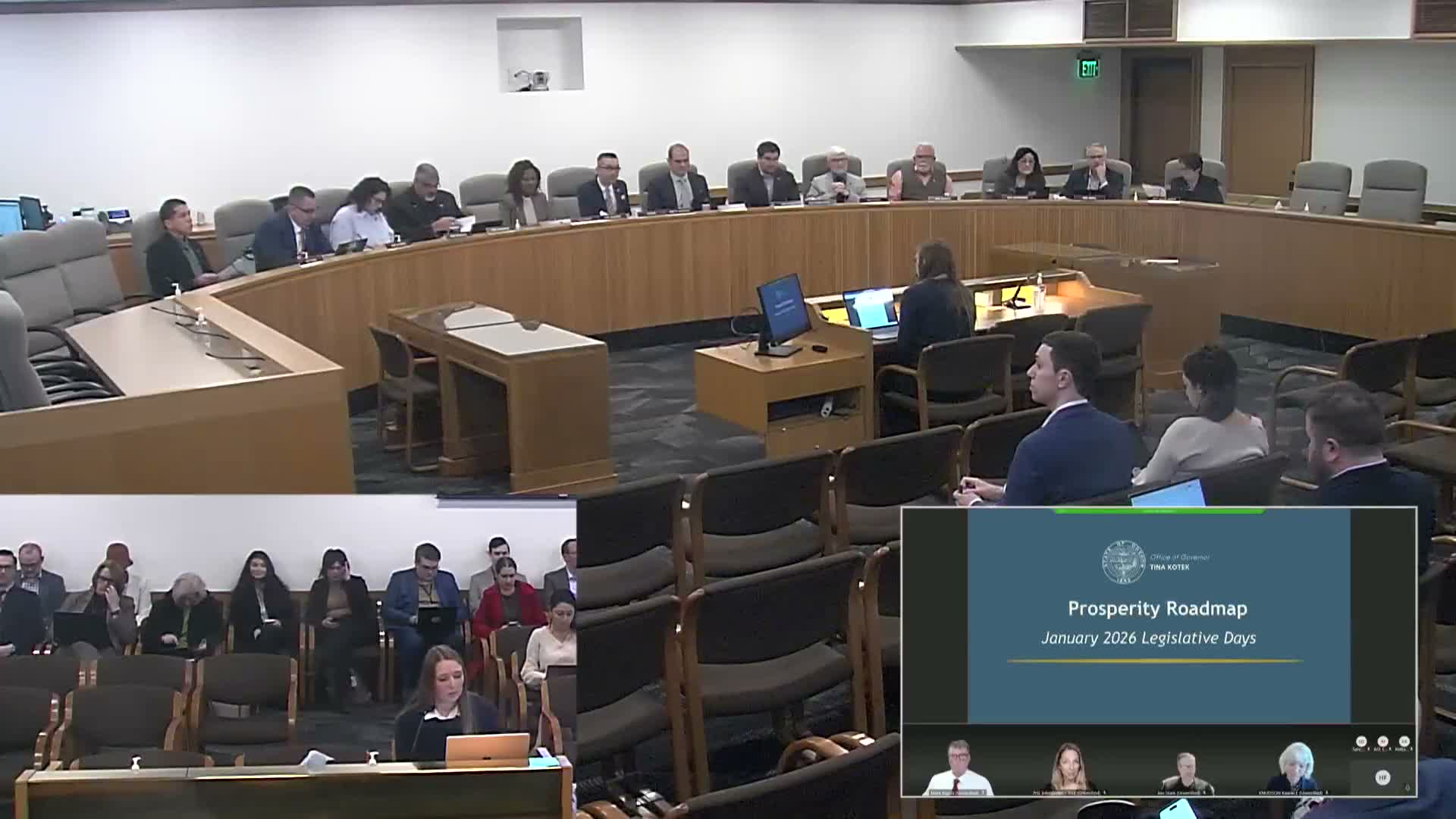
Summary
Governor Kotek’s Prosperity Roadmap, presented to the House interim committee Jan. 13, proposes a fast-track permitting program (initially framed around a $150 million threshold with a tiered approach), permit audits with a 120‑day review deadline after passage, $40 million added to the industrial site loan fund, and Enterprise Zone modernization to broaden eligibility and extend exemption timelines.
State officials and local leaders outlined the governor’s Prosperity Roadmap and related 2026 legislative concepts at the House Interim Committee on Economic Development on Jan. 13.
Sarah Means, the governor’s workforce, higher education and economic development advisor, told the committee the roadmap responds to “slowing population growth, elevated unemployment and business out migration” and is organized around three core goals: retain and grow businesses, catalyze job creation through targeted industry strategies, and modernize economic development systems.
Key proposals described include: - Fast Track Permitting: A program modeled on other states to accelerate permitting for projects with large, multiagency permitting needs. The presenters described a tentative $150,000,000 private-investment threshold for initial eligibility but said a tiered approach is under consideration so rural and smaller projects can qualify under different criteria. - Permit audits: The legislation would direct natural resource agencies and ODOT to complete comprehensive reviews of permits related to economic development projects and provide recommendations on updated timelines within 120 days of passage. - Industrial site readiness: The governor proposes adding $40,000,000 to the existing industrial site loan fund at Business Oregon to support upfront infrastructure, environmental mitigation and site assembly. - Enterprise Zone modernization: The plan would modify job-creation thresholds, allow flexible hiring timelines, expand qualifying criteria to include productivity and revenue improvements, and extend exemption terms beyond the current 3-to-5-year norm.
Local officials told the committee why the investments matter. Eugene Mayor Karen Knudsen said the proposed $40 million would be a "game changer" for projects such as the Clear Lake Road industrial area, a 650-acre site she said could yield up to 6,000 jobs if made developable. A county commissioner supporting expanded fast-track access called the program a possible path "from uncertainty to yes" for sites that have stalled for decades under complex regulations.
Committee members pressed speakers on the proposed $150 million threshold, asking whether it would exclude rural projects and create regulatory capture. Presenters repeatedly said the proposal is preliminary and that a tiered approach and local coordination would be included as language is refined.
The governor’s team encouraged committee members to submit feedback before the short-session deadlines and said draft language and supplemental memos are posted in OLIS.