Get Full Government Meeting Transcripts, Videos, & Alerts Forever!
Get email alerts on the Estate Tax topic
No spam. Unsubscribe anytime.
Legislative economist outlines Oregon estate tax trends and trade-offs
Summary
The Legislative Revenue Office presented data showing estate tax receipts have grown substantially since 2012 and that changing Oregon’s $1,000,000 exclusion would materially reduce revenues; policymakers were briefed on natural-resource exemptions, distribution of tax liabilities and migration-related uncertainties.
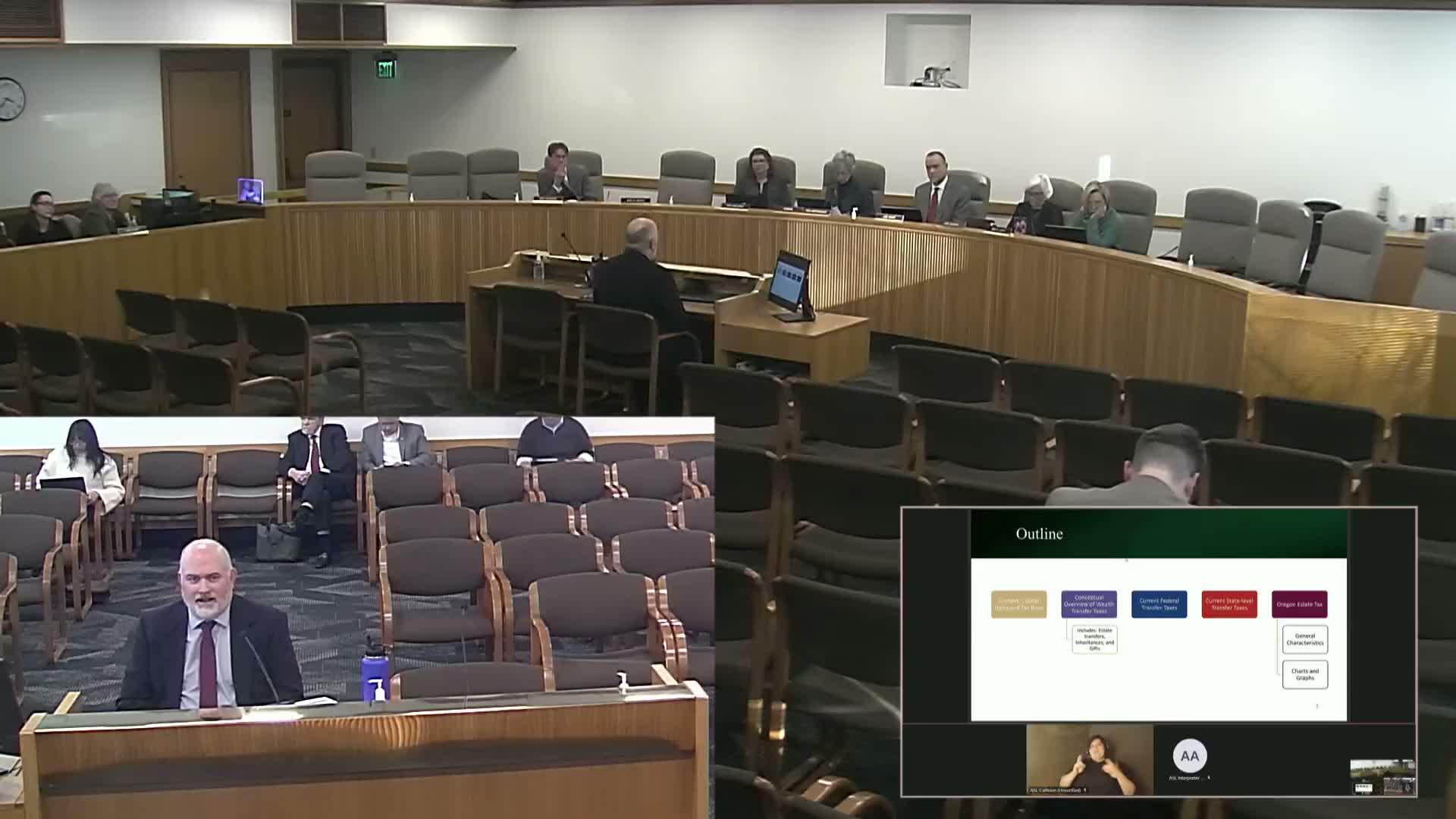
John Hart of the Legislative Revenue Office briefed the committee on state wealth transfer taxes — estate, gift and inheritance tax distinctions — and Oregon’s estate tax specifics.
Hart explained technical distinctions: gifts generally carry over basis to recipients, while inherited assets typically receive a stepped-up basis equal to value at death; federal estate and gift tax parameters (2025 figures cited in the presentation) include a unified exclusion (presented as $13,990,000 in Hart’s slides) and a top statutory rate the presentation described as 40%.
Using Oregon Department of Revenue data, Hart showed estate tax receipts by fiscal year (FY2017–FY2027 forecast), noting receipts grew roughly fourfold since 2012 and projected continued growth. He noted concentration: a small number of large taxable estates produce a large share of receipts (the presentation cited 67 returns above $9.5 million in taxable estate accounting for about 43.7% of tax paid).
Hart described the 2023 natural resource exemption and a related credit available to qualifying family-run farm, forest and fishing businesses (eligibility: five years ownership, participation requirements; exemption up to $15 million in qualifying property; credit rules and a sunset currently scheduled for December 2028). He explained how raising the estate-tax exclusion would reduce collections (illustrated examples: raising the exclusion to $2 million estimated to reduce estate tax collections by about 36%; to $6 million estimated ~70% reduction, phased over roughly three years in the presentation).
Committee members asked how many deaths result in taxable returns; Hart said roughly 7% of deaths led to an estate tax return and about 5% of deaths resulted in tax owed under recent data. Members also raised anecdotal concerns about residency migration to avoid estate tax; Hart said isolating motives for migration is difficult and offered to share related research (a 2020 paper was referenced).
Hart concluded by offering to provide follow-up revenue-estimate work should the committee want to pursue policy options in the February session.