Get Full Government Meeting Transcripts, Videos, & Alerts Forever!
Get email alerts on the FORGE Design topic
No spam. Unsubscribe anytime.
Advisers tell Oregon committee FORGE could recycle capital, mobilize private investment
Summary
Experts from the Connecticut Green Bank, S2 Strategies and the Center for Public Enterprise told the Senate committee that a FORGE‑style fund could leverage public seed capital to attract private finance, deliver technical assistance, and create a revolving loan fund to finance resilience and clean‑energy projects across Oregon.
Experts advising the Senate Energy and Environment Committee said a Fund for Oregon Resilience, Growth and Energy (FORGE) could amplify limited public dollars by attracting private capital, offering technical assistance and running revolving financing products to support projects that otherwise would not access affordable financing.
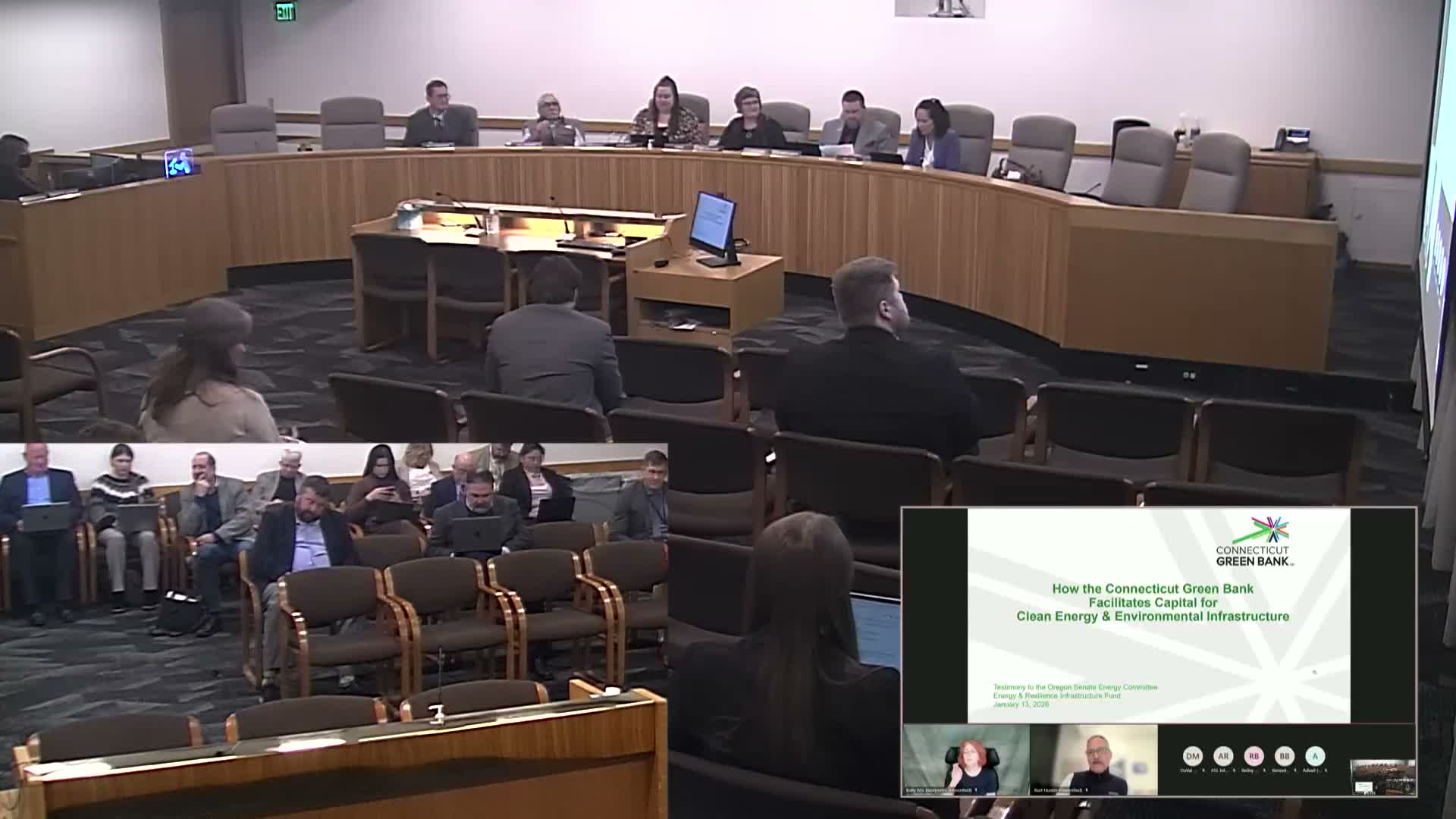
Bert Hunter from the Connecticut Green Bank described the Green Bank model in detail and the institutions and revenue streams that make it work. He said Connecticut’s quasi‑public Green Bank was established in 2011, uses a variety of public revenues (including a small electricity surcharge—described in the presentation as roughly 0.1¢ per kilowatt‑hour, yielding about $25 million per year—and Regional Greenhouse Gas Initiative receipts), and has leveraged roughly $3 billion of total investment using about $460 million of public resources. Hunter emphasized governance, transparency, and program examples—SmartE loans, CPACE for commercial properties, and a battery electric school bus financing program.
Bennett Byerly (S2 Strategies) and Advait (Center for Public Enterprise) framed FORGE as a fund that combines technical assistance with capital to close market gaps. They recommended features such as: clear pathways to raise capital from federal, state, philanthropic and private sources; early seed funding to build admin and underwriting capacity; use of RFIs/RFPs to prioritize projects; and flexibility to design products (subordinated debt, loan guarantees, co‑investment, performance incentives). Advisers also flagged institutional design choices—nonprofit vs. state authority—and suggested partnering with existing state conduits (for example, Business Oregon) to access tax‑exempt bonding where appropriate.
Committee members probed the scope and technology priorities; presenters said FORGE does not need to be limited to solar and wind and can include battery storage, grid enhancements, geothermal, and resilience investments that stabilize prices and create local jobs. Presenters cautioned that careful design—clear governance, underwriting capacity and market‑appropriate products—would be essential to avoid crowding out private capital while achieving public objectives.
The session did not advance a bill vote; advisers provided slide decks and offered follow‑up materials to staff for technical review.