
Oregon Values & Beliefs survey: plurality say state is on 'wrong track'; rural connectedness has fallen
Get AI-powered insights, summaries, and transcripts
Subscribe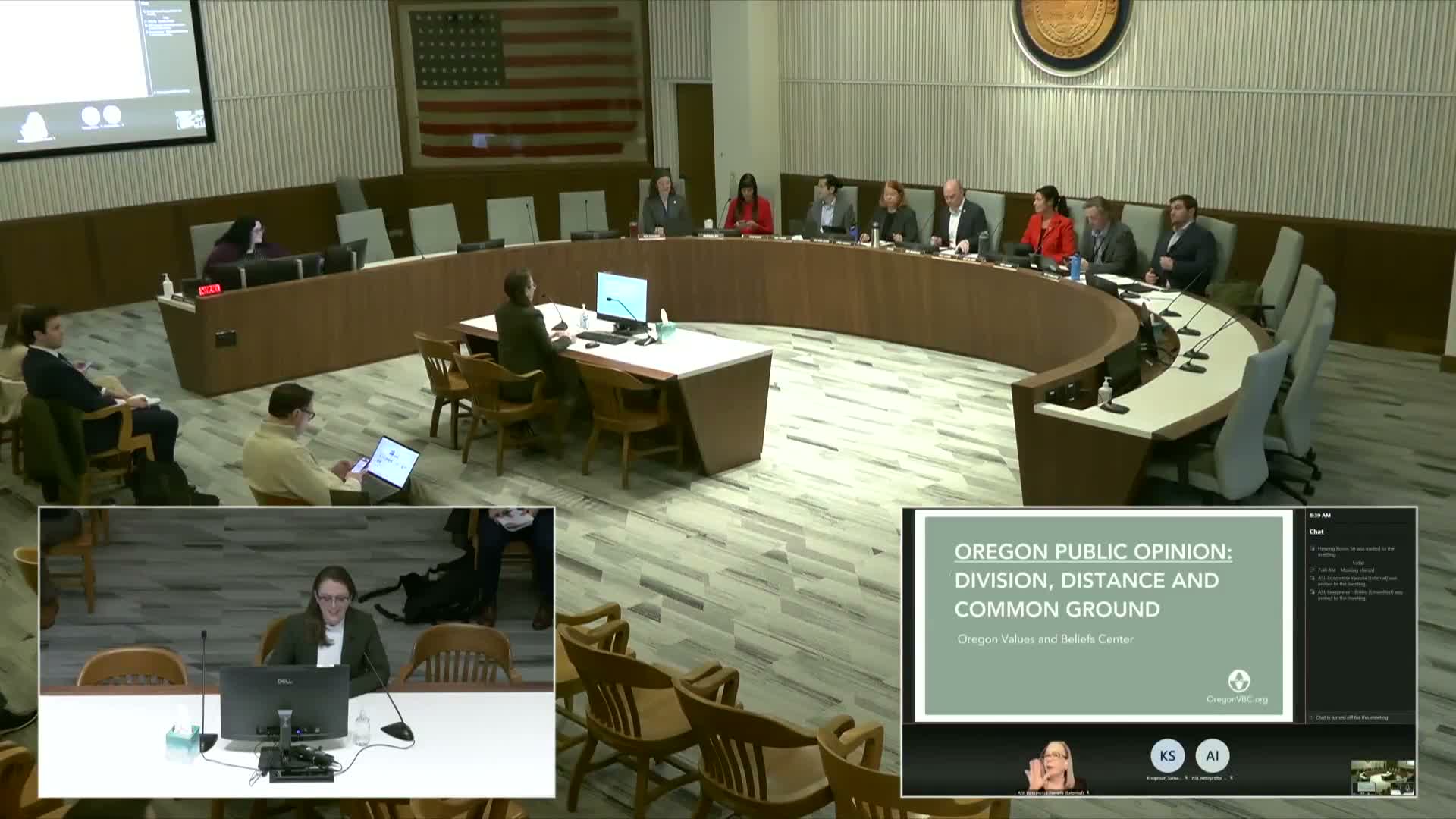
Summary
The Oregon Values and Beliefs Center told the House Rules Committee that its representative statewide survey finds more Oregonians say the state is on the 'wrong track' than the 'right direction,' with rural respondents reporting a notable drop in feelings of community connection. OVBC provided disaggregated results and methodological notes to legislators.
Omry Vogel, executive director of the Oregon Values and Beliefs Center, told the House Interim Committee to Rules on Jan. 13 that his group's representative-population polling shows a plurality of Oregonians view the state as off on the "wrong track," and that rural residents report falling levels of community connectedness.
"More people say the state is off on the wrong track than headed in the right direction," Vogel said, presenting multi-year trend data and subgroup breakouts. He said only a small share — "7% say strongly in the right direction" in the wording he presented — report strongly positive direction, while a larger share reported negative direction and cited rising costs, unaffordable housing and worsening homelessness as top reasons.
Vogel emphasized the organization's sampling approach: OVBC uses a large general-population sample rather than a "likely voter" sample so it can reliably break out rural and other underrepresented groups. "We have built up a panel of over 4,000 Oregonians that we ask," he said, and OVBC supplements that panel with professional panels and community partners to improve response quality and rural representation. He also noted OVBC makes its data publicly available for independent review.
On specific metrics, Vogel reported that 74% of respondents say their community is socially or politically divided and that 72% believe people like them can have a significant impact locally. He flagged a drop in rural connectedness compared with prior years, reporting about 51% of rural respondents now say they feel connected while roughly 45% say they do not.
Vogel also presented urban–rural differences on climate questions: when asked whether investing to combat climate change would be positive, he reported urban support around 77% and rural support around 57%, while noting that when the same topic was asked in a different framing — whether people should be doing "more" to reduce global warming — statewide agreement was much higher (about 84%).
Committee members asked for methodological detail on question wording and definitions of "rural-to-suburban" and Vogel promised disaggregated breakouts and follow-up materials. The presentation and data were positioned as background information for legislators ahead of later policy hearings; the data are available on OVBC's website and OVBC said it will provide the committee with further breakdowns.