Get Full Government Meeting Transcripts, Videos, & Alerts Forever!
Get email alerts on the Data Centers topic
No spam. Unsubscribe anytime.
Data center growth debated: industry touts jobs and flexibility while lawmakers ask about water, taxes and grid impacts
Summary
Industry and ODOE told lawmakers data centers bring large capital investment, jobs and tax revenue and could provide demand‑flexibility to help reliability; legislators pressed on remote disconnection, water use, tax incentives and whether large loads will lower or raise residential rates in practice.
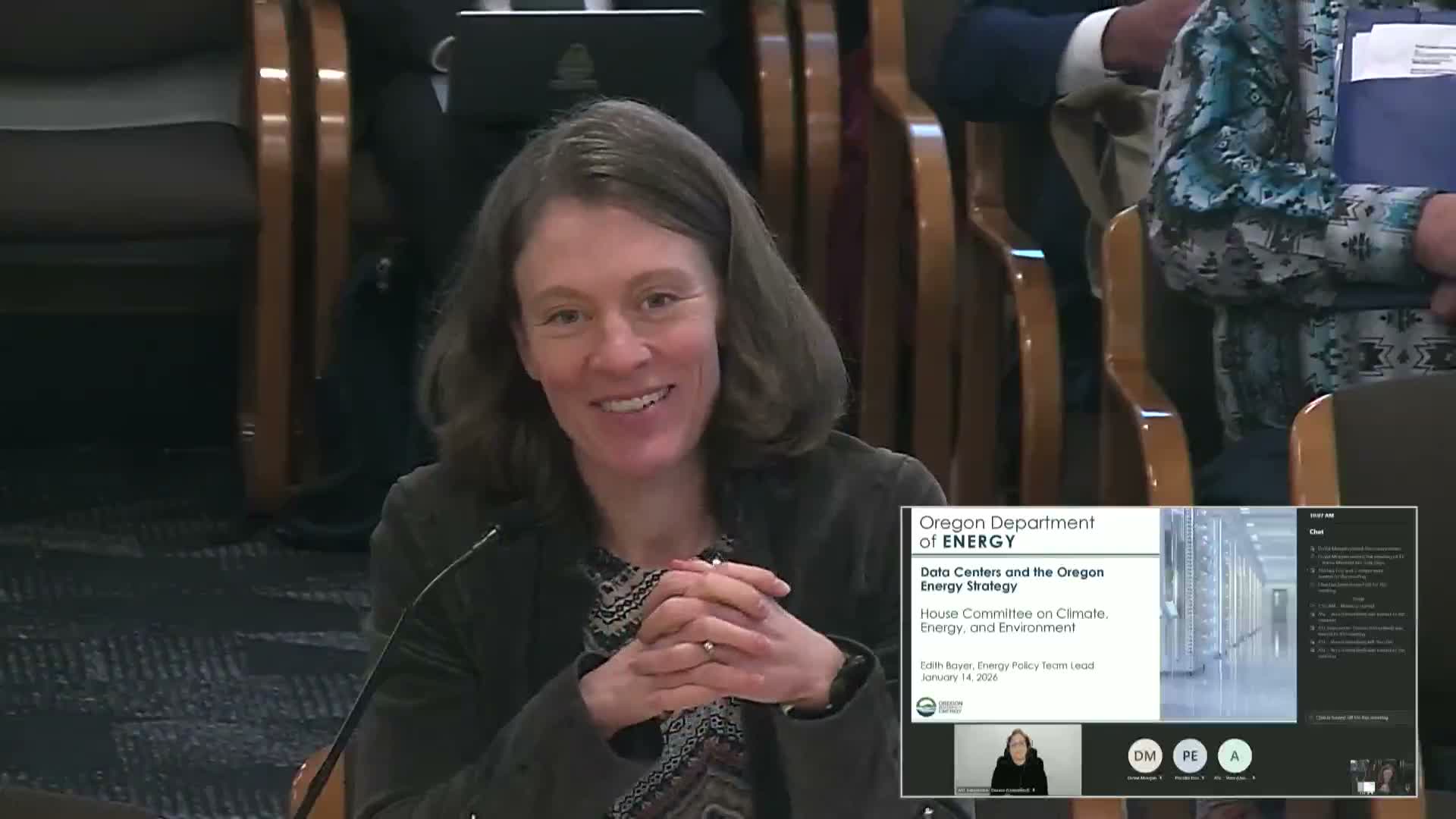
The committee held an informational session on data centers, with an Oregon Department of Energy presentation followed by industry testimony from the Data Center Coalition and questions from lawmakers.
Edith (Energy Policy Team Lead, ODOE) presented historical commercial and industrial electricity demand, noting a 39% increase in commercial/industrial sales from 2014 to 2024 and that tech loads (including data centers and chip manufacturing) account for a significant share of projected growth through 2050. ODOE recommended registration and reporting for large electric loads to improve planning and suggested demand‑side flexibility as a near‑term tool to address resource adequacy.
Dan Diori of the Data Center Coalition said data centers generate substantial local tax revenue and construction activity, support high‑wage operational jobs, and have been major corporate purchasers of clean energy. He and other industry witnesses said companies are exploring load‑shifting, compute‑shifting and advanced cooling and water‑reuse technologies. The industry emphasized voluntary demand response programs and sought regulatory certainty for generator use and environmental compliance if backup gens were deployed during emergencies.
Lawmakers asked specific questions about: (1) whether data centers could be ordered to disconnect remotely during emergencies (citing Texas SB 6), (2) water consumption and reuse or district‑heating opportunities (Denmark example), (3) Oregon’s tax policy role (property tax exemptions and no state sales tax were cited as factors that make Oregon competitive), and (4) the metric and threshold for defining "large loads" (committee noted the PUC already reports on loads larger than 20 megawatts per recent legislation). The industry warned that forced remote disconnection raises national security and operational concerns for some tenants; industry representatives supported voluntary, negotiated approaches with clear environmental and operational parameters.
What happens next: committee members requested follow‑up on the Sylvan Energy Analytics evaluation and other reports referenced by ODOE; they also flagged the need for tariff, market design and contract changes to ensure fair outcomes if large loads are integrated into reliability programs.