
Oregon energy strategy review draws bipartisan questions on reliability, costs and role of emerging technologies
Get AI-powered insights, summaries, and transcripts
Subscribe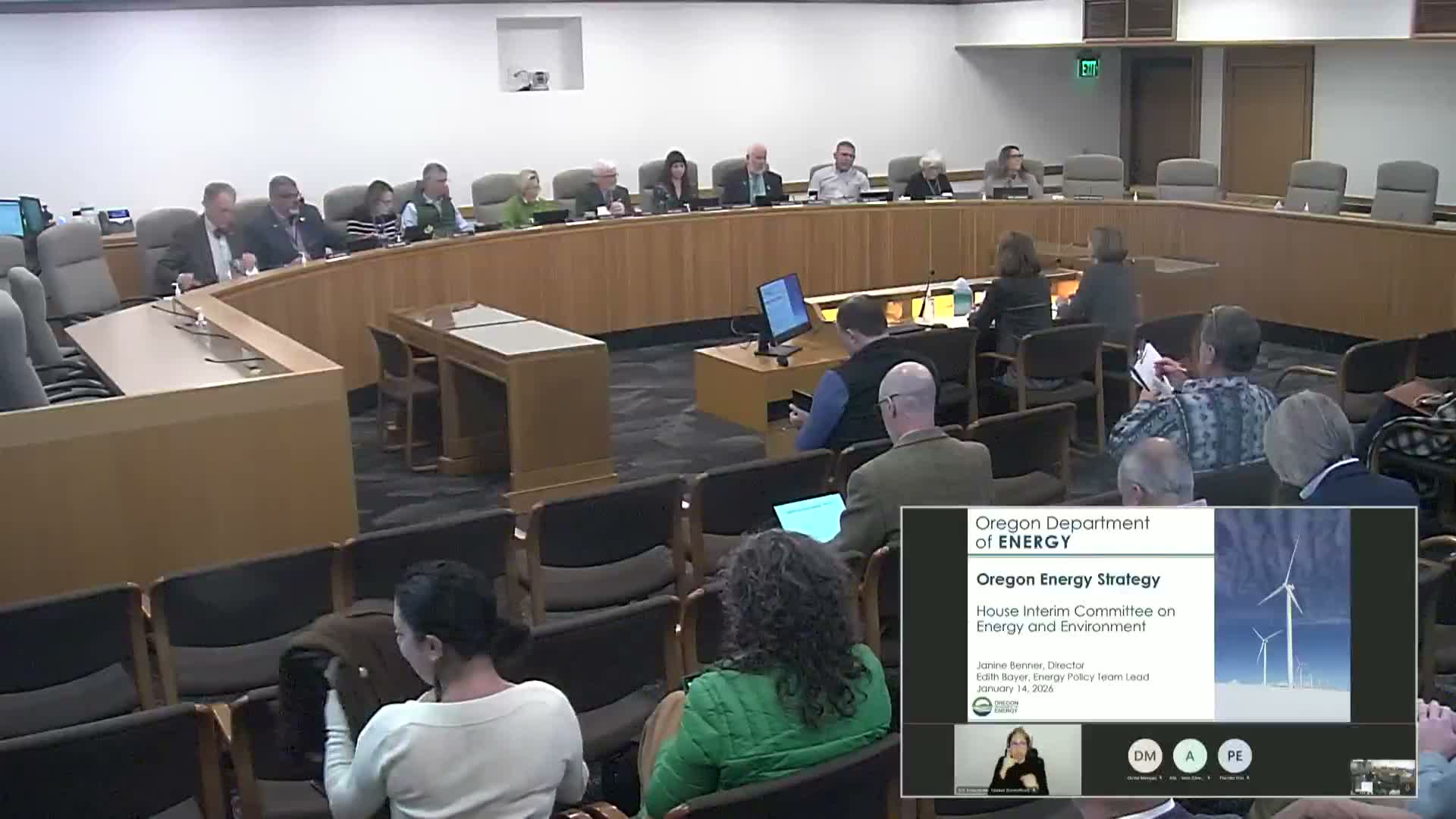
Summary
The House interim committee heard Oregon Department of Energy officials summarize the state energy strategy and faced detailed questioning from lawmakers and utilities about affordability, wildfire liability, transmission bottlenecks and whether emerging technologies such as small modular reactors or large flexible loads (data centers) can help meet near‑term reliability needs.
Chair Lively convened the House Interim Committee on Climate, Energy and Environment for a briefing and Q&A on the Oregon Energy Strategy, with Janine Benner, director of the Oregon Department of Energy, presenting the plan’s framework and near‑term actions.
Benner told the committee the strategy — developed under the mandate of HB 3630 (2023) — lays out five pathways and 42 legislative and policy actions focused on the next four years to advance affordability, reliability and resilience. She said the strategy modeled a least‑cost reference scenario that considers electricity, transportation and other fuels and stressed that some recommended actions can be started by agencies within existing authority while others will require legislation or funding. Benner also noted Governor Kotek’s executive order directing agencies to align investments with the strategy.
The nut of the committee’s inquiry centered on cost, system reliability and near‑term remedies. Members repeatedly pressed ODOE on how the strategy’s scenarios translate to household and rate‑payer costs. Benner said the strategy does not include a single business‑as‑usual cost projection but pointed to an “energy wallet” analysis that examined five household archetypes and found mixed outcomes: for example, new electric vehicles often reduce operating costs for households that can afford them, while impacts from heat‑pump adoption depend on specific household factors.
Lawmakers and stakeholders also questioned whether the state has adequate tools to avoid rolling blackouts while large quantities of clean generation and transmission are built. ODOE said that while long‑term transmission and generation build‑out remains necessary, the strategy emphasizes near‑term solutions — energy efficiency, distributed energy resources, batteries and demand‑side flexibility — and flags large flexible loads such as data centers as potential participants in short‑term reliability solutions. The department cited recent analyses suggesting coordinated flexibility by large loads could mitigate near‑term winter adequacy risks, while acknowledging that many details remain to be worked out, including environmental and public‑health effects when backup diesel generators are used.
Utility representatives and consumer‑owned utilities pressed the committee to weigh reliability and affordability equally with decarbonization. Tucker Bellman of the Oregon Rural Electric Cooperative Association and Danelle Romaine of the Oregon People’s Utility Districts Association urged restoring access to firm generation and removing siting and permitting barriers; they warned that litigation affecting Federal Columbia River Power System (FCRPS) operations could increase costs and reduce reliability. Portland General Electric highlighted wildfire liability as an escalating cost driver that constrains utilities’ ability to invest. Fuel‑sector witnesses said renewable‑fuel and transportation transitions also raise affordability and resilience questions, citing distribution chokepoints such as Portland’s CEI hub.
Several members asked about the role of nuclear energy, including small modular reactors, in meeting long‑term capacity needs. Benner said current modeling does not identify new nuclear as the least‑cost option at present, but the strategy includes an action to monitor emerging technologies and revisit them periodically; Representative Bobby Levy later introduced LC 309 directing ODOE to study advanced nuclear options.
What happens next: committee members asked staff to provide the referenced reliability reports and more granular cost data. The committee will take up the strategy and related bills during the short session; ODOE said it will return with recommendations and implementation priorities as directed by the governor’s executive order.