Get Full Government Meeting Transcripts, Videos, & Alerts Forever!
Get email alerts on the Watershed Governance topic
No spam. Unsubscribe anytime.
Advocates say Senate Bill 2276 gives new joint-board tools; stakeholders urge careful design if moving to watershed model
Summary
Presenters described how 2025's Senate Bill 2276 mandates joint project boards for cross-county water projects, outlines remedies (mediation, DWR appeal, court) and equal representation rules; some stakeholders want flexibility for agreed alternative board makeups and urged DWR involvement in any code refinements.
Danny Quistle, executive vice president of the North Dakota Water Users Association, briefed the committee on current water-resource district structure and on changes made in 2025 by Senate Bill 2276.
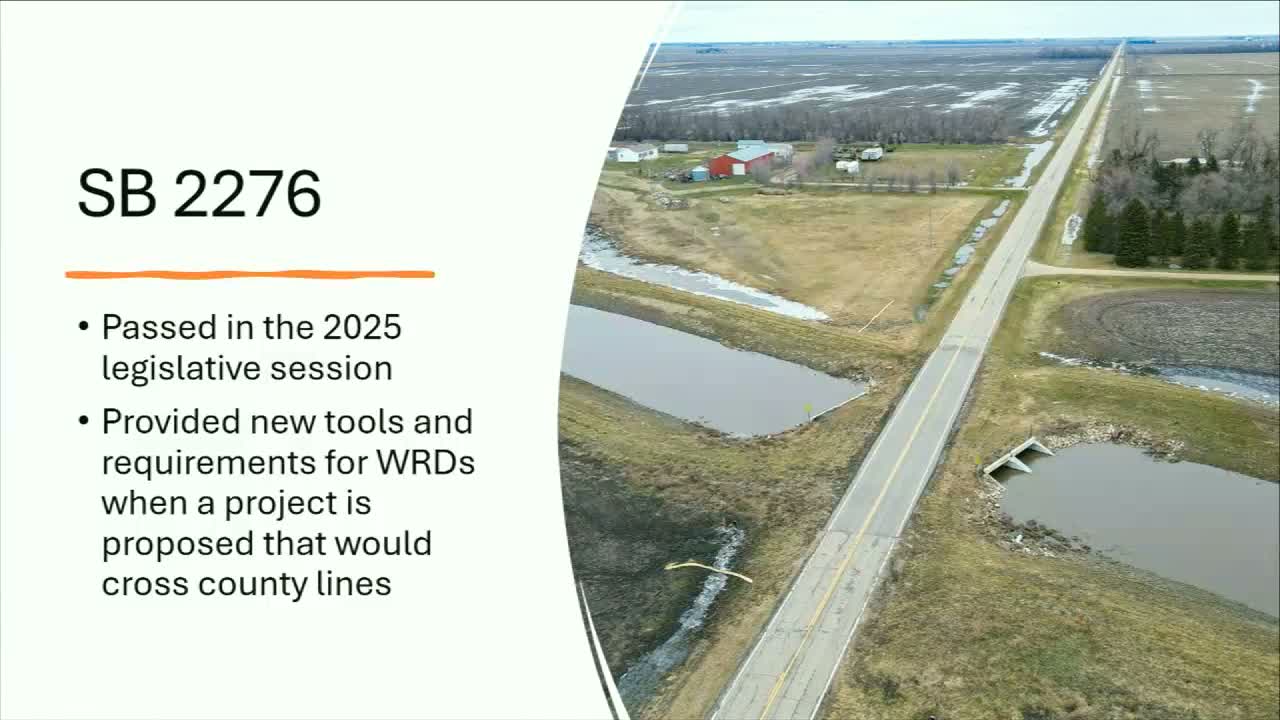
Quistle explained county-based water resource districts (in place since 1935, refined in the 1980s) perform planning, infrastructure maintenance and dispute resolution. He described joint basin and joint project boards as voluntary tools for cross-jurisdiction cooperation; Senate Bill 2276 (2025) changed the landscape by requiring counties affected by a cross-county petition to participate in joint board formation and by setting equal-representation rules for some joint project boards.
The bill also created stepwise remedies where counties cannot agree: mediation (Department of Agriculture mediation service), an appeal to the Department of Water Resources and, if necessary, court. Quistle said the law's remedies provide new enforcement and dispute-resolution tools but that some existing joint boards use different makeups by mutual agreement. Stakeholders suggested adding statutory clarity to allow flexibility where all parties consent to an alternative structure and to ensure DWR has capacity for any new appeals workload.
Committee members asked whether shifting to watershed-based governance would solve county-to-county disputes; Quistle said the current framework successfully resolves most cases, and moving to a watershed model could relocate—not eliminate—conflicts unless the new design is carefully tailored to avoid unintended consequences.
Quistle offered several policy questions for future consideration (defining watershed boundaries, board composition and taxation or levy authority) and said DWR and stakeholders should be part of any statutory refinement ahead of the 2027 Legislature.