Get Full Government Meeting Transcripts, Videos, & Alerts Forever!
Get email alerts on the Childcare topic
No spam. Unsubscribe anytime.
State projects $35 million childcare shortfall; DHHS proposes rate cuts, wait list and TANF use
Summary
DHHS reported a projected $35 million shortfall for CCAP after enrollment rose to ~7,600 children/month. To close the gap the department will reduce part‑time reimbursement rates, change quality bonus payments, implement a wait list for new applicants and use available TANF carryover funds as a temporary bridge.
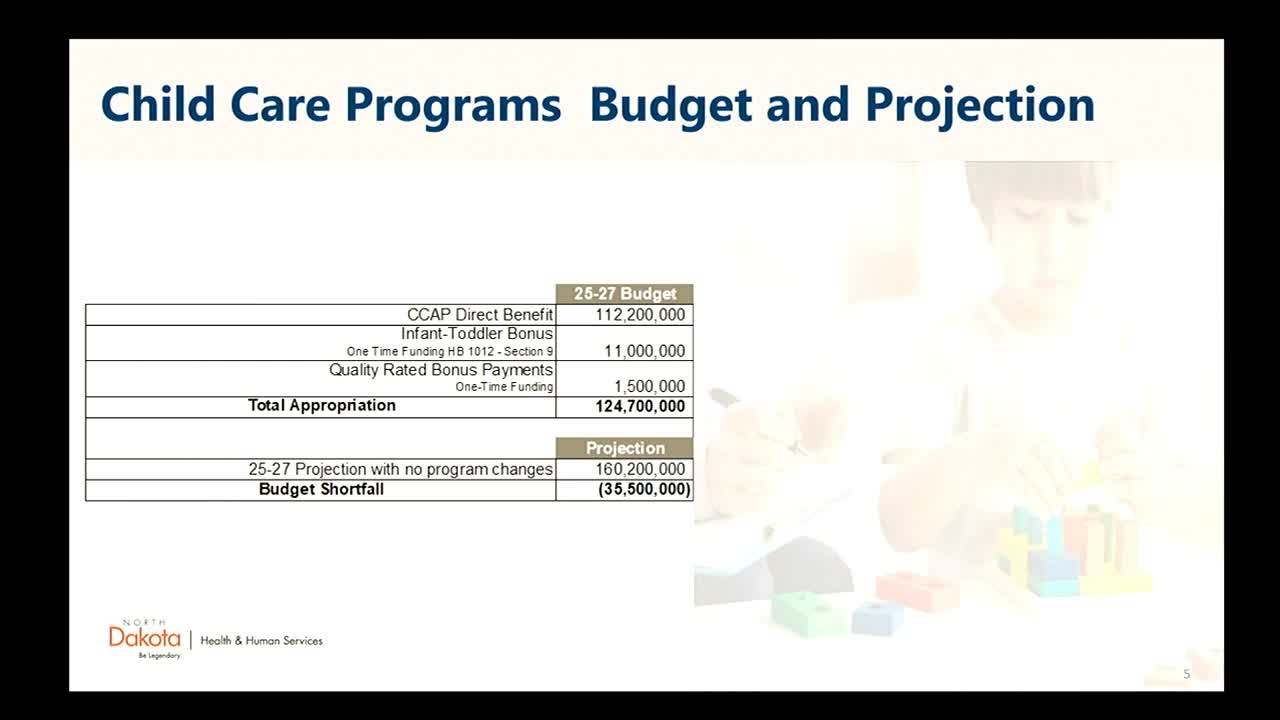
Donna Ochland, chief financial officer for the Department of Health and Human Services, told the Budget Section the state’s childcare assistance program (CCAP) faces a budget gap after higher‑than‑expected enrollment. Ochland said appropriations for CCAP and related bonuses totaled roughly $124,700,000, while projected program costs without changes were about $160,200,000, yielding a projected shortfall of approximately $35,000,000.
Michelle Gee, director of economic assistance, explained the principal driver: utilization exceeded budget assumptions. "At the beginning of the biennium ... we were anticipating about 6,400 children per month. We're right now serving about 7,600 children per month," she said. The department highlighted the childcare workforce benefit implemented in July 2024 as a major contributor to higher enrollment and utilization.
To reduce expenditures, DHHS proposes several program adjustments effective Jan. 1: reduce the state maximum payment for part‑time care for preschool (3–5) and school‑age (6+) children from roughly 75% of the market‑rate benchmark to 50%; eliminate the step‑2 quality bonus (retaining bonuses for higher tiers with smaller percentages); and implement a wait list for new applicants effective Dec. 1. The department estimated the part‑time rate change would save about $8.7 million, the quality rating change about $1.4 million, and the total savings from adjustments at about $13.2 million.
Ochland said the department intends to use unexpended TANF federal funds as a temporary funding source, noting federal rules allow use of up to 30% of annual TANF grant amounts and that DHHS identified carryover across federal years that could be applied; she cautioned the amount usable beyond the current biennium will be smaller. The department said it will provide the committee a schedule showing prior TANF balances and how the carryover would be applied.
Committee members pressed for detail on household out‑of‑pocket impacts and asked for spreadsheets and a co‑pay calculator; DHHS said those resources and updated rate tables will be shared online.
The department also announced a targeted communications effort to notify families and providers of changes and the new wait list rule. Several legislators asked for additional TANF history and projected impacts in future budget cycles.