
UND medical‑school leaders propose removing MD program from general funding formula to protect capacity
Get AI-powered insights, summaries, and transcripts
Subscribe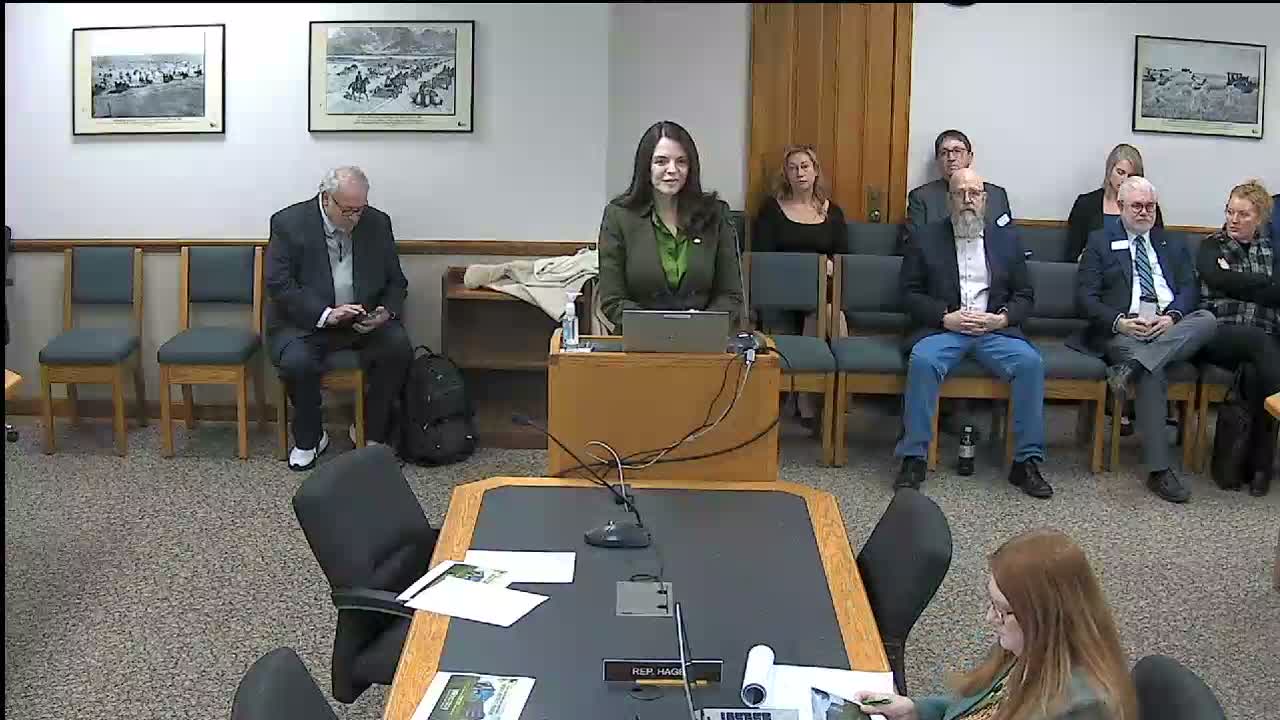
Summary
University medical‑school representatives told the Higher Education Funding Committee they favor a fixed or phased funding approach for the MD program to keep clinical training and residency expansion funded while legislators consider formula reforms.
Chair Sorvaugh convened the Higher Education Funding Committee to hear a presentation from Doctor Jenkins about options for funding the state’s MD program. Jenkins, speaking for the School of Medicine and Health Sciences, said the committee is considering three approaches: keep the MD program inside the current funding formula, adopt a fixed funding model that preserves next‑biennium funding levels for the MD program, or pursue a more complex phased (transcript term: “bridal”) model that would phase changes in over several years.
Jenkins described the MD program’s role in state health workforce development: the SMHS administers nearly all residency slots in the state (he said about 98% of residency slots are within SMHS) and currently enrolls roughly 290 MD students. He said primary revenue sources include the state general fund, a statewide 1‑mill property mill levy and targeted Health Workforce Initiative dollars that have supported new residencies.
Jenkins emphasized pipeline and retention strategies to ensure North Dakotans become local doctors: the North Dakota 85 recruitment initiative, an academic success team, expanded early‑acceptance pathways, MCAT preparation and a Primary Care Accelerated Track (PCAT) scheduled to launch in 2028. Jenkins said PCAT, designed as a scholarship program tied to in‑state residency and five‑year practice commitments, is estimated at about $4 million per year when fully implemented. He told the committee that graduate medical education (residency) is the key retention lever: students who complete residency in North Dakota stay at higher rates, which supports keeping state‑trained physicians in underserved areas.
On costs and future needs, Jenkins pointed to technology and curriculum investments—including required AI training tools—that will add recurring license and implementation costs over coming years. He and presenters asked the committee to consider whether removing MD credits from the broad funding formula could produce a simpler and more predictable funding pathway for clinical training.
The committee engaged Jenkins on eligibility for PCAT and on the projected impacts of removing MD credits from the formula; Jenkins said system leadership (including President Armacost and VP Stewart, mentioned in testimony) supports a model that preserves MD funding while allowing other system units to remain in the broader formula. The chair asked staff to continue modeling options and to provide clearer cost projections at a future meeting.
The committee did not take formal action on policy at the hearing; members asked the system office to return with proposals and cost scenarios for legislative consideration.