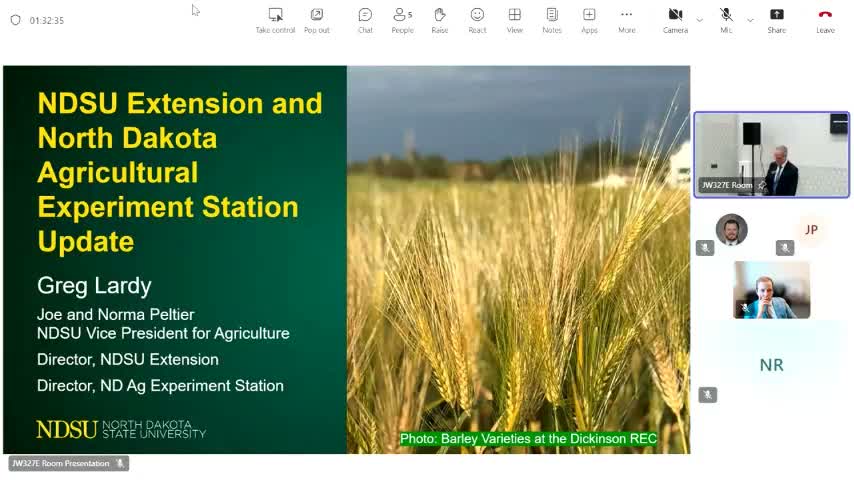
NDSU Extension highlights crop varieties, research centers and funding mix
Loading...
Summary
NDSU Extension and the Agricultural Experiment Station described statewide extension outreach, Research Extension Center sites, recent research impacts (variety releases, virtual fencing, NDON) and budget mix (FY25: ~54% state appropriations, ~12% federal, ~15% sales/services, ~11% grants/contracts).
Greg Lardy, vice president for agriculture at North Dakota State University and director of NDSU Extension and the Agricultural Experiment Station, told the committee that NDSU’s research-and‑extension network combines a main‑campus research base with seven regional Research Extension Centers (Langdon, Minot, Williston, Dickinson, Hettinger, Streeter, Carrington) and a seed agronomy farm in Castleton.
Lardy highlighted research outputs that support state agriculture: 20 recently released publicly‑available crop varieties (including the Dakota Russet potato accepted by a major buyer), advances in precision agriculture, virtual fencing for grazing management, pest and disease tools leveraging the North Dakota Agricultural Weather Network (NDON), and partnerships to propagate native plants for the Theodore Roosevelt Presidential Library roof. He said extension reaches every one of the state’s 53 counties through county partnerships and cited 4‑H youth reach (nearly one in four youth for 2024–25) and emergency response trainings (Stop the Bleed).
On funding and operations, Lardy presented FY25 snapshots for agency budgets: Extension (about $17M from state appropriations, ~54% of its budget), Experiment Station (about $30M state appropriations, ~49% of its budget), and branch stations (state appropriations ~49% with sales and services ~36% and grants/contracts ~15%). He described how grants and contracts often provide programmatic match and that branch stations’ sale of foundation seed is a key revenue source.
Board governance and oversight: Lardy reviewed the State Board of Agricultural Research and Education (SBARE) membership structure and the role of county advisory boards at each REC. Committee members asked about the experiment station’s R1 research contribution (Lardy said research expenditures from grants/contracts contribute to NDSU’s R1 status) and about operational costs for new buildings (the experiment station will cover ongoing maintenance for the Bali Agricultural Laboratory once complete).
What’s next: committee members requested further detail on grant matching, breakdowns of research vs. extension funding for specific programs, and continued engagement on possible state partnerships for outreach tied to rural health efforts.