Get Full Government Meeting Transcripts, Videos, & Alerts Forever!
Get email alerts on the Treatment Outreach topic
No spam. Unsubscribe anytime.
Commission urges low‑threshold wound care, self‑care kits and expanded harm reduction to address xylazine harms
Summary
The commission's outreach and treatment subgroup recommended prioritizing wound care (including inexpensive self‑care kits), maintaining naloxone availability for polysubstance overdoses, expanding mobile/low‑threshold services, and mapping geographic treatment gaps to target investments.
Commission presenters framed xylazine-related harms as primarily clinical and service-access problems that can be mitigated by low-threshold interventions. Dr. Simeon Kimmel described common patterns: many people who are exposed to xylazine do not know it is present in the drugs they use and frequently self-manage wounds until they become severe. He recommended co‑locating wound care with syringe-service and harm‑reduction programs and pairing wound care with medications for opioid use disorder when appropriate.
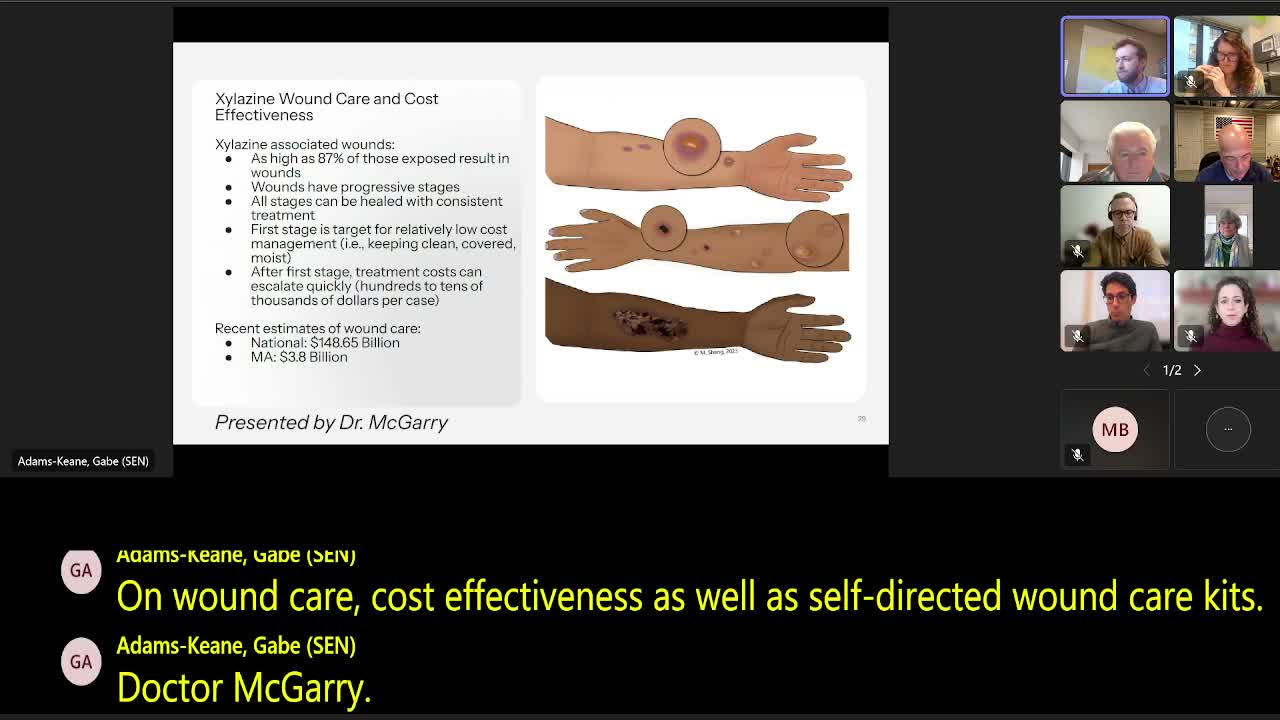
Dr. David McGarry underscored the economic and clinical burden of xylazine-associated wounds, citing research that shows a wide range of prevalence for wounds and high rates of severe progression without early care. He highlighted an example from the Pennsylvania Department of Health that distributed roughly 50,000 self-directed wound-care kits at a bulk cost of under $1 per kit and urged Massachusetts to pilot similar kits while collecting outcome data.
Working-group recommendations presented by staff included: ensure naloxone and oxygen are available to first responders treating overdose calls (because xylazine commonly co-occurs with opioids); provide self-directed wound-care kits and directories of follow-up sites in inpatient and outpatient settings; expand street and mobile outreach and integrate wound‑care referrals into harm-reduction service visits; and commission GIS mapping to identify areas with treatment access gaps and reimbursement limitations.
Representative Kate Donahue emphasized that wound care gaps impede access to residential treatment placements: many residential programs are reluctant to accept patients with untreated or complex wounds, creating an access barrier distinct from stigma. Commissioner McGarry reiterated the prevention logic: early, inexpensive wound care can prevent progressive stages that require costly surgical or hospital care.
What happens next: the subgroup recommended staff coordinate with the Department of Public Health and harm-reduction partners to pilot wound‑care kits, document outcomes, and explore state-level procurement to achieve low unit costs.