Get Full Government Meeting Transcripts, Videos, & Alerts Forever!
Get email alerts on the Scheduling Xylazine topic
No spam. Unsubscribe anytime.
Xylazine commission split on scheduling: law enforcement pushes penalties while public health urges surveillance and harm reduction
Summary
A state commission debating whether Massachusetts should schedule xylazine heard sharply different recommendations: law-enforcement voices urged criminal penalties for non-veterinary use, while public-health officials warned scheduling could be duplicative, ineffective and worsen disparities and instead recommended surveillance, drug checking and outreach.
Chair Mindy Dom convened a full-day virtual meeting of the Xylazine Commission that included extensive discussion about whether Massachusetts should classify xylazine beyond its automatic designation in Schedule 6. Representative Ixaros, drawing on a 40-year policing background, argued the Commonwealth needs clearer criminal prohibitions for non‑veterinary xylazine use and ‘‘some type of combined education and enforcement’’ to give law enforcement tools to act when appropriate.
Deputy Director Sarah Ruiz, speaking from a public-health perspective, countered that xylazine is ‘‘most often’’ found as a contaminant alongside opioids such as fentanyl and that Massachusetts already treats such medications under Schedule 6. Ruiz cautioned against layering additional penalties and cited a study from Florida showing a large increase in xylazine detection after the state imposed strict scheduling: ‘‘Despite having the highest level of schedule, it still was present, at increasing rates,’’ she said, noting the evidence cited a dramatic rise in xylazine presence in medical-examiner toxicology after Florida’s action.
Panelists described the national landscape as fragmented: Ernie Gates summarized state-by-state actions and told the commission that eight states have taken steps to schedule xylazine at various levels, with several states criminalizing illicit production or distribution. Commissioners and staff framed the choice as weighing potential public-safety benefits against possible public-health harms and racial disparities in enforcement.
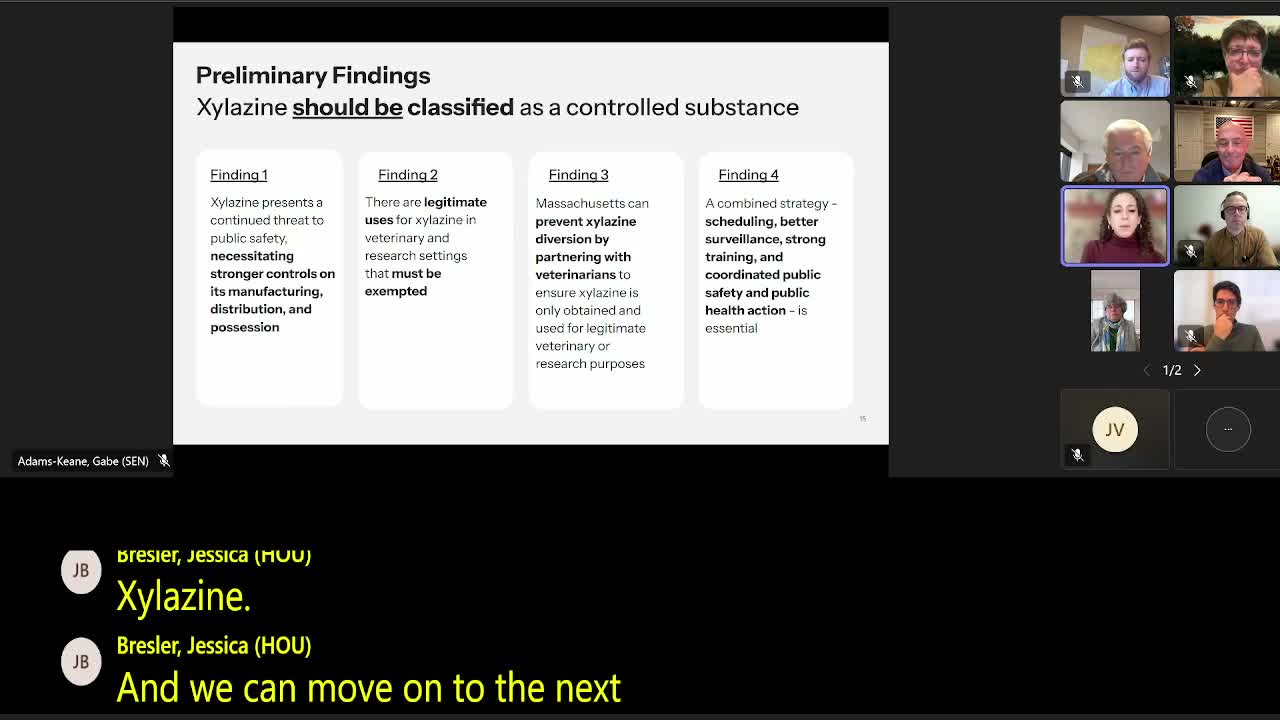
Commissioners recommended several compromise approaches rather than blanket policy: compile data on legal distribution and veterinary use, require secure purchase and storage practices for licensed veterinarians, expand drug-supply surveillance and drug‑checking programs, and direct law enforcement resources to large-scale trafficking rather than to individual possession of adulterants.
Representative Ixaros said scheduling ‘‘must be clear that we’re not talking about veterinarians using it properly’’ and sought assurances that exemptions for veterinary and research use could be preserved. Deputy Director Ruiz acknowledged such exemptions are possible and said that, if penalties were considered, limiting them to illicit manufacturing and distribution (with explicit veterinary and research exemptions) would be a more measured option.
What happens next: commission staff will reconcile overlapping recommendations from both perspectives and incorporate them into the draft sections of a final report to be circulated before the commission’s February 9 meeting for further review.