Get Full Government Meeting Transcripts, Videos, & Alerts Forever!
Get email alerts on the Agritourism topic
No spam. Unsubscribe anytime.
Council approves Dwellings Farms agritourism permit after hours of testimony and added stipulation
Summary
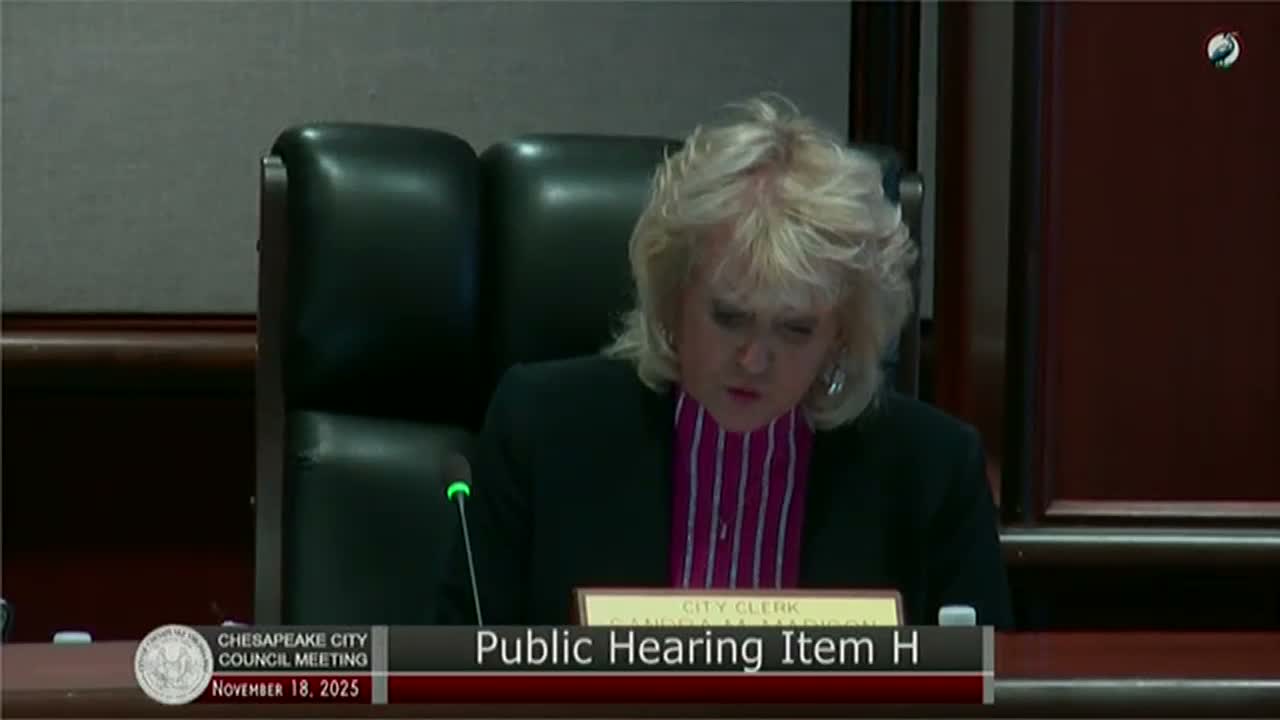
After extended public comment both supporting and opposing the request, Chesapeake City Council approved a conditional use permit for Dwellings Farms to host small agritourism events, adding a stipulation that the permit be limited to Dwelling Farms LLC (non-transferable). Planning staff had recommended denial citing incompatibility with adjacent residential uses.
Chesapeake City Council voted to approve a conditional use permit (CUP) allowing Dwellings Farms to operate small agritourism events and limited meeting/banquet activity on a 41-acre parcel in Southern Chesapeake, after more than an hour of public testimony that split neighbors and prompted detailed council deliberation.
Planning staff recommended denial, concluding the proposed use is inconsistent with the "quality of life" section of the comprehensive plan and incompatible with surrounding single-family properties because of potential traffic, noise and lighting impacts that could not be mitigated by administratively feasible stipulations. In the planning staff presentation, staff emphasized that the intensity of the proposed use — a venue for gatherings, private events and educational agritourism activities — raised compatibility concerns for adjacent residents.
The applicant and supporters portrayed the site as a working farm with USDA recognition (farm number cited during testimony) and active silviculture and livestock production. Applicant Jessica Dieffenbach told council the farm includes more than 30 acres under silvicultural production and that agritourism events have been small, community-focused gatherings: "Our 41 acre USDA certified farm includes over 30 acres of silviculture and the care of livestock," she said, adding that activities are intended to preserve land and provide educational experiences.
Opponents raised sharper criticisms. Ernest Smith, who owns adjacent property, alleged the farm's existing activity was constructed without proper permits and that prior violations and repeated vendor setups had produced safety and quality-of-life problems: "Constructed everything on this parcel under false pretenses, with the intended use has always been an event venue," Smith said. Other neighbors cited concerns about rural roads, emergency access, event-related traffic, enforceability of attendance limits, and cumulative impacts because another nearby venue had previously been approved.
During deliberations councilmembers discussed enforcement limitations and whether conditions would be meaningful. In response, the applicant agreed to several conditions and to a council-added stipulation that the CUP be limited to Dwelling Farms LLC and not be transferable with the land (the permit would not automatically run with a future purchaser). Council also discussed but did not adopt a last-minute proposal to shorten operating hours; that narrower-hours motion lacked a second and was not added to the final approval.
The approval included the staff-proposed stipulations and the added non-transferability condition. Council members who favored the permit cited farmland preservation, the smaller scale of events planned for this site (proffered maximums were discussed; the applicants said typical events were well under the cap), and the ability to require a future operator to return to council if uses changed. Members opposed or voting against noted planning staff’s analysis, the history of code violations and enforcement concerns.
Next steps: the permit takes effect under the listed stipulations; enforcement and compliance will be monitored by the city’s zoning staff. If the property is offered for sale, a new owner intending similar uses would have to seek council approval under the non-transferable CUP stipulation.