Get Full Government Meeting Transcripts, Videos, & Alerts Forever!
Get email alerts on the Public Participation And Environmental Health topic
No spam. Unsubscribe anytime.
Residents accuse council of limiting public input; raise health and equity concerns over compressor station, data center and FEMA demolitions
Summary
A string of public commenters at Chesapeake's July 27 meeting accused the council of limiting speech during prior hearings, raised health and safety concerns about a proposed compressor station and a data center, and questioned the fiscal and policy outcomes of FEMA-funded home demolition programs.
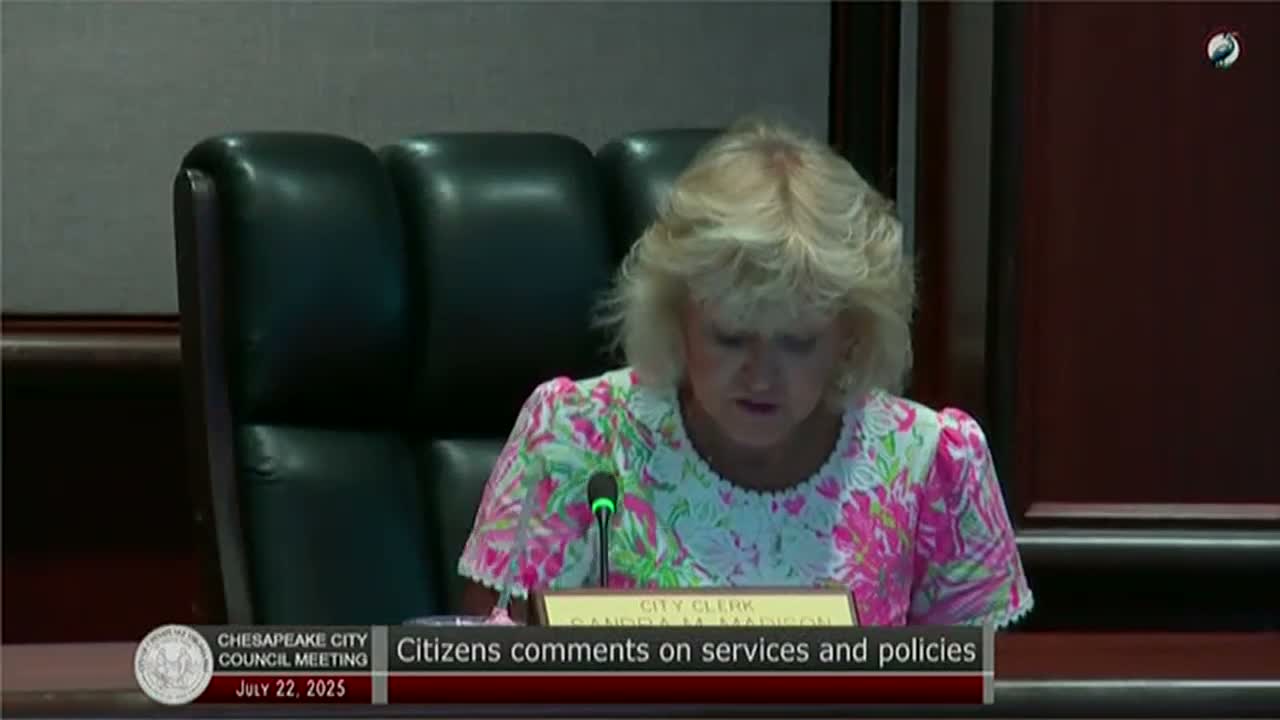
A group of Chesapeake residents used the city council's non‑agenda public‑comment period on July 27 to criticize recent hearing procedures, allege racial bias in prior meetings, and press for more transparent flood‑mitigation and land‑acquisition planning.
Vic Nichols opened the series of non‑agenda speakers with a complaint about perceived favoritism and speaker‑time rules at previous hearings. "If you can't listen to us and we're not worth it, leave," Nichols said, urging the council to address what he described as unequal treatment in public processes.
Jeff Staples and several other commenters described sharp differences in decorum and access between two prior meetings. Staples said earlier meetings allowed lengthy public participation and that a later hearing imposed a one‑hour time limit on agenda items that left many speakers without a chance to be heard.
Susan Sherbo, who identified herself as a Southside resident, focused on safety concerns tied to the VNG/Gidley compressor station and pipeline transmission. She said transmission pipelines (larger, higher‑pressure lines) present a different risk profile than distribution lines and urged council to seek alternatives that would not force residents to "sacrifice their health and safety." "It should not be necessary to sacrifice either," Sherbo said.
Other speakers, including Joseph Davis, Tommy Hart and Dr. Sarah Eason Williams, accused the council of disrespecting residents—particularly residents of color—during recent land‑use hearings and warned of long‑term health and housing consequences. Tommy Hart also raised claims about a local murder investigation and alleged mishandling of police reports; those allegations were made during public comment and were not addressed or adjudicated during the meeting.
Marquela Moore pressed city staff about the city's FEMA acquisition program, noting the city has received more than $13 million to demolish 45 homes over the past 18 years and asking whether the strategy has reduced tidal or rainfall flooding or worsened the housing shortage. City Manager Price later responded in the unfinished‑business portion that FEMA and the Virginia Department of Emergency Management fund acquisition and demolition for repetitive‑loss properties, that those programs are grant‑funded with property‑owner matches, and that the city typically converts acquired parcels to open or vegetated space to reduce runoff and flood impacts.
Speakers repeatedly asked for more study and clearer metrics: who decides when to grant continuances, how the city evaluates alternatives to demolition, and what the long‑term fiscal responsibilities are for municipally owned cleared parcels. Council members said staff would prepare follow‑up reports, and the public works director had been speaking with the Army Corps of Engineers regarding flood issues.