
Lynchburg debate centers on zoning approach to abortion clinics as ordinance heads to public hearing
Get AI-powered insights, summaries, and transcripts
Subscribe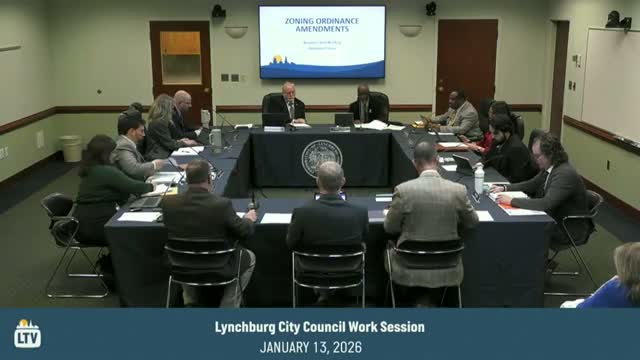
Summary
Planning staff presented a draft ordinance to define and restrict abortion clinics by zoning district and setback, prompting a heated council debate over legal defensibility, intent and whether to broaden regulation to all outpatient medical clinics; the item is scheduled for public hearing Jan. 27.
City planning staff presented a draft ordinance on Jan. 13 intended to regulate abortion clinics’ location through zoning definitions, conditional‑use requirements and setback standards. Tom Martin, the planning lead on the item, said the draft was shaped to improve enforceability and legal defensibility and that it would require a public hearing before council on Jan. 27.
Martin said staff’s amendments would remove Institutional‑1 (IN‑1) from CUP treatment because those districts are primarily residential or adjacent to residential areas, expand the proposed CUP requirement to certain B‑3 and B‑5 business districts for defensibility, and exclude family‑planning services from the ordinance’s definition of an abortion clinic. He noted the city currently has no abortion clinics and that the proposed ordinance would not absolutely prohibit clinics in every neighborhood but would limit where they could operate and require discretionary review in selected zones.
Councilmembers focused on three practical questions: legal defensibility (whether the record would show the council’s intent to prevent clinics from opening), whether regulation should target one industry or more broadly address outpatient medical facilities, and whether the proposed ordinance matches community standards about siting sensitive uses near schools. Several council members praised staff and outside legal review for tailoring the language to meet a rational‑basis test; others, including Council Member Feraldi, said they feared the record could be read as intentionally exclusionary and urged a broader, less targeted approach.
The council discussed an effective date for the ordinance if adopted: staff proposed March 1, 2026, to accommodate a 30‑day pamphlet posting required under the city charter in cases where a new section could impose penalties. Council members raised hypotheticals about an entity filing for a by‑right location in the period between adoption and the effective date; staff said such scenarios were possible but practically constrained by acquisition, leasing and closing timelines.
The ordinance will be the subject of a public hearing before full council on Jan. 27. No final action was taken at the work session; council members asked staff to prepare materials that clarify the ordinance’s scope and legal rationale prior to the hearing.