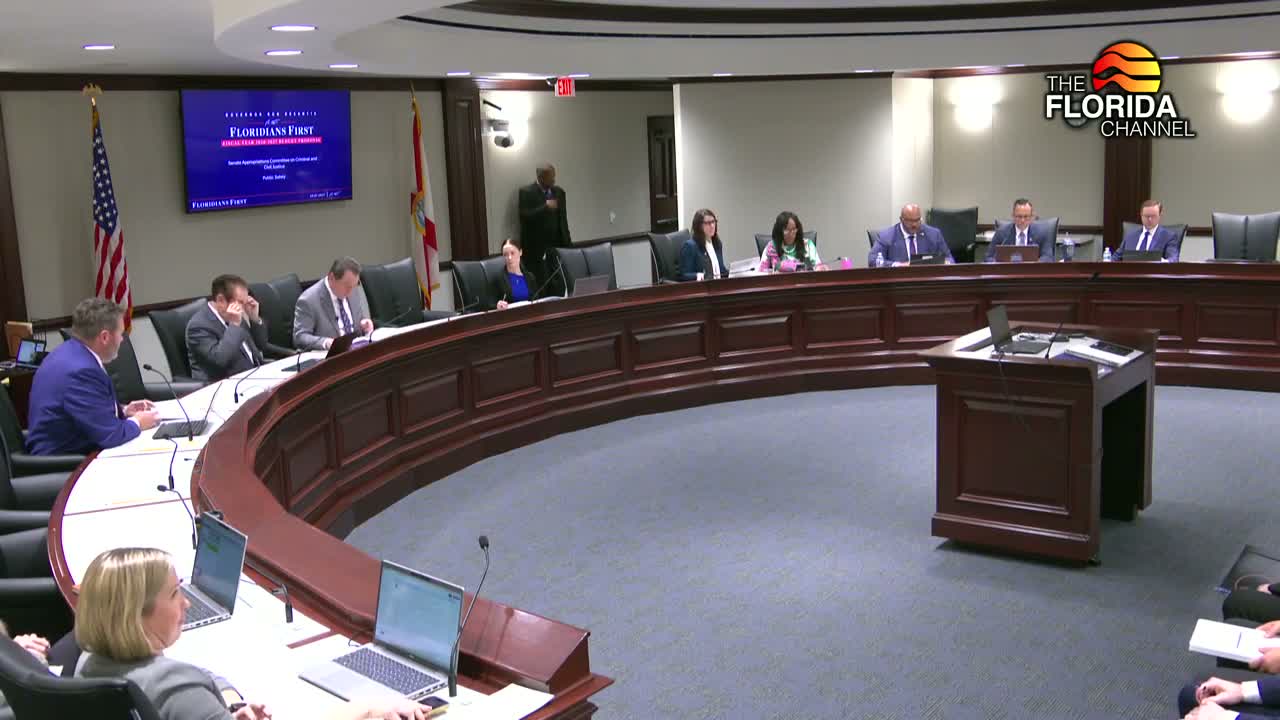
Committee hears governor's FY2026–27 public safety budget, agencies request new funds for fentanyl response, juvenile services and corrections pay
Loading...
Summary
The Operations Committee reviewed the governor's FY2026–27 public safety budget proposal, hearing presentations from the Governor's Office, FDLE, the Department of Juvenile Justice and the Department of Corrections. Agencies requested targeted funding for fentanyl enforcement, juvenile education and inmate health and pay increases for corrections staff.
The Operations Committee on Criminal Veil Justice reviewed the governor’s fiscal year 2026–27 public safety budget recommendation during a presentation by Caitlin Dawkins of the Governor’s Office of Policy and Budget. Dawkins said the proposed statewide budget totals $117,400,000,000, a $1.3 billion (1.1%) increase over the current year, with general revenue comprising about 45% of the total and trust funds 55%.
Dawkins said the proposed public safety silo is roughly $8.2 billion (about 7% of the overall budget), including $7.55 billion in base funding and $742.1 million in new funding. The package includes $128.6 million in fixed capital outlay across agencies and roughly $106.3 million for IT projects; Dawkins also noted recurring reductions across silos totaling $850 million and vacancy reductions equivalent to 354.5 FTE statewide.
Deputy Commissioner Baden Pollard of the Florida Department of Law Enforcement outlined FDLE priorities within the request, including $15 million for the SAFE fentanyl eradication program, $1.5 million to create a dedicated career-offender registry unit (8 FTE), $2.4 million to upgrade the 21-year-old MEPIC missing/endangered-persons system, $3.3 million to replace intoxilyzer devices and adopt a cloud data system, and $5 million plus 16 FTE to expand officer mental-health and wellness services. Pollard characterized the SAFE program as an effective tool against trafficking and cited prior enforcement results.
Secretary Matt Walsh of the Department of Juvenile Justice asked for $3.7 million to expand the Florida Scholars Academy (bringing total funding for that program to $34 million), increased per-diem contract funding ($30.1 million) for residential programs, $41.3 million for a new 45,000-square-foot Broward juvenile detention center and $29.4 million for facility security and maintenance statewide. Walsh said the department is seeking additional staff and investments to serve a growing residential population and expand career-technical offerings for youth.
Department of Corrections Secretary Ricky Dixon presented a request that includes $430.6 million aimed at competitive pay and retention (noting an increase in starting pay toward $28 per hour), 500 additional FTE, $56.4 million to begin construction at Lancaster Correctional Institution, and multiple maintenance, communications and IT items. Dixon also requested $105.5 million for inmate health care (including contracted services and added staff at facilities) and described rising pharmaceutical and food-service costs tied to population increases.
Committee members pressed agencies on program scope and recurring costs. Senator Smith asked FDLE whether $1.2 million labeled for immigration intelligence would be used to locate undocumented people generally or to target transnational criminal groups; Pollard responded the funds would supplement current capabilities and focus on transnational organized crime and convicted offenders, and said collateral encounters would be vetted with federal partners. On corrections pay, Dixon said the requested pay package is a multi-year need and indicated the department will return for further appropriations as population and inflation pressures continue.
Public comment highlighted conditions inside facilities: a Florida resident urged attention to failing infrastructure, lack of basic clothing and delayed medical care in several named institutions, saying wages alone would not fix those problems.
The committee did not vote on the budget itself but moved next to the day's bills. The presentations provide the committee with agency requests and background that will inform appropriations deliberations in the coming weeks.