WIFA outlines seven candidate projects for long‑term water augmentation; asks legislature not to cut existing funds
Loading...
Summary
WIFA Director Chelsea McGuire briefed the committee on three WIFA programs and described a competitive solicitation that yielded seven candidate long‑term augmentation projects (desalination, groundwater storage and reuse, cross‑border reuse/exchange concepts). McGuire said WIFA has invested about $3 billion in Arizona water infrastructure over 30 years, that conservation grants exhausted ARPA funds, and urged legislators not to reduce WIFA’s budget while feasibility work proceeds.
Chelsea McGuire, director of the Water Infrastructure Finance Authority of Arizona (WIFA), gave the committee a detailed update on WIFA programs and its long‑term water augmentation work.
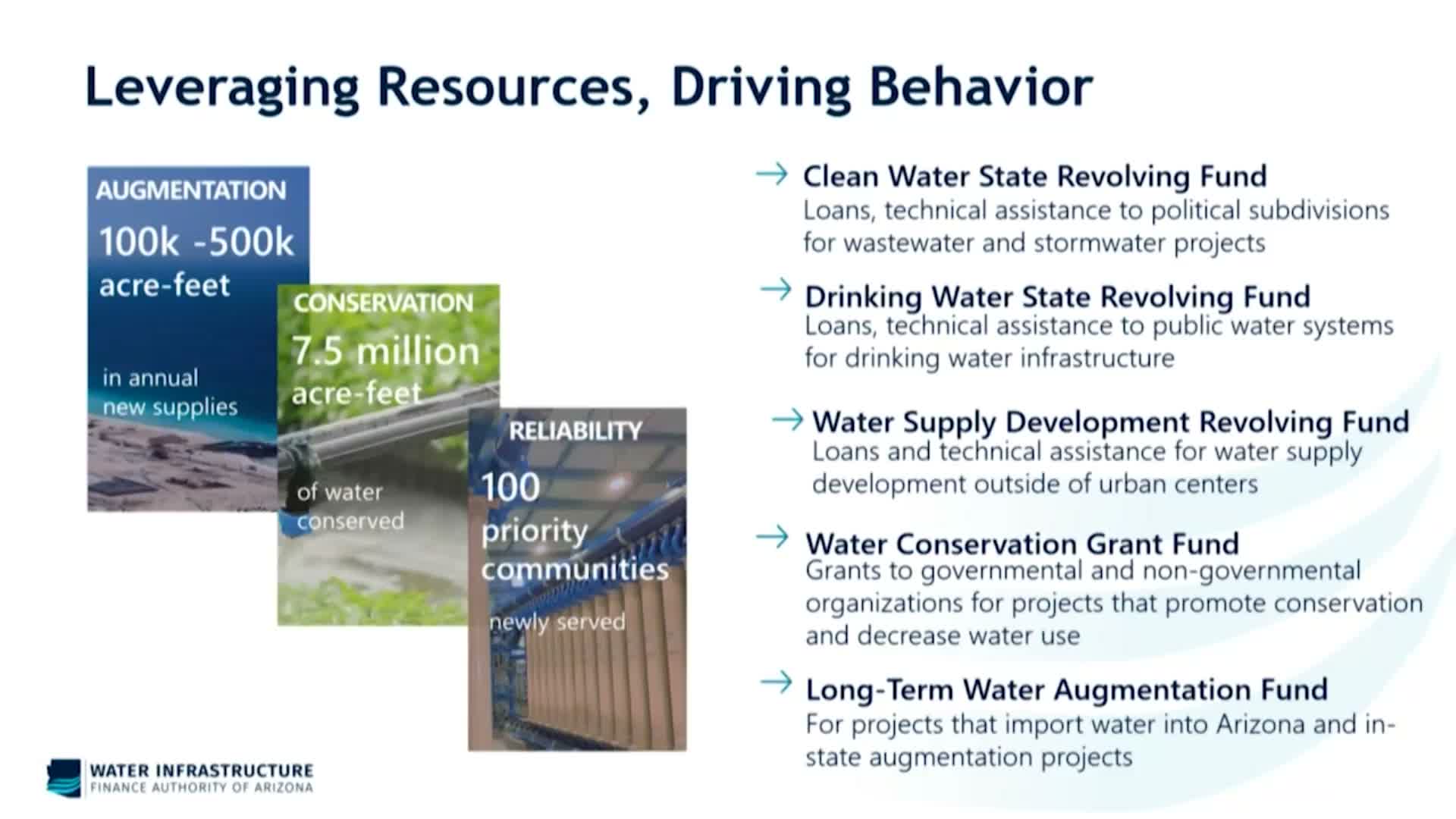
McGuire said WIFA has deployed roughly $3 billion in loans and grants over the last three decades and described three state programs created in 2022: the Water Supply Development Revolving Fund (rural fund), the Water Conservation Grant Fund (ARPA seed money), and the Long‑Term Water Augmentation Fund. She reported $87.3 million awarded from the rural fund (about $60 million of that in grants), and said the conservation grant fund has awarded roughly $211 million across about 211 projects and is currently out of ARPA funds.
On long‑term augmentation, McGuire summarized the solicitation process that attracted 17 responses and yielded seven projects for further development by two development teams: Acciona/FenGate and EPCOR Water Innovation Partners. Project concepts include Gulf of California desalination, Pacific Coast desalination, cross‑border reuse and exchange arrangements with Mexico, California groundwater storage and recharge with exchanges of Colorado River allotments, and expansion of existing South Bay reuse infrastructure. McGuire described the projects as varied in location and approach and emphasized they remain at feasibility and task‑order stages.
McGuire said WIFA will pay development teams for deliverables (financial, environmental, regulatory and technical analyses) and will own the resulting intellectual property so the state retains options. She said feasibility work will answer critical questions on cost, off‑taker commitments and environmental impacts. WIFA’s immediate request for the session was narrow: McGuire asked that legislators not reduce WIFA’s existing funding (a "do no harm" request) while the feasibility analyses proceed.
Committee members asked about project costs, who would pay and how offtaker commitments are being structured. McGuire said the specific costs are under study and that WIFA is convening offtaker advisory groups to engage potential municipal and regional buyers early in the process. She offered public 1‑pagers and a website (ltwaf.azwifa.gov) for more details and said Judah Wexelbaum would circulate summaries and firm qualifications to members.
McGuire emphasized that the long‑term projects are hard and expensive but that the WIFA board prioritized a deliberate process: identify gaps in providers’ portfolios, quantify likely demand (WIFA's assessment estimated 100,000–500,000 acre‑feet per year of additional demand over 10–15 years), and pursue multiple approaches in parallel while engaging public stakeholders.
The presentation concluded with committee questions and WIFA offers to provide additional written materials and project one‑pagers to the members.