
Committee advances stormwater recharge mapping bill with amendment after agency and SRP concerns
Get AI-powered insights, summaries, and transcripts
Subscribe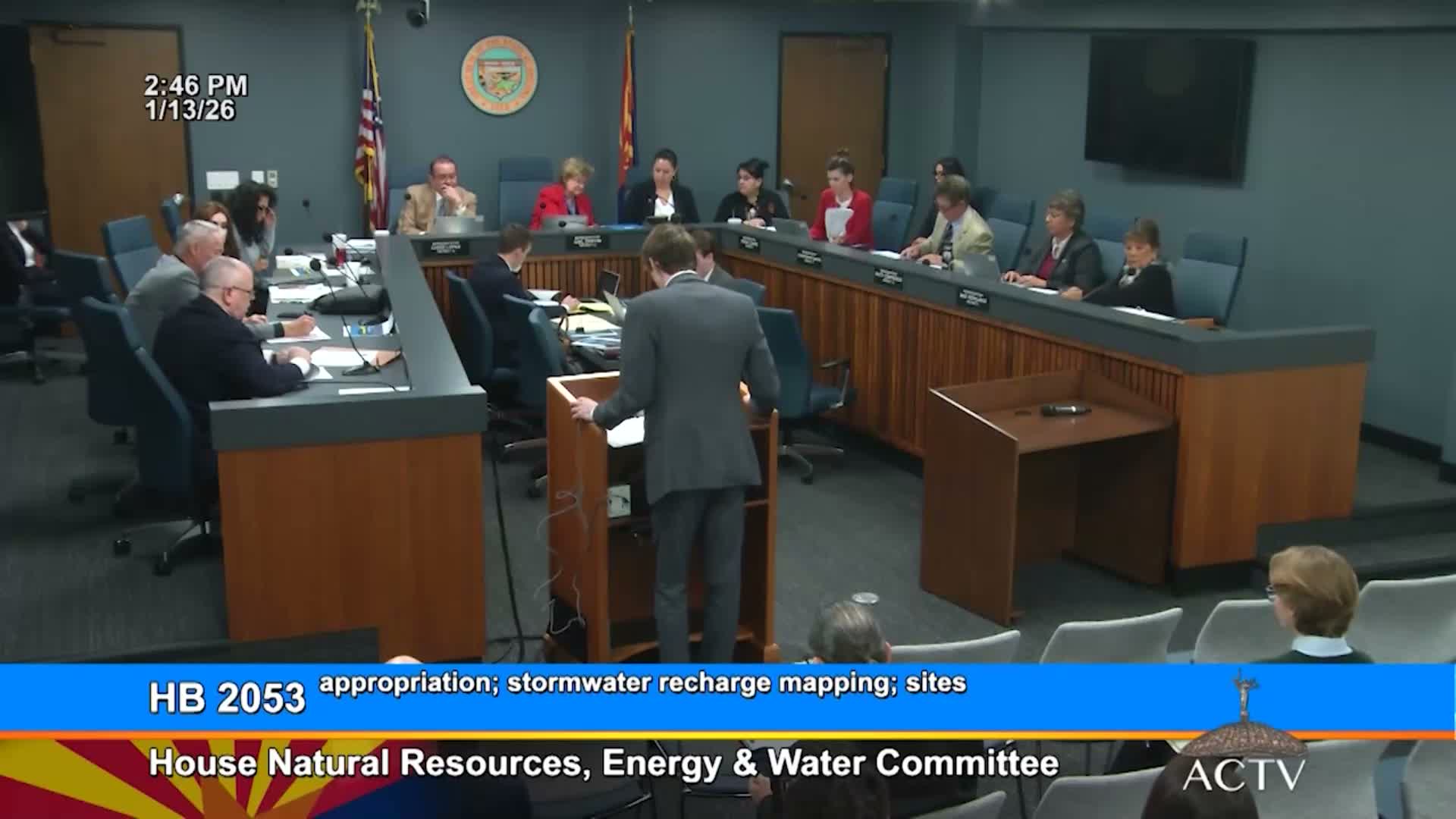
Summary
House Bill 20 53, which would fund ADWR to update statewide stormwater recharge mapping and coordinate with outlined agencies, advanced from committee with a committee amendment extending the delivery timeline to one year; stakeholders raised concerns about excluding nature‑based recharge sites and about ADWR making determinations affecting surface‑water rights.
The committee recommended House Bill 20 53, as amended, which appropriates $100,000 (FY27) to the Arizona Department of Water Resources (ADWR) to create updated statewide stormwater recharge mapping.
Sponsor and staff explained the Griffin committee amendment (01/12/2026) lengthening ADWR’s delivery window from 180 days to one year and refining which sites must be excluded because they would capture appropriable surface water. Trent Blomberg, ADWR chief legislative liaison, testified that ADWR can expand its earlier state‑land inventory (331 identified recharge sites) to a statewide map and has the hydrologic staff to perform an updated analysis but cautioned ADWR cannot make legal determinations about appropriable surface‑water rights — that remains a court or adjudication function.
Stakeholders registered mixed reactions. Sandy Barr (Sierra Club) said the bill’s language could exclude ephemeral washes and other nature‑based solutions that provide recharge opportunities. Fareed Bailey representing Salt River Project (SRP) opposed the bill respectfully and urged continued discussion, noting nearly all surface‑water claims in Arizona are subject to pending adjudications and warning that agency determinations about unappropriated surface water risk stepping into judicial territory.
Vice Chair Chris Lopez moved the amended bill, the committee adopted the Griffin amendment by voice vote, and the committee approved HB20 53 as amended with a do‑pass recommendation on a recorded vote (committee announced 6 ayes, 4 nays). The chair said additional information on the exclusion language would be discussed in future sessions.