House committee advances bill to add cloud seeding to WIFA’s water‑supply toolbox
Loading...
Summary
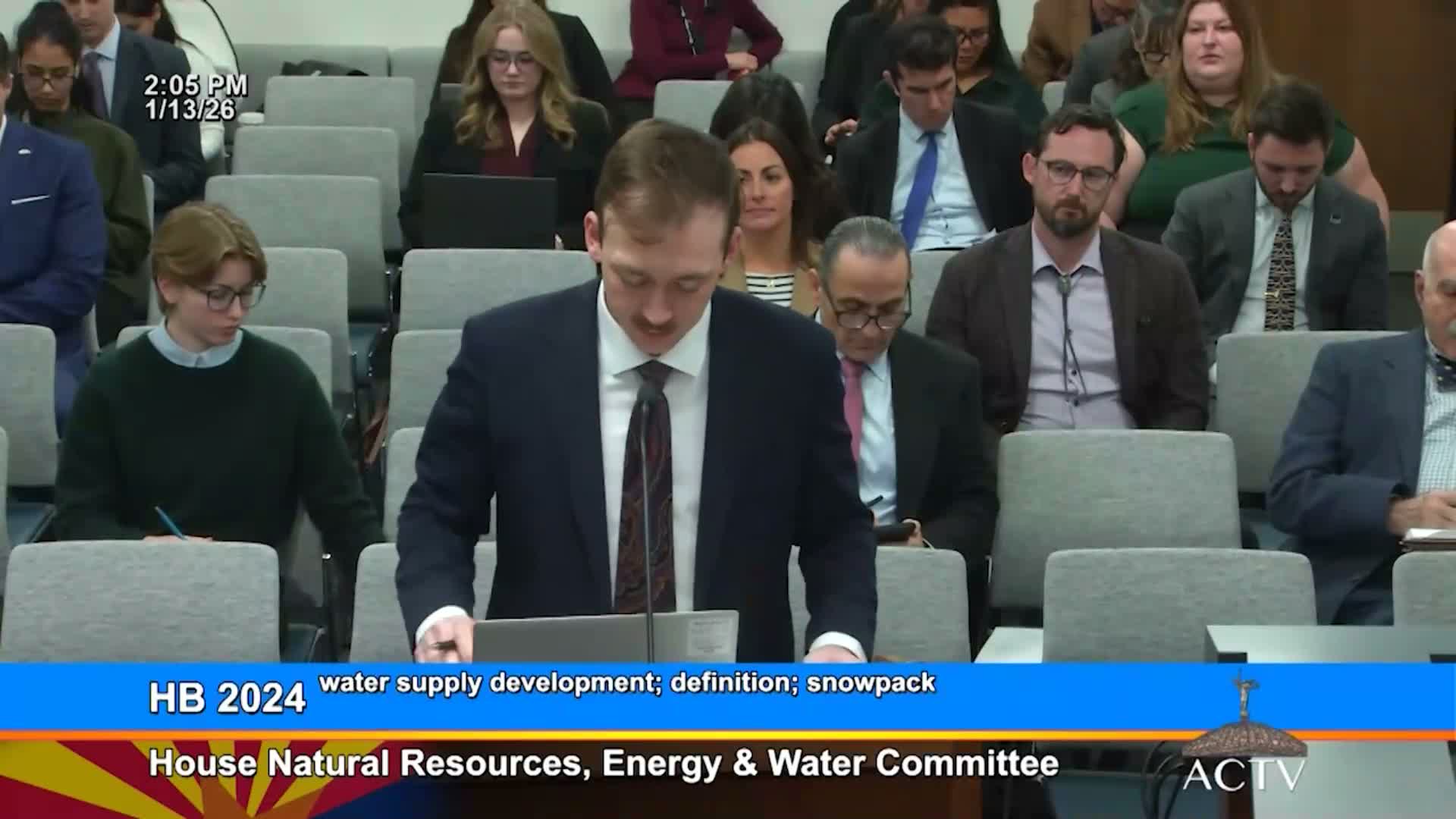
The Arizona House Natural Resource, Energy and Water Committee voted 6–4 to recommend passage of House Bill 20 24, which would let the Water Infrastructure Finance Authority fund and plan projects that include snowpack augmentation under the state weather‑modification statute. Proponents cited new drone and radar validation technology; opponents raised health and ecological concerns over silver iodide.
A legislative committee voted Tuesday to send House Bill 20 24 to the House with a "do pass" recommendation after a two‑hour discussion that balanced advocates’ claims of measurable water gains against environmental and public‑health concerns.
The bill, introduced by committee staff, would expand the statutory definition of "water supply development" within the Water Infrastructure Finance Authority (WIFA) to include snowpack augmentation pursuant to the state's existing weather‑modification statute and to allow related planning, permitting and project development activities to be eligible for WIFA programs.
Proponents described a changed technology landscape. Sean Martini of Rainmaker Technology, which he said is a two‑and‑a‑half‑year startup deploying drone‑based cloud seeding with radar validation, told the committee the company can target clouds more precisely than older airplane or ground‑generator approaches. Martini said drone operations disperse small amounts of silver iodide ("a couple of ounces at a time"), that research shows large water returns relative to the seed material (he cited a National Center for Atmospheric Research ratio figure), and that the technology can deliver "10–20% and upwards of 20%" additional precipitation under the right conditions. He said Rainmaker currently operates in seven states and asked for the committee's support.
"At Rainmaker we make water more abundant through next‑generation cloud seeding," Martini said. "With radar technology we can validate the phase change and determine volumetrically how much we're getting out of our operations."
Opponents urged more study before putting cloud seeding into statute or committing public funds. Sandy Barr, director of the Sierra Club's Grand Canyon Chapter, said available research is mixed, described potential unintended consequences and raised questions about the environmental fate of silver iodide and the possibility of bioaccumulation.
"We should not be modifying our weather any more than we already are," Barr said, adding that Arizona should ask for more evidence before authorizing statutory funding.
Committee members pressed both sides on measurement, safety and cost. Martini said radar validation permits direct estimates of additionality and cited long‑running cloud‑seeding programs (he referenced Utah) that regulators have studied; he also said detectable increases in silver are orders of magnitude below EPA thresholds. Members asked for simpler, accessible summaries of longitudinal studies; Representative Patty Contreras asked Martini to provide plain‑language materials the committee could use.
Cost estimates drew scrutiny. Martini said his company can price per‑acre‑foot results and that in some cases additional water could cost less than $400 per acre‑foot, depending on geography and intensity; members noted that costs vary and asked for state comparisons and independent validation.
Several members expressed reservations. Representative Pamela Carter said she was not comfortable with the notion of releasing chemicals into precipitation without clearer health evidence and voted no. Representative James Taylor and others said EPA thresholds and regulatory limits address some concerns but also asked for more review. Chair Gail Griffin, while acknowledging the concerns, described the technology as "another tool in the toolbox" and said the state would continue research and oversight.
After members explained their votes, the chair announced passage of HB20 24 from committee with a do‑pass recommendation on a recorded 6–4 vote. Several members who voted aye said they reserved the right to vote differently on the House floor.
The next steps include possible amendment on the House floor and requests from committee members for the proponents to provide concise study summaries and WIFA to clarify how any future projects would be evaluated and funded.