
Opponents tell committee tax-conformity bill could open door to federal voucher program
Get AI-powered insights, summaries, and transcripts
Subscribe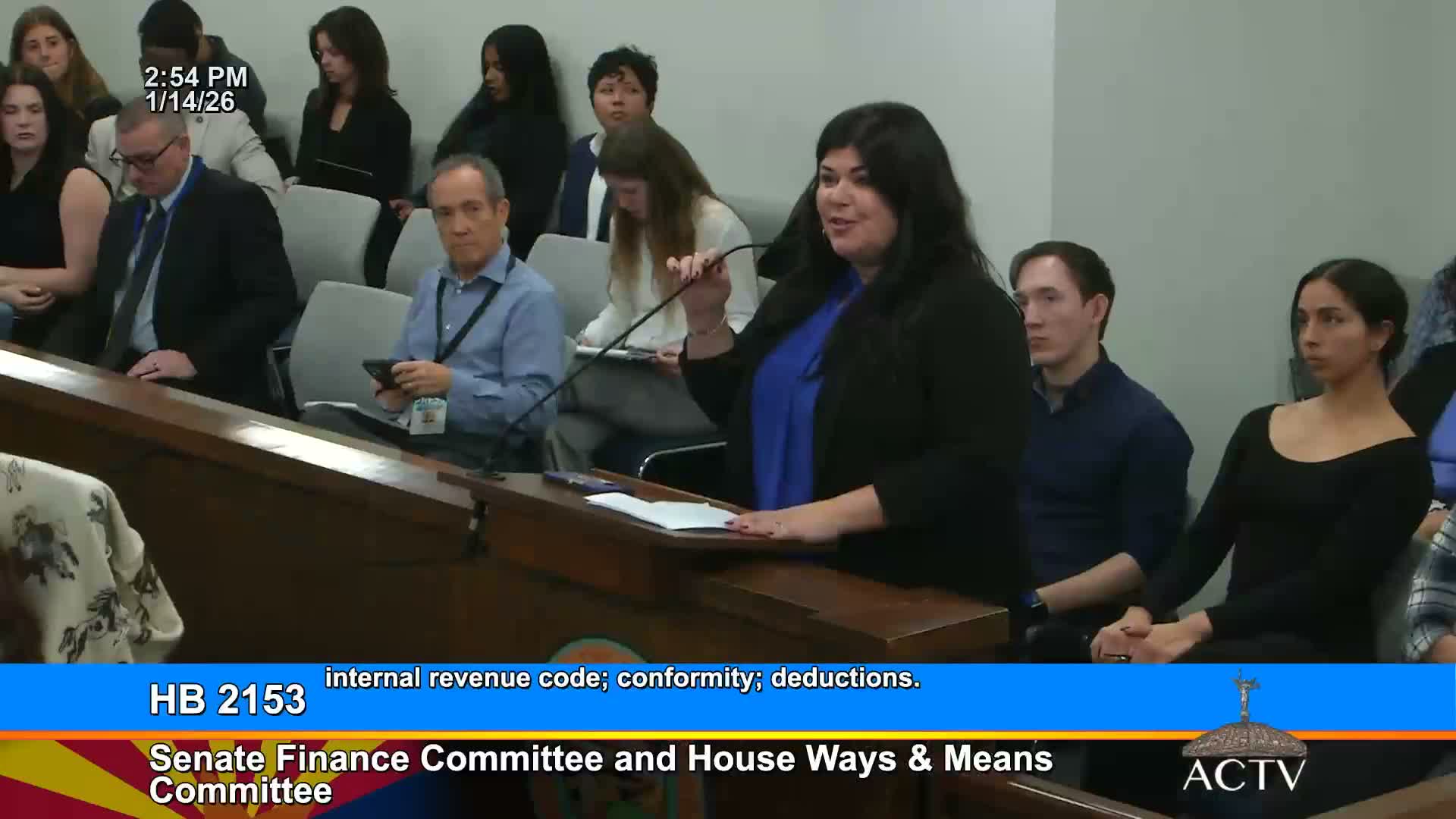
Summary
Save Our Schools and other witnesses testified that provisions attached to the conformity bills could enable participation in the new federal scholarship/tax-credit program (SGOs), raising accountability and equity concerns; sponsors and other members disputed that characterization and asked for federal guidance.
Public testimony at the joint Ways and Means and Senate Finance hearing focused heavily on distributional effects and an attached federal scholarship mechanism that opponents described as a voucher program.
Beth Lewis, director of Save Our Schools Arizona, testified she opposed HB 21-53 and SB 1106 and said the bills carried "the poison pill that was forced in the back end of this bill, which would be the federal private school voucher package that would be forced into Arizona through these bills." Lewis told the committee she feared the federal program would move public funding to private, largely unaccountable schools and that the U.S. Treasury had not yet issued regulatory guidelines to states.
Committee members pressed for textual specificity. Representative Cooper asked whether the word "voucher" appears in the bill; Lewis acknowledged the colloquial but not literal usage and framed her concern as a program effect rather than an exact textual change. "I'm describing the yeah. Of course, the colloquial term," Lewis said when asked for bill-language detail.
Supporters of the bills said the measures before the committee are tax-conformity decisions about federal tax law adoption and not an explicit change to state school finance law. Sponsors pointed to provisions intended to shift certain tax savings toward families (for example, raising the dependent credit to $125) rather than a broad transfer to private tuition programs. Chair members also noted the statutory limits of state authority and said they had invited the governor’s office and Department of Revenue to clarify administrative questions.
Members asked whether federal guidance, if it ultimately restricted or allowed state regulation of any federal SGO program, would change witnesses’ positions. Beth Lewis said the group would remain opposed if the program lacked sufficient state regulatory controls.
The hearing record shows continued disagreement over whether the conformity vehicle was the right place to address federal program participation and whether additional federal regulatory guidance is needed before any state decision. Lawmakers asked the Department of Revenue and advocates to return with clarifying information about program mechanics and potential state oversight options.