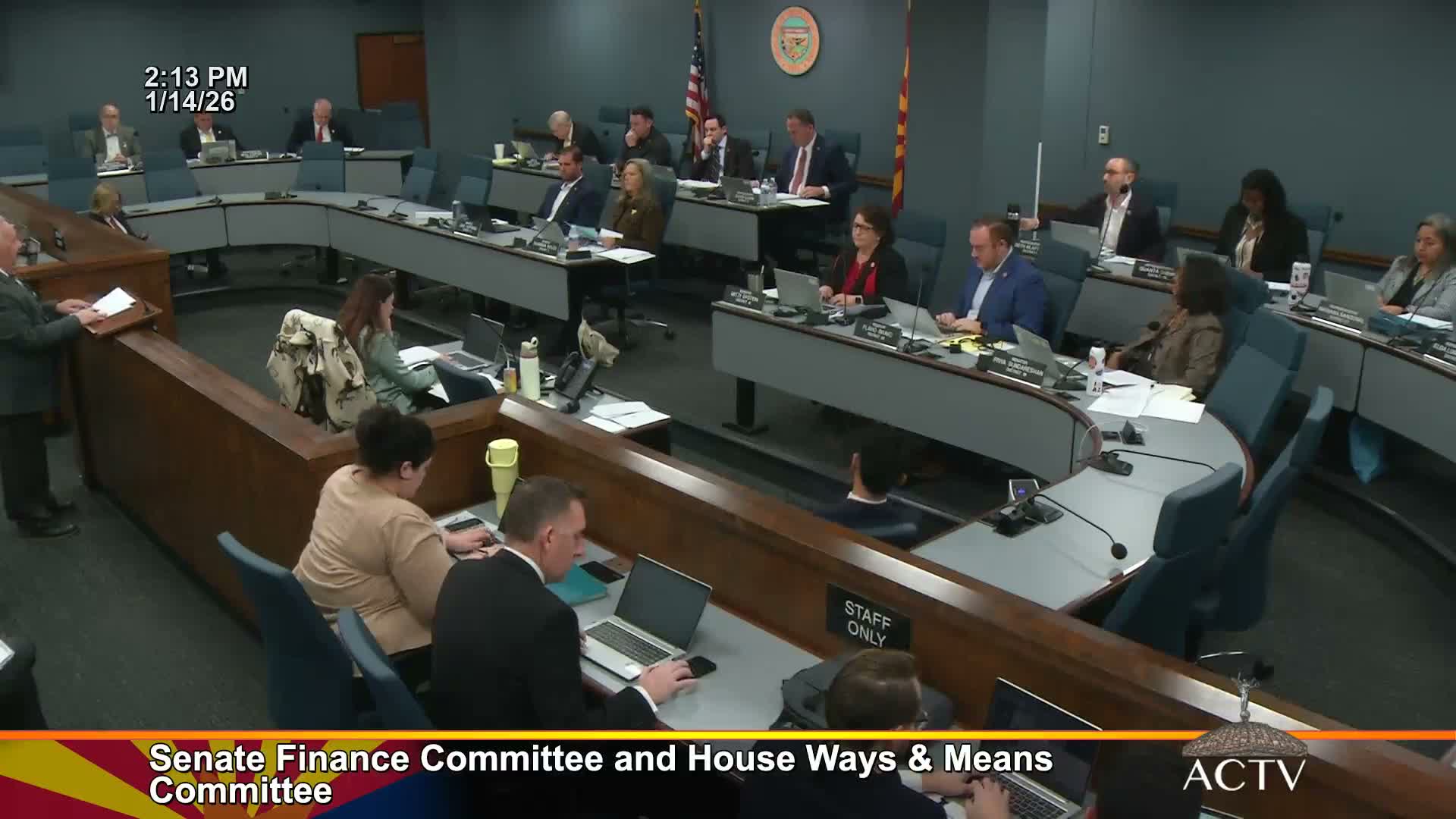
Joint committees advance tax-conformity bills, sponsors say action needed to avoid amended returns
Loading...
Summary
House and Senate committee chairs and sponsors urged quick action on HB 21-53 and SB 1106 to align Arizona law with federal changes in HR1, saying early passage would prevent confusion and amended returns; Department of Revenue warned of heavy operational costs if retroactive changes occur after forms are issued.
A joint hearing of the House Ways and Means and Senate Finance committees advanced identical bills, House Bill 21-53 and Senate Bill 1106, intended to conform Arizona tax law to federal changes in HR1 and to give filers certainty for the 2025 tax year. Committee sponsors and representatives of the accounting community said acting quickly will prevent widespread confusion and the need for amended returns.
Vince Perez, research analyst for the House Ways and Means Committee, summarized the bills and the fiscal impact: "the JLBC estimated that the bills would reduce the general fund income tax revenues by 441,300,000.0 in fiscal year 26," he told the committee, citing the official fiscal note. Perez also outlined provisions included and excluded from the federal law in the draft Arizona package.
Ryan Domena of Domena Public Affairs, representing the Arizona Society of Certified Public Accountants, told lawmakers that the CPA community and software vendors are already operating under the assumption of conformity. "Having conformity in place as early in tax season as possible gives those taxpayers the predictability, the stability that they deserve when filing their tax returns," he said, arguing that early action reduces amended returns and compliance costs.
Committee sponsors said they tailored some provisions to Arizona — for example, changing the senior deduction to apply to distributions from retirement accounts for taxpayers aged 60 and older, and increasing the dependent tax credit from $100 to $125 per child — and stressed that the bills are designed to provide clarity before filing season. "If we pass this and the governor signs it, we will then know what we're dealing with as we head into the budget," a sponsor said during remarks.
Department of Revenue officials cautioned that retroactive changes carry operational risk. Molly Murphy, appearing on behalf of DOR in a neutral posture, said the department "would expect to see nearly 1,000,000 amended returns coming in, which would bring the department's operations to a halt" if retroactive items require mass amendments. Murphy told the committee the department estimated it would need roughly "$20,000,000 in [funding] and 200 FTE" to process that workload while maintaining normal operations.
Lawmakers divided along fiscal and policy lines during questioning. Some members argued the package would unbalance the budget and should be addressed in the context of the broader budget process; others said the immediate cost of inaction — continued uncertainty and the administrative burden on filers and the Department of Revenue — justified expedited consideration.
After public testimony and extended debate, committee members moved the bills forward. The Senate roll call on SB 1106 passed in committee; the House roll call returned HB 21-53 with a due-pass recommendation by a 5–4 vote, sending the bills to the next steps in their respective chambers. The committees said they will seek a governor’s signature to ensure those who file early are not required to refile later.