Get Full Government Meeting Transcripts, Videos, & Alerts Forever!
Get email alerts on the Criminal Justice topic
No spam. Unsubscribe anytime.
Monroe County women’s commission presses for a written plan after ACLU action on jail
Summary
Commissioners heard that correspondence from the ACLU makes the county’s jail the subject of a lawsuit requiring a plan by April 15; commissioners discussed funding shortfalls caused by recent property-tax reform and agreed to pursue a joint work session with county commissioners and public input.
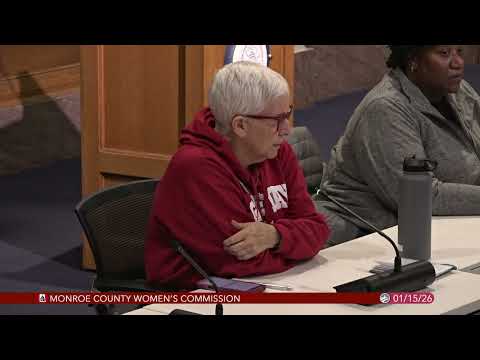
The Monroe County Women’s Commission on its regular meeting discussed an ACLU lawsuit focused on the county jail and an urgent April 15 deadline for the county to produce a plan.
Commissioner Bridal told the commission they had received correspondence from ACLU attorney Ken Falk and that “we are under the gun to get this all in order,” noting the correspondence leaves little room for extension. Bridal said the legal action pertains only to the jail — not to other county services such as the clerk, courts or prosecutors — and urged the commission to concentrate its work on producing material the ACLU will consider.
Vice Chair Julie Hardesty said the commission had intended to share documents and statistics from prior special committee meetings about the jail and committed to sending that material to Bridal and others before the next meeting. Bridal said county leaders are planning a joint work session with county commissioners, aiming for evening hours and public participation so the community can weigh in.
Commissioners discussed financing constraints. Bridal said property tax reform (referred to in the meeting as SEA 1) and earlier budget limits reduced the county’s bonding capacity, forcing changes in project scope and complicating plans that had once envisioned a larger, multiuse facility at North Park. Commissioners emphasized the need to design housing and services that account for mental-health beds, LGBTQ needs and other special requirements rather than assuming a single-floor or single-approach solution.
No formal vote was taken; the commission committed to provide the previously prepared materials and to collaborate with county commissioners on a publicly noticed work session so a feasible plan can be developed before the ACLU’s timeline.