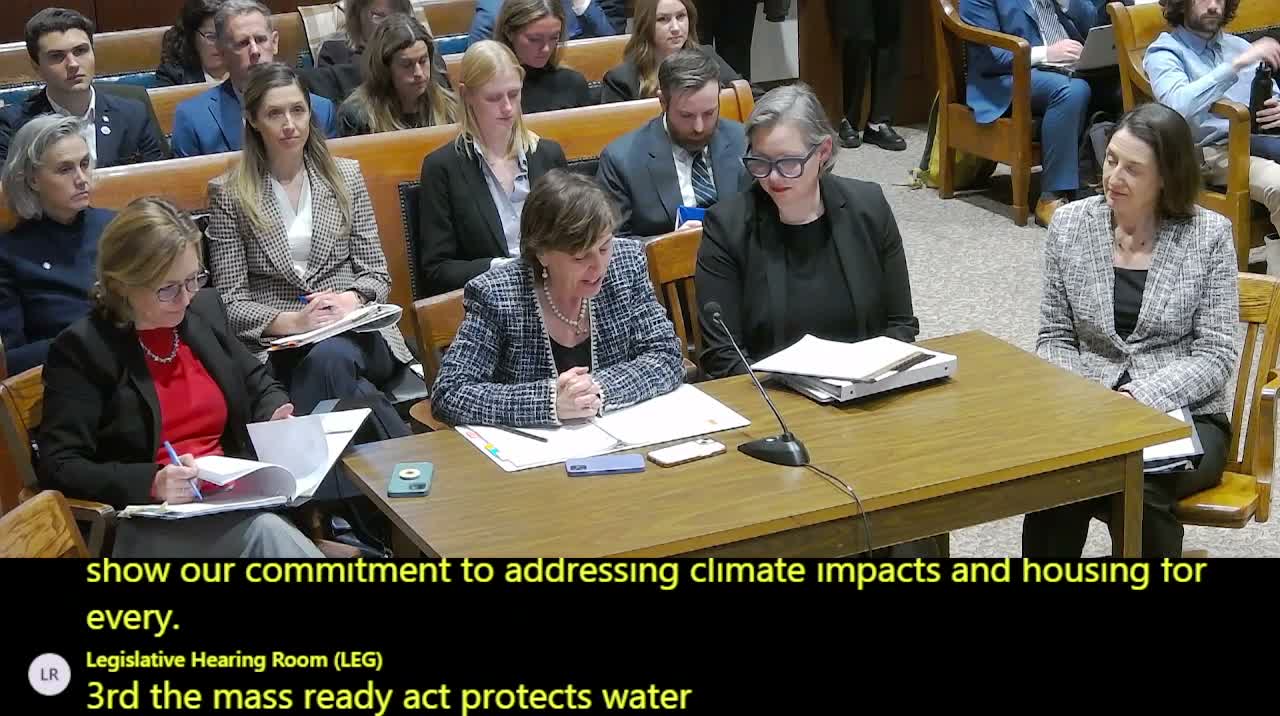
Experts tell bonding committee Mass Ready's water funding helps but may be insufficient for PFAS and large drinking‑water needs
Loading...
Summary
Agency officials said S.2542 adds $385 million to support drinking‑water and wastewater projects and $120 million for PFAS work, but water‑utility representatives warned the state faces multi‑billion dollar needs and urged recurring, dedicated funding and expanded eligibility for resilience grants.
The committee heard focused testimony on drinking‑water, wastewater and PFAS needs in Massachusetts alongside discussion of how S.2542's proposed $385 million and $120 million line items would be used.
"This is for drinking water and wastewater upgrades," Secretary Rebecca Tepper said of the $385 million line, explaining the appropriation would supplement the state's Clean Water Trust state revolving fund and include low‑ and no‑interest loans and grant support for affordability. DEP staff added that roughly $250 million was described in committee discussion as new authorization to support the SRF program and that federal SRF funding has been historically important but appears less certain going forward.
Jennifer Peterson, executive director of the Massachusetts Water Works Association, warned that state needs far exceed those figures, citing a U.S. EPA estimate that Massachusetts will need roughly $37 billion in drinking‑water and clean‑water investments over 20 years. She said the bill's PFAS allocation will help private‑well cleanup and smaller sites but is unlikely to cover the full cost for larger municipal systems facing new PFAS standards.
DEP testified that some PFAS projects have experienced cost overruns tied to supply‑chain delays and complexity, and that the bill's state funding can backfill projects to completion when federal support declines. Officials emphasized affordability screening to direct low‑interest SRF loans and grants to communities with fiscal constraints.
What was requested: Water systems and utilities asked the committee to consider recurring, predictable funding and expanded grant eligibility for core utility upgrades, redundancy projects, and school and childcare filtration where contamination is found. Suppliers and manufacturers also urged earmarks for point‑of‑use filtration in schools and childcare centers to reduce exposures quickly while lead service line replacements and large PFAS remediation projects proceed.
Next steps: Officials said additional technical details on SRF capitalization, project prioritization and eligibility will be provided to the committee as the bill is amended.